TOP

KUBS News

Total 1416

Department of Business Administration, Graduate School, Korea University Recruiting New Students

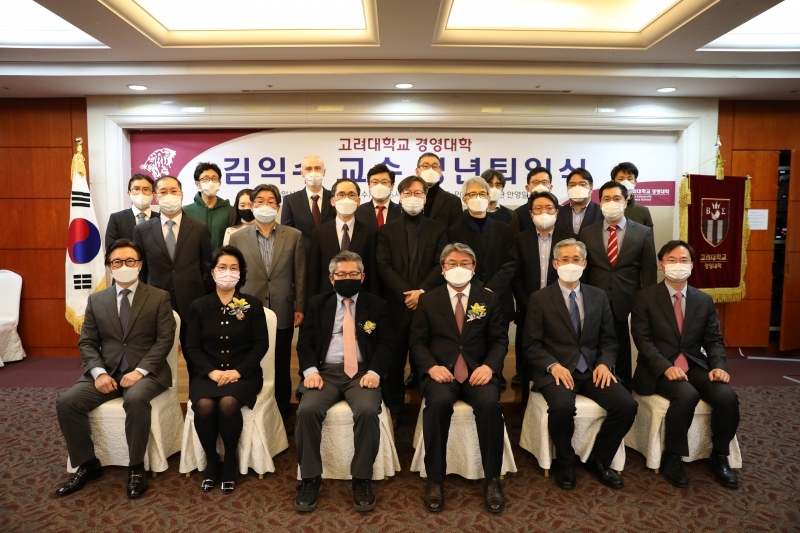
Department of Business Administration, Graduate School, Korea University Recruiting New Students for Fall 2026… Applications Open Until April 9   A new opportunity is opening for those seeking to advance both their research direction and career development. The Department of Business Administration at the Graduate School of Korea University has begun accepting applications for domestic students for the Fall 2026 intake, with the application deadline set for 5:00 PM on Thursday, April 9.   As the business environment continues to evolve rapidly, the criteria for selecting a graduate program are also shifting. Beyond the name of the major, the strength of the research environment and academic network has become an increasingly important factor.    ▲ A group of full-time faculty members at Korea University Business School pose for a commemorative photo.    Korea University Business School boasts one of the largest research infrastructures in the country, supported by 95 full-time faculty members. This is considered a key strength, as it enables applicants to choose academic advisors who closely align with their research interests and topics. The faculty’s diverse expertise, spanning a wide range of subfields and research areas, provides a strong foundation for graduate students to conduct rigorous and advanced research.    As a research-oriented graduate school, Korea University Business School is also strengthening its interdisciplinary research environment to reflect rapidly evolving industries and societal needs. With a focus on the so-called “4Tech” fields—AI, semiconductors, robotics, and energy—the school is expanding the scope of business research beyond traditional boundaries and fostering the exploration of emerging challenges. Through this approach, students are able to analyze business phenomena from a more multidimensional perspective and develop their research questions into independent scholarly work.    Its research infrastructure is another key strength. Graduate students are provided with dedicated research spaces, including offices, seminar rooms, and lockers, along with access to data analysis software such as SAS, SPSS, STATA, and MATLAB. In addition, Korea University Library houses approximately 3.31 million volumes and 86,000 non-book materials, offering a comprehensive foundation for academic research.    In particular, students have access to major databases such as Bloomberg, Compustat, CRSP, WRDS, and LSEG Workspace. Recently, thanks to a donation from Eugene Investment & Securities, the number of Bloomberg terminals has been expanded to 12, further enhancing the research environment in finance and related fields.    Korea University Business School also offers a range of scholarship programs to support students in focusing on their research. These include full tuition coverage through research and teaching assistantships, as well as research scholarships under the BK21 program and merit-based scholarships. Approximately KRW 2.3 billion in scholarships are awarded annually, along with programs that encourage research activities, such as support for participation in international academic conferences.    For the Fall intake, the department will admit students to master’s, doctoral, and integrated master’s–doctoral programs in the following fields: Management, Global Business, Strategy, Finance, Information Systems (IS), and LSOM. The Marketing field will recruit only for doctoral and integrated programs, while Accounting and Business Analytics are excluded from this round of admissions.    The Fall admissions cycle is particularly meaningful as it provides another opportunity for applicants who have reassessed their academic or career paths following the Spring admissions cycle. For those who have further refined their research interests or career goals, this can serve as a strategic opportunity to select a research environment that best fits their needs.    Daeil Nam, Associate Dean for Research at Korea University Business School, stated, “As business studies become increasingly interconnected with industry, the importance of research environments and networks continues to grow,” adding, “We support our students in expanding their research and connecting it to real-world applications.”      ▶ Apply for Fall 2026 Domestic Graduate Admissions at Korea University ◀ 

2026.04.13 Views 42

[Interview with Dean Johngseok Bae] “KU, University that makes everyone proud”

[Interview with Dean Johngseok Bae] “KU, University that makes everyone proud”     Q. Please share your impression looking back at the last two months since you have taken the lead of KUBS   I am still spending my day and night thinking about the promising pathway for the growth of KUBS, which can also correspond well with the preceding executives of the school. I thought my role would be pretty much similar to the things that I have experienced before as Associate Dean of Business School and Director of Institute of Business Research and Education (IBRE), but now I can say it is totally different. Workloads in different KUBS departments are quite considerable, and I have to be responsible to make wise decisions over the streams of ongoing businesses.   According to the Mintzberg, who defined the roles of business leaders, I would say a Dean of KUBS has multiple responsibilities in three dimensions: interpersonal / informational / decisional roles.     Q. What are you planning for the next 2 years, as a leader who should open up a new pathway for the future.   The core vision of KUBS education has not been changed for the last 5 years, since 2015. I believe that’s because the preceding Deans have pursued a sustainable goal that can create large possibilities in the future. Therefore, I’ll continue strive to maintain that goal in the long-term. We are keep looking forward to the ‘Business for Society - Inspiring Next Leaders’, and again, we are to become Asia’s No.1 business school in the next coming 10 years.   In specific, I would try to interpret our vision in different terms, through the lens from the diversified business perspectives. I believe the genuine reason of business should be found in the process of creating happiness and making the world better place to live in. In KUBS, the three core curriculums – Entrepreneurship, Social Value, Business Analytics – will fit into the direction that we are heading and I expect there will be a foreseeable impact on our performance soon.     Q. What aspects do you think does KUBS need to take a leap forward to achieve the objective of becoming ‘Global Top 30, Asia No. 1 by 2030’.   To achieve the objectives, research, educational, and administrative capabilities must be strengthened. For research capabilities, we need to invite tenure-track professors with high research abilities and various types of research professors, find ways to increase the research cycle, and also secure enough research time for incumbent professors at the same time.   In order to secure educational capabilities, each program needs to be innovated. This will require consideration for expanding the scope of courses which students can choose from, providing continuous teaching methods, offering incentives to open new courses, and restructuring of courses by the undergraduate/MS&PhD/MBA program etc., ultimately contributing to the expansion of the previously mentioned four dimensions.   Finally, administrative capabilities should also be reinforced. It will be necessary to establish quarterly and annual performance indicators by combining each task and various evaluation indicators at KUBS, set long-term and short-term goals while continuously managing them, and link such goals to the system construction. Of course, we also need to make various efforts to improve the capabilities of our staff members.     Q. In a rapidly changing environment (i.e. due to COVID-19), what kind of talented people do you think does the society need. Please tell us how KUBS will nurture people with such talents.   Business administration is not designed to nurture people who will work for 4~5 years under other people and who can only do what they are told to do. It is important to nurture talented people who will become leaders in each field of society and can contribute to lead a good life together.   I hope that our KUBS students will be able to become talented people who pursue 'novelty with dignity', people who have both personality and ability. In times of crisis, we not only need talented people who have resilience in the process of overcoming the crisis while sufficiently manifesting the four dimensions (height, depth, width, and length) mentioned above, but also need those who can comprehensively look at the crisis and make balanced decisions.   In fact, 'dignity' is already established in Korea University’s culture and tradition. It's not just about individual interests, but about promoting the benefits of the whole. In this context, I think we have been already fostering talented people who pursue the common good in our society. In order to accumulate this spirit, we should consider variously including this in the curriculum of the Business School, and furthermore through extracurricular courses such as various events and activities.     Q. Do you have any last words to give to the members of KUBS. First of all, I would like to express my gratitude to all members of the Business School. Our students' passion and pride are the start of developing KUBS. I would also like to thank the staff members for their hard work in each field. Moreover, without the dedication of our alumni, KUBS would not have developed as it is now. Above all, the dedication of professors who give their best in lectures and research was the driving force of development. I am really thankful to you all. I believe that all members have been devoted to their own and many ways, leading KUBS so far.   If I were to be a little greedy, however, I think this period - called a crisis - is the right time for KUBS to accumulate the foundation competency to become a lasting organization. To this end, I hope our members will seek "novelty with dignity" and create a new culture. I hope that the value of continuously ‘creating’ novelty, ‘collaborating’ by forming partnerships that trust and respect each other, and ‘contributing’ to each and everyone's development becomes internalized. I surely believe this culture will be a great help for KUBS to take a step further in the future.           

2021.01.12 Views 3370

‘Board on the train of successful startups!’ 2020 Startup Express Winter Season held

‘Board on the train of successful startups!’ 2020 Startup Express Winter Season held KUBS (Dean= Bae Johngseok) Startup Station (Head= Dr. Shin, Hojung)’s 10th teams were selected. ‘2020 Startup Express Winter season,’ held online on December 4th (Friday) 2pm, was filled with passionate and brilliant ideas of pre-entrepreneurs.   KUBS Startup Station hosted ‘2020 Startup Express Winter season’ with Seung Myeong Ho Entrepreneurship education center supervising, sponsored by Korea University Management Research Association and the Social Value Committee of SK SUPEX Pursuit Council. ‘2020 Startup Express Winter season’ is a startup competition in which participants propose creative business items based on entrepreneurship and innovation.   Dean Bae Johngseok began his opening speech by saying “I can’t predict which team will board on the ‘Startup Express,’ but I send my applause to all the teams who have worked passionately night and day for this moment.” “This day will be the first step of our entrepreneurs who will glorify Korea University and Korea. Please join us today,” he told the judges and viewers.   Director of Seung Myung-Ho Center for Entrepreneurship Education, Dr. Shijin Yoo, introduced successful companies such as , , that have been on the Startup Express. “I hope all of you presenting today can lead your company successfully with passion and brilliant ideas,” he said in his welcoming speech.   A total of twelve teams that passed prior evaluation attended ‘2020 Startup Express Winter Season’ and introduced their business items. △Open market platform for Chinese online present-giving (EUZEN), which aims to be a global kakao present-giving platform △New platform for all license exams (Pro-pass) △Sustainable English education taught by mothers (Tingle) △A friendly, easily accessible vegetarian meal-kit (Ham bat Kkot) △Online personal construction service for simple self-interior decorating: ByJieun (Jung Han) △Meal managing service (Kilo) △Region-based pet care service (Come Me) △Platform for easily comparing convenience food (SJB) △Service that provides core values for citizens preparing for law suits by themselves (Mimisbrunnr) △AI Interior curating service based on color (Cowus) △Wedding guest management service (8K) △Content saving service using AI classification technology: stack (Journisome) were the teams that presented.   In ‘2020 Startup Express Winter season,’ each company was given five minutes to present their business items and five minutes of Q&A session. The jury selected teams based on △problem defining △business model △ability and willingness.   Among fierce competition, seven teams including △Kilo (Seung Myung-Ho Entrepreneurship award) △ Tingle (Iljin startup incubator award) △ Mimisbrunnr (SK Social Value award) were permitted on board the ‘Startup Express,’ the key to becoming a successful startup. The teams awarded with △Seung Myung-Ho Entrepreneurship award △Iljin startup incubator award △SK Social Value award are given operating expenses, and all seven teams including △Participation award winners can move into the Startup Institute’s Iljin Center for Startup Incubation. They will also receive systematic enterprise education and support as well as continuous consultation and support from mentors composed of senior entrepreneurs, industry experts and venture capitalists.   Head of the Startup Station, Dr. Shin, Hojung, concluded the event by saying “I’m so sorry that we could not meet offline, but it was a great pleasure and meaningful to meet all of you.”   Korea University Business School’s Startup Station hosts various events such as ‘Startup Express (Startup competition),’ ‘Choo Choo Day (Demo day)’ and has fostered 71 companies until today and total enterprise value of all companies that have moved in is 45 billion KRW, making the KUBS Startup Station a successful university startup supporting institute.

2021.01.11 Views 3046

[Obituary] Kim Dong Ki Emeritus Professor, a pioneer in Korean business administration

[Obituary] Kim Dong Ki Emeritus Professor, a pioneer in Korean business administration Korea University Business School Emeritus Professor Kim, Dong Ki passed away at 6:58 p.m. on December 15, 2020.   After graduating from Korea University College of Commerce, he received a master's degree in business administration from New York University and PhD in business administration from Korea University. He taught and studied marketing for 34 years from 1965 to 1999, a pioneering role in introducing marketing studies in America to Korea in the 1960s.   In addition, he led and developed Korean business administration by serving as the Dean of Korea University Business School, president of Korean Marketing Association, president of The Korean Academic Society of Business Administration, president of Korean Academy of Commodity Science & Technology, president of Korea Logistics, and vice president of the National Academy of Sciences, Republic of Korea. He also received the "Sangnam Business Scholar Award of the Year", Order of Civil Merit Seogryu Medal, and the President's Commendation. He published a number of books including "Modern Marketing Principles", "Modern Distribution Organization Theory", "Consumer Credit System Theory", and "International Management Strategy".   From 2018 until recently, the Kim continued to serve as the 37th and 38th (second term) chairman of the National Academy of Sciences, a national institution established to encourage academic research and promote international exchanges; but passed away at the age of 87 due to sudden deterioration in health.

2020.12.21 Views 3427

[Startup Station Lecture Series #6] - `Success in the Global Market` – Jongkap Kim, Chief Executive

      [Startup Station Lecture Series #6] 'Success in the Global Market' – Jongkap Kim, Chief Executive Director of Born2Global Centre   The sixth lecture of the Lecture Series, organized by Korea University Business School (Dean=Johngseok Bae) and KUBS Startup Station (Director= Hojung Shin), was held on November 17 (Tue). The Lecture Series is a lecture given by startup mentors currently active in the field as a part of the Entrepreneurship Academy hosted by Seung Myung-Ho Center for Entrepreneurship Education - the education institution in the Startup Station.   The special lecture was conducted under the title of "Success in the Global Market" by Jongkap Kim, Chief Executive Director of Born2Global Centre, a consulting center that helps Korean startups enter overseas markets. The lecture was sent online in real time due to the COVID-19 situation.   According to Jongkap Kim, Korea has invested a lot in Research & Development (R&D) that it ranked first in the Bloomberg Innovation Index in 2019, but has failed to produce global startups.   Then how can Korean startups enter the global market? Kim stressed the importance of consulting on Product Market Fit (PMF). It is crucial to connect the customers that best match the ideas that startups are trying to implement. Therefore, the first step in the consulting process is to ask "what value does the startup offer to customers?" and define the target customer accordingly. Afterwards, depending on the type of business, the company will find potential partners or receive feedback through hands-on experiences.   Kim concluded the lecture by saying that startups must make plans thoroughly in order to succeed. He introduced the formula for startup success: "Idea + Timing + Planning x Execution," and emphasized that not only ideas, but also the right timing, setting hypothesis about potential customers, implementing and accepting feedback are important.  

2020.12.17 Views 2768

KUBS Career Hub holds the 2nd Career Week

      KUBS Career Hub holds the 2nd Career Week   Hosted by KUBS (Dean = Bae, Johngseok), the 2nd Career Week was held on November 20th(Fri) by the KUBS Career Development Center. The 2nd Career Week was composed of two sessions – a special lecture on employment and another on corporations, the same way as the 1st Career Week.   The special lecture on employment is a time to get practical assistance from job consulting experts regarding the strategies of preparing for employment, writing self-introduction letters, and how to respond in interviews; while the special lecture on corporations is a time to mainly focus on introducing industries and jobs as well as dealing with recent issues by inviting corporate personnel who are working in various fields. Due to the COVID-19, both lectures were conducted as an online untact format.   In the morning, university business mentor Kim Tae-jong gave a special lecture with the subject of "Industry and Company-based Job Analysis." He presented specific methodologies for analyzing trends and prospects in certain industries and methods for analyzing the roles and positions of certain companies within the industry. He advised that industry/corporate analyses help students to shape the reason of application when they write self-introduction letters.   Mr. Kim also introduced how to gather information on job competencies and job experiences required to prepare for employment through various websites, adding that these industry/business/job analysis experiences will help answer the questions given by companies. He then stressed that employment is a "process of persuading interviewers why I am a person with competitive talent" and is part of business communication. To that end, he prepared a meaningful time by conducting practical activities with students who participated in the special lecture.   In the afternoon, CEO of Franklin Templeton Jun Yongbae gave a lecture on corporations in English. He spoke about a new industry in the 4th industrial revolution and changes in the asset management market. CEO Jun explained that existing industries are being replaced by more simple models with a new form in the 4th industrial revolution. Such changes have already occurred as we can see that the car-sharing industry has substituted taxi and car-rental industries, and the core of distribution has moved from markets to e-commerce like Amazon.   He concluded his lecture by emphasizing the importance of thinking what kind of changes will happen while moving towards the 2020s, just as much have changed while carrying out from the 2000s to 2010s.   Korea University Business School manages the Career Development Center to support students with their employment and career-setting. It provides practical assistance to students regarding their employment and career by holding career-related seminars, special lectures and etc. according to Business School students’ demand.   The 3rd Career Week (planned for a total of 4 times) will be held on December 18th(Friday). Mentor Kim Tae-jong will be providing a special lecture on employment with the subject of ‘Strategies of writing your letter of self-introduction’, and Jo Hyunsoo (HR Team Leader of L'Oreal) will be giving a lecture on corporations.  

2020.12.17 Views 2919

[Startup Institute Lecture Series #7] “Start up from Scratch” - Park Joon-hye, CEO of Woot

      “Start up from Scratch” - Park Joon-hye, CEO of Woot   The seventh lecture of the Lecture Series, organized by Korea University Business School (Dean=Johngseok Bae) and KUBS Startup Station (Director= Hojung Shin), was held on December 1 (Tue). The Lecture Series is a lecture given by startup mentors currently active in the field as a part of the Entrepreneurship Academy hosted by Seung Myung-Ho Center for Entrepreneurship Education - the education institution in the Startup Station.   Under the title of "Start up from Scratch," the special lecture was delivered by Park Joon-hye, a graduate of Korea University's business school and CEO of "Woot," a networking platform based on interest. The lecture was transmitted online in real time due to the COVID-19 situation.   Taking advantage of her experience, CEO Park Joon-hye listed what one should know when starting a business as a student. To start a business, △experience △technology △capital are needed, but most university students cannot gain all three of these. Then how can one overcome the absence of these factors? Park proposed three ways. △If you don't have experience, don't try to gain experience in advance, but rather jump into the business and go through trial and error △test the technology in a way that minimizes costs and use the same technology when converting business items, △apply for various funding sourcesfrom various institutions such as the KUBS Startup Station.   Based on this information, Park also offered practical tips and psychological advice to university student founders. In particular, he emphasized the spirit of challenge, saying that they should start their business in the field where there are no competitors rather than a business model with a good marketability. He also concluded his lecture by stressing that one should reflect on “why” he or she wants to start a business.    

2020.12.17 Views 3069

  • 첫페이지로
  • 96
  • 97
  • 98
  • 99
  • 100
  • 마지막페이지로