TOP

KUBS News

Total 1416

Department of Business Administration, Graduate School, Korea University Recruiting New Students

Department of Business Administration, Graduate School, Korea University Recruiting New Students for Fall 2026… Applications Open Until April 9   A new opportunity is opening for those seeking to advance both their research direction and career development. The Department of Business Administration at the Graduate School of Korea University has begun accepting applications for domestic students for the Fall 2026 intake, with the application deadline set for 5:00 PM on Thursday, April 9.   As the business environment continues to evolve rapidly, the criteria for selecting a graduate program are also shifting. Beyond the name of the major, the strength of the research environment and academic network has become an increasingly important factor.    ▲ A group of full-time faculty members at Korea University Business School pose for a commemorative photo.    Korea University Business School boasts one of the largest research infrastructures in the country, supported by 95 full-time faculty members. This is considered a key strength, as it enables applicants to choose academic advisors who closely align with their research interests and topics. The faculty’s diverse expertise, spanning a wide range of subfields and research areas, provides a strong foundation for graduate students to conduct rigorous and advanced research.    As a research-oriented graduate school, Korea University Business School is also strengthening its interdisciplinary research environment to reflect rapidly evolving industries and societal needs. With a focus on the so-called “4Tech” fields—AI, semiconductors, robotics, and energy—the school is expanding the scope of business research beyond traditional boundaries and fostering the exploration of emerging challenges. Through this approach, students are able to analyze business phenomena from a more multidimensional perspective and develop their research questions into independent scholarly work.    Its research infrastructure is another key strength. Graduate students are provided with dedicated research spaces, including offices, seminar rooms, and lockers, along with access to data analysis software such as SAS, SPSS, STATA, and MATLAB. In addition, Korea University Library houses approximately 3.31 million volumes and 86,000 non-book materials, offering a comprehensive foundation for academic research.    In particular, students have access to major databases such as Bloomberg, Compustat, CRSP, WRDS, and LSEG Workspace. Recently, thanks to a donation from Eugene Investment & Securities, the number of Bloomberg terminals has been expanded to 12, further enhancing the research environment in finance and related fields.    Korea University Business School also offers a range of scholarship programs to support students in focusing on their research. These include full tuition coverage through research and teaching assistantships, as well as research scholarships under the BK21 program and merit-based scholarships. Approximately KRW 2.3 billion in scholarships are awarded annually, along with programs that encourage research activities, such as support for participation in international academic conferences.    For the Fall intake, the department will admit students to master’s, doctoral, and integrated master’s–doctoral programs in the following fields: Management, Global Business, Strategy, Finance, Information Systems (IS), and LSOM. The Marketing field will recruit only for doctoral and integrated programs, while Accounting and Business Analytics are excluded from this round of admissions.    The Fall admissions cycle is particularly meaningful as it provides another opportunity for applicants who have reassessed their academic or career paths following the Spring admissions cycle. For those who have further refined their research interests or career goals, this can serve as a strategic opportunity to select a research environment that best fits their needs.    Daeil Nam, Associate Dean for Research at Korea University Business School, stated, “As business studies become increasingly interconnected with industry, the importance of research environments and networks continues to grow,” adding, “We support our students in expanding their research and connecting it to real-world applications.”      ▶ Apply for Fall 2026 Domestic Graduate Admissions at Korea University ◀ 

2026.04.13 Views 42

Korea University Business School successfully holds the 4th Career Week

  Hosted by Korea University Business School (Dean=Dr. Bae, Johngseok) and held by KUBS Career Development Center, the 4th Career Week was held on January 21st (Thu). The Career Week is consisted of two sessions -  Employment and Corporate special lectures which help students explore their careers.   Employment lectures are designed to receive practical help from job consulting experts on job preparation strategies, self-introduction letters, and interview response strategies, while corporate lectures are designed to focus on introducing industries, duties, and recent issues by inviting corporate incumbents working in various fields. All lectures were conducted online due to COVID-19.   In the morning employment lecture session, university business mentor Kim Tae-jong gave a lecture on the theme of "Interview Response Strategies". He began his lecture by saying, "Interviews are an extension of the self-introduction letter, and furthermore, the interests and self-development that you have been accumulating for more than 20 years." In other words, interviews cannot be prepared in a rush. Several practical strategies were then introduced to prepare for interviews, one of which is the "Inside Out Questioning Method," a brainstorming strategy to prepare for interviews. It is a questioning method that starts with questions about yourself and expands to questions about jobs, corporations, and industries.   The employment lecture in the afternoon was held by Kim Jae-eun, director of Standard Chartered Bank, under the title "Understanding the Asset Management Business and My Career." Director Kim Jae-eun explained some basic knowledge, such as the definition and type of the financial industry, and then introduced the financial Big Blur phenomenon, which emerged with the advent of the 4th industrial revolution. This means that the boundary between the financial and ICT industries will be broken.   "There are many different types of financial businesses, and specific career plans are important as the financial industry has expanded due to the Big Blur phenomenon," director Kim advised. In particular, she pointed out that students who set their careers in the financial industry tend to think traditional banks separately from Techpin and Big Tech industries, stressing that "they should think more broadly about how to enter the financial industry and the knowledge needed in the industry."   This concluded the ‘Career Week’ which has been held four times since October 2020, with the active participation of students. In 2021, KUBS Career Development Center will help students design their jobs and careers by holding various seminars and special lectures based on students’ demand.

2021.02.08 Views 2853

Undergraduate Student of Korea University Business School passed the 36th Legislative Entrance Exami

Undergraduate Student of Korea University Business School passed the 36th Legislative Entrance Examination as the Top Applicant Jung Ji-hyun (Business ‘15) Jung Ji-hyun (Business ‘15), an undergraduate student who is a senior at Korea University Business School (hereinbelow KUBS), finally passed the 36th Legislative Qualification Examination in 2020 as the top applicant for administrative officer. The Legislative Qualification Examination is a competitive recruitment test for Grade 5 civil servants in the legislature conducted by the National Assembly Secretariat, with an average of only 15 people selected annually, including △ General Administration △ Legislation △ Finance and Economy. Three students from Korea University, including Jung Ji-hyun, were listed on the list of 17 final successful candidates for the 36th legislative exam in 2020. In particular, they all heightened the status of Korea University by winning the titles "Top Applicant of Secretary of General Administration," "Top Applicant of Finance and Economy," and "The Youngest Successful Candidate of General Administration." Among them, Jung, who took the top position in the General Administration exam with a record competition ratio of 316.3 to 1, stood out even more. KUBS met with Jung Ji-hyun, who was honored to be accepted as the top applicant and listened to her story. Q. Congratulations on your acceptance! I wonder what motivated me to prepare for the Legislative Qualification Exam When I first entered Korea University and thought about my career, I vaguely thought that I should try for public offiicial. Meanwhile, as I took the ‘Labor Management&Relations’ for major, I learned a lot of cases in which conflicts between different interest groups are resolved through laws and policies. Through this class, I thought about the importance of legislation and the role of the National Assembly in charge of legislation and revision. As a result, I became interested in the job of a public official in the National Assembly and naturally prepared for the Legislative Qualification examination. Q. What do you think was the key to passing the exam as the top applicant? I didn't expect to pass as the top student, but I think I was lucky. There are many students who are better than me, but I think the reason why I was able to take the top position is because of the even score distribution among subjects, While preparing for the exam, I thought that I would be able to pass the exam only if I could make the ability to write the answer without panic no matter what questions came out in the exam. That is why I tried to study to make up for my shortcomings in each subject. For ‘Economics’, I studied lots of exam questions in order to fix my habit of making many calculation mistakes, and in the case of ‘Administrative Law’, I learned a lot from the latest judicial precedents so that I do not miss out on what the precedents emphasize. For ‘Public Administration’ and ‘Political Science’, I looked at the textbooks again and tried not to miss the basics, and for ‘Information System Theory’, I read the information white paper carefully and tried not to miss the latest trends. I think that studying evenly without focusing only on certain subjects led to an even score in the second round of the exam, allowing me to pass the top position. Q. I wonder what was the most difficult part while preparing for the exam in uncertain situations, such as several delays due to COVID-19 in 2020, and how did you overcome that hardship? Personally, it was the most difficult thing to prepare for both the first and second round subjects as the schedule for the Legislative Qualification Exam changed due to COVID-19. I had prepared the Grade 5 public recruitment (administrative exam) and the Legislative Qualification Exam together, but I failed both exams on the first round before 2020. Therefore, there was always a lot of anxiety about the first round, but in the case of the 2020 exam, the first round schedule was postponed to June, so I had to study the first and second round at the same time. Even if I passed the first round exam, without enough study for the second exam, I would have to study for the first and second rounds together. I tried to overcome this difficult situation through regular life and the help of study mates. I had the burden of the test and fear of failing, but the time was tight for studying, and the amount of study I had to do per day was fixed, so I overcame this by studying with my study mates. I participated in the group study to manage my study schedule and solved the same problem with my friends so that I wouldn't be lazy. Studying steadily and regularly with friends whenever I was tired of studying alone was also the key to passing this exam. Q. Any advice for juniors preparing for various exams? I think all the juniors preparing for the Legislative Qualification Examination and other kinds of examinations are having a hard time. The examination process is also important, but the result of "passing" is the most important, so the study process seems to be more difficult. There are times when I doubt whether I'm doing well, and sometimes it's very depressing to think that I’m worse than others, but I think studying steadily without being shaken by the circumstances is the only shortcut to passing. I hope you remember that out of many test-takers, those who have studied steadily and hard will eventually pass. As it is an exam that you can't pass if you don't work hard, I hope you have faith in yourself and continue to study without forgetting your aspirations when you first started studying. If you keep working hard, you will definitely pass the exam. I hope all of your dreams of true! Q. Could you give us a brief introduction and aspirations of your future work? Those who have passed the Legislative Qualification Examination are assigned to the National Assembly Standing Committee, the National Assembly Budget Office, or the National Assembly Legislation Office to prepare review reports on bills and budget bills, assist the plenary session and general administrative affairs, and collect and provide basic data for legislation. I don't know what kind of work I'll be in charge of in the future because I'm still waiting to be appointed due to my remaining studies, but I'll continue to make efforts to become a National Assembly official with both neutrality and expertise. Although I still lack a lot, I will always try to fill in the gaps with the attitude of learning and become a public official who serves the public interest.  

2021.02.01 Views 2928

KU students participated in a meaningful contest and made special donation

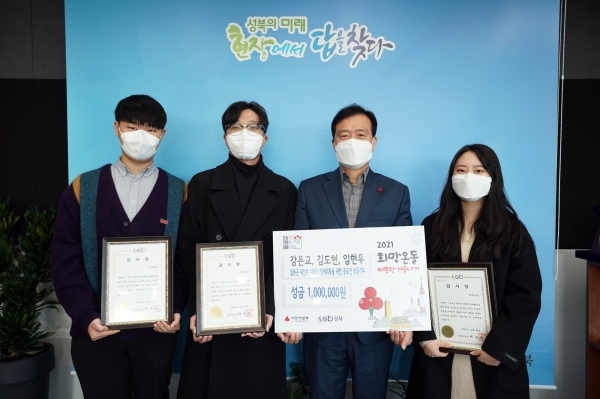
KU students participated in a meaningful contest and made special donation   (From the left) Kim Do Hyun (Business ’19), Kang Eun Kyo (Political Science and International Relations ’19), Head of Seongbuk-gu Lee Seung Ro, Lim Hyun Woo (Media & Communication ’19)   The donation of three KU undergraduates warmed the hearts of many people. Kim Do Hyun (Business ’19), Kang Eun Kyo (Political Science and International Relations ’19), and Lim Hyun Woo (Media & Communication ’19) participated in the ‘2020 Symposium contest for the rehabilitation of Japanese military sexual slavery victims.’ They won the honor award for their paper titled ‘The desirable approach for movie contents to improve the awareness of Comfort women.’   The students must have wanted to spend the prize money for themselves, as it is the well-deserved reward for their efforts and hard work. Yet, since the money was rewarded from a meaningful contest, the students wanted to use the prize money in a meaningful way. They added their own money and donated it to the Anam Community Service Center to be used to aid local low-income youths.   Head of Seongbuk-gu, Lee Seung Ro, met and encouraged the students and gave them a letter of appreciation to show his thanks.   KUBS met Kim Do Hyun, a business school undergraduate and one of the three students, to hear his story.     Kim Do Hyun (Business ’19)   Q. You participated in a meaningful contest and made a very special donation. How did you meet your friends from other majors and get together as a team? We met as fellow students in the School of Interdisciplinary Studies, Class of 2019. We became close friends before being assigned to our majors, and this is how we decided to make a team.   Q. Please tell us about how your team decided to donate the prize money to local low-income youths. We did not expect to win a prize at the time of submitting the paper, and were simply content to participate in a contest with a meaningful topic. We were lucky to be selected for the honor award, and received a huge amount of prize money. We contemplated on how we should use the money, and concluded that we should give it back to society because most of the funding were from civic group donations. One of our teammates had participated in educational service activities suggested to donate the prize money for those who lack access to education. So, we donated our money to Anam Community Service Center to aid students of low-income, single parent families.   Q. Briefly tell us about your paper that won the honor award in the ‘2020 Symposium contest for the rehabilitation of Japanese military sexual slavery victims’ We felt that solutions for Comfort women are mainly focused on formal aspects. We contemplated to find a novel approach that can reach out globally and chose movie contents as our main topic.   Compared to Holocaust movies, contents about Comfort women were extremely uniform. Holocaust films such as ‘Life is Beautiful’, ‘Schindler’s List’ and many other masterpieces have various themes, characters, backgrounds etc. On the contrary, movies on Comfort women are mostly documentary films that focus solely on reenacting what happened. We thought this was a huge problem since it limits attracting a wide pool of audience.   If films about Comfort women become movies that people ‘want to watch,’ more people will remember Comfort women, and furthermore this will contribute in preventing this tragedy being repeated. Therefore, we wrote a paper titled 

2021.02.01 Views 2828

[Interview with Professor Song Oh Yoon] First Female Faculty Inaugurated as a Management Board

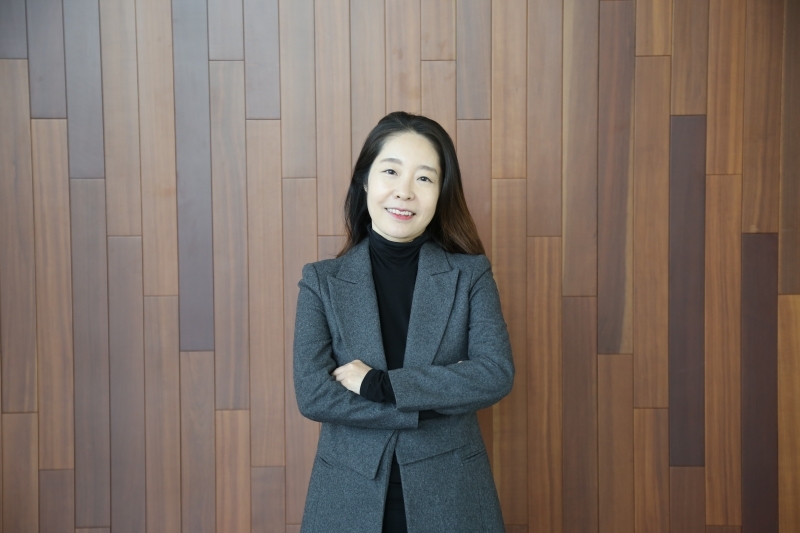
[Interview with Professor Song Oh Yoon] First Female Faculty Inaugurated as a Management Board       Q. You are the first female faculty to be inaugurated as a management board of KUBS. What is your impression on this?   I understand that the phrase ‘first female member’ might sound like a special issue but I personally do not feel much things from it, and I just feel that I should be highly responsible for this role. From now on, I should focus on the ways to contribute in KUBS management and to preserve the legacy of KUBS, which has been stacked up by a lot of great faculty members and students. Recently I find a lot of female talents taking the leadership in business, and the society is changing to embrace the growth of female leadership. Having been working in KUBS, I haven’t experienced any discriminations between male and female members, so that I haven’t realized that I am the first female faculty member who was appointed as a board. Nevertheless, no matter how I personally feel about the title ‘first female board’, I believe the key issue in a female joining the leadership group of KUBS is to direct us to pursue diversity in management. It is clear that our society can now easily find out diversity as a quantitative measure, but I think we have much things to solve when it comes to the qualitative diversity. For the prosperity of organization, improving the quality of diversity is very important and I believe the other board members are resonated with its context.   Q. Please introduce your role and concentration for your term in office.   My position is a vice-president in research, and my role has 5 big categories:  △Faculty Research Support △ Campus Internalization △ Management of Career Development Center △ Management of Start-up Institute △ Observation of Domestic and Global Ranking of KUBS. I have lots of concentrations in different fields but I’ll strive to balance my workloads in order to work for every part of school where my support is needed. My primary concentration will be on broadening the foundation of KUBS’s research infrastructure. Second, I’ll be striving to support the departments that are working for international businesses, such as AACSB, Outbound Research, Internships. Another important division in KUBS is Career Development Center, where students can search for diversified career paths and develop their experience in outside work spaces. At last, KUBS Startup Center will open up further startup opportunities for students who are interested in developing their own business and services.   Q. Please share your plans and goals as a female leadership in KUBS.    KUBS is an elephant organization that manages thousands of students, 80+ faculty members, and about 40 administrative officers. Making developments in KUBS cannot be done by the efforts from 5 leadership board itself but it will be possible when all the members are trying their best to advance the value of KUBS with a huge proud of ourselves in mind. Therefore, I will do my best in improving the qualitative infrastructure so that students and other staffs can develop their own pride in KUBS community so forth. At last, I personally hope a ‘female leadership’ to become a non-special title in KUBS, and I wish KUBS to become a place where everyone can realize their dreams no matter who they are and where they from. In that way, KUBS becoming a global leading business school will not be just a dream but a real objective that we can soon achieve.

2021.01.25 Views 3423

Special Lectures on Korea Investment & Securities featuring enthusiastic participation of students i

Special Lectures on Korea Investment & Securities featuring enthusiastic participation of students interested in investment.       Korea University Business School (Dean=Johngseok Bae) Career Development Center held an online lecture on December 4 (Friday) about the Korea Investment & Securities Research Center. This special lecture was based on a report released by the Korea Investment & Securities Research Center in October, which taught students the concept of the ‘Price to Dream Ratio (PDR)’ indicator. The lecture was jointly conducted by Yoon Hee-do, head of the center, and other research center employees.   PDR Indicators are new indicators for assessing industries with high future value in stock investment. The indicator was developed to reflect the recent phenomenon in which industries with high potential are drawing attention, although they are not making immediate profits. The PDR metric represents the Price/Dream ratio, the market capitalization divided by the product of the potential market size and market share.   The analysis of PDR indicators in the BBIG industry was the main focus of this special lecture. The BBIG industry stands for △ Battery △ Bio (Bio) △ Internet Game (Internet and Game), which are the currently growing industries. Presentations on the differences in specific methods of calculating PDR indicators by sector, major growth factors, and the most notable sub-sector were followed.   The special lecture was held for about an hour, and despite the constraints of online special lectures, it was completed successfully with active questions and answers.  

2021.01.12 Views 3096

[KU Business Journal 60th Anniversary] 60 Year History of KU Business Journal

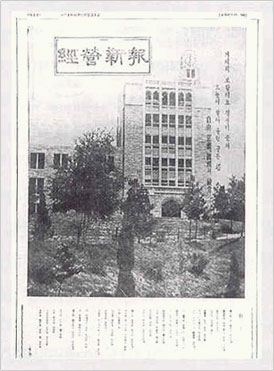
[KU Business Journal 60th Anniversary] 60 Year History of KU Business Journal   < The first weekly newspaper in Korea > Acting as a compass for business management and a guide for business prosperity, the Center for Business Research & Education, affiliated with KUBS, launched the Business Journal on December 15, 1960, the first business newspaper in Korea. The publication was led by Prof. Kim Hyo-rok, then Director of the Center, Prof. Yun Byeong-uk, then Deputy Director, and Prof. Jo Gu-yeon, then Director of the Center’s Research Department. After gaining official permission for publication during the Jang Myeon administration, the four-page newspaper was published weekly. It was printed by renting the site of the Minkook Daily Newspaper (the Shinhan Bank building today) in Namdaemun, Seoul. < A tumultuous era – Publication suspension and reissue > The publication of the Business Journal was suspended temporarily in early 1964 as student demonstrations against the Korea- Japan negotiations caused the school to close several times. Most other forms of university media also had operations suspended.     < First Business Journal>   < Business New Report > The following year, Business Journal was reissued under the name of the Business New Report. The then Korean government had flexed its muscles to force the name change. The government banned all university media from using the word “journal” in their publications, claiming that “journal” represented established media; thus, university journals could trigger student demonstrations when addressing social issues. For the same reason, it was at this time that the “KU Journal” was also changed to "KU New Report." The first issue of Business New Report was published on September 21, 1965, and the current order of the Business Journal is added one by one in the order in which it was issued under the first issue of September 21, 1965. It is a great pain that more than 100 issues, which had been published before 1965, were omitted from the calculation of the order. < Reporting academia and school news > In 1966, the name reverted to the Business Journal. Originally published by the Center for Business Research & Education (the Institute for Business Research & Education today), the Business Journal fell under the control of KU Graduate School of Business Administration. Accordingly, there have been a lot of articles from the Graduate Student Association and Alumni Association, and the distribution targets were changed. Since the 1980s, it has served as a public relations material for KUBS, and since 2003, the dean of KUBS became the publisher of the journal. Although there have been difficulties and ups and downs in publishing the journal, it is difficult to find a similar example of publishing 16 pages of the tabloid four times a year (once a quarter).   >> Go to see KU Business Journal No. 691.      

2021.01.12 Views 3001

  • 첫페이지로
  • 96
  • 97
  • 98
  • 99
  • 100
  • 마지막페이지로