TOP

KUBS News

Total 1416

Department of Business Administration, Graduate School, Korea University Recruiting New Students

Department of Business Administration, Graduate School, Korea University Recruiting New Students for Fall 2026… Applications Open Until April 9   A new opportunity is opening for those seeking to advance both their research direction and career development. The Department of Business Administration at the Graduate School of Korea University has begun accepting applications for domestic students for the Fall 2026 intake, with the application deadline set for 5:00 PM on Thursday, April 9.   As the business environment continues to evolve rapidly, the criteria for selecting a graduate program are also shifting. Beyond the name of the major, the strength of the research environment and academic network has become an increasingly important factor.    ▲ A group of full-time faculty members at Korea University Business School pose for a commemorative photo.    Korea University Business School boasts one of the largest research infrastructures in the country, supported by 95 full-time faculty members. This is considered a key strength, as it enables applicants to choose academic advisors who closely align with their research interests and topics. The faculty’s diverse expertise, spanning a wide range of subfields and research areas, provides a strong foundation for graduate students to conduct rigorous and advanced research.    As a research-oriented graduate school, Korea University Business School is also strengthening its interdisciplinary research environment to reflect rapidly evolving industries and societal needs. With a focus on the so-called “4Tech” fields—AI, semiconductors, robotics, and energy—the school is expanding the scope of business research beyond traditional boundaries and fostering the exploration of emerging challenges. Through this approach, students are able to analyze business phenomena from a more multidimensional perspective and develop their research questions into independent scholarly work.    Its research infrastructure is another key strength. Graduate students are provided with dedicated research spaces, including offices, seminar rooms, and lockers, along with access to data analysis software such as SAS, SPSS, STATA, and MATLAB. In addition, Korea University Library houses approximately 3.31 million volumes and 86,000 non-book materials, offering a comprehensive foundation for academic research.    In particular, students have access to major databases such as Bloomberg, Compustat, CRSP, WRDS, and LSEG Workspace. Recently, thanks to a donation from Eugene Investment & Securities, the number of Bloomberg terminals has been expanded to 12, further enhancing the research environment in finance and related fields.    Korea University Business School also offers a range of scholarship programs to support students in focusing on their research. These include full tuition coverage through research and teaching assistantships, as well as research scholarships under the BK21 program and merit-based scholarships. Approximately KRW 2.3 billion in scholarships are awarded annually, along with programs that encourage research activities, such as support for participation in international academic conferences.    For the Fall intake, the department will admit students to master’s, doctoral, and integrated master’s–doctoral programs in the following fields: Management, Global Business, Strategy, Finance, Information Systems (IS), and LSOM. The Marketing field will recruit only for doctoral and integrated programs, while Accounting and Business Analytics are excluded from this round of admissions.    The Fall admissions cycle is particularly meaningful as it provides another opportunity for applicants who have reassessed their academic or career paths following the Spring admissions cycle. For those who have further refined their research interests or career goals, this can serve as a strategic opportunity to select a research environment that best fits their needs.    Daeil Nam, Associate Dean for Research at Korea University Business School, stated, “As business studies become increasingly interconnected with industry, the importance of research environments and networks continues to grow,” adding, “We support our students in expanding their research and connecting it to real-world applications.”      ▶ Apply for Fall 2026 Domestic Graduate Admissions at Korea University ◀ 

2026.04.13 Views 42

Korea University Business School ranked 1st in Hankyung Business National Business School Evaluation

Korea University Business School ranked 1st in Hankyung Business National Business School Evaluation for 14 Consecutive Years KKorea University Business School (Dean = Johngseok Bae) took first place in the '2021 National Business School Evaluation' conducted by Hankyung Business. As a result, Korea University Business School has taken the first place for 14 consecutive years since 2008, when the evaluation began, and has firmly maintained its top position in Korea.   KUBS took the first place in the overall ranking by taking the lead in four categories out of 9 evaluation items: work adaptability and practical ability, organizational harmony, sincerity and responsibility, and preference for new employees. In particular, it overtook Seoul National University and ranked first in the preference for hiring new employees selected by personnel in charge of major companies, establishing itself as the best training center for human resources in South Korea.   Hankyung Business said, “Korea University’s unrivaled education and research capabilities are the secret to its success.” They added that “Its strength comes from the fact that they do not slow down the pace of innovation to respond to changes in the business environment and the demands of the times, rather than being complacent with the best titles.”   KUBS is nurturing 'creative leaders who can contribute to society' in line with the needs of companies. In an interview with Hankyung Business, the Dean of Business School, Bae Johngseok, said, "KUBS is pursuing various educational innovations to not only transfer business knowledge, but to add 'humanistic imagination' and cultivate the ability to solve practical problems.” Revealing the educational innovation and talents pursued by the Business School, he also added, "In fact, it is when you encounter a real problem in the real business environment that you truly can understand what the 'essence' of the problem is. The ability to 'communicate' these problems clearly in your own language and collaborate with others to 'find a practical solution' is important,"   In addition, Dean Bae said, “The purpose of management is to help people enjoy a good life together,” and emphasized the importance of imagination for social leaders that want to pursue a better future for humankind. At the same time, revealing the characteristics of students pursued by KUBS, he said, “Korea University Business School aims to create a virtuous circle where better talents can grow into 'social leaders'.”   To achieve this goal, Dean Bae said, “At the business school level, ‘5 strategies, ▲15 core tasks, and ▲30 practical tasks’ have been selected and are currently being implemented.” We are building a problem-based learning (PBL) infrastructure and trying a teaching method for smooth communication.”   Meanwhile, KUBS was the first in Korea to receive the accreditation from AACSB in 2005 and the accreditation from EQUIS in 2007 for all degree programs including undergraduate, graduate, and MBA programs. In 2015, it also acquired full membership of the CEMS Global Alliance, an association of world-class business schools. In addition, it has been firmly holding “the CPA throne” for six consecutive years in the CPA exam, establishing its place as the first and best business school in Korea.   In addition, KUBS has responded to changes in the times through detailed track certification system, which has been in effect since May of this year, and rolled up its arms to nurture creative convergence talents who will lead the future society. In addition, KUBS is taking the lead in social contribution by supporting the start-up of students from other majors and other colleges as well as students from KUBS through Startup Station, contributing to the revitalization of start-up activities of Korea University and society as a whole.   Hankyung Business’s ‘National Business School Evaluation’ evaluates universities from the perspective of companies that are the real users of talent. Personnel managers of the top 300 domestic companies can select schools from 1st to 10th in each evaluation category. The questionnaire consisted of a total of nine items, including △work suitability of major and liberal arts education △work adaptability △organizational harmony △development potential △creative work solution △internationalization system △conscientiousness and responsibility △recruitment preference for new employees △recommendation for admission to college. In order to give equal weight to all nine evaluation categories, the rankings of each category were summed to give the final ranking.    See other related articles>>   Korea University, elected as ‘The best business school’ for 14 consecutive years by HR personnel Korea University’s relentless run.. its secret is its matchless education and research capability “We need to raise ‘social leaders’ capable of adjusting to changes… Merely having business knowledge is not enough”

2021.12.20 Views 5325

KUBS-KB Small and Medium Enterprise Management Academy (K-SMA) Completion Ceremony

KUBS-KB Small and Medium Enterprise Management Academy (K-SMA) Completion Ceremony    Organized by Korea University Business School and KB Kookmin Bank, “KUBS-KB Small and Medium Enterprise Management Academy (K-SMA)” Completion Ceremony was held at the LG-POSCO Building Lecture Hall 432 on December 8, 2021. On this day, Dean Johngseok Bae of Korea University Business School, Academic Director Seungwoo Kwon of K-SMA, Director Bokyung Bae of Executive Education Center (EEC), and all executives and employees who participated in the K-SMA program attended the event. The event was held both online and offline, and some of the graduates participated in the event through ZOOM.    Dean Johngseok Bae of KUBS congratulated the participants by saying, “Throughout the past eight weeks, I am sure all of you here have grown one step further as important business leaders of this era.” “What you learned in the K-SMA program will be the beginning of your career as influential business leaders, who can build a healthy and competent organization by utilizing abilities meaningfully,” he added.         Followingly,  Seungwoo Kwon, K-SMA Academic Director and Director Bokyung Bae of EEC gave a congratulatory speech. The event ended by delivering certificates and souvenirs to a total of 30 K-SMA graduates.   K-SMA is a program based on KUBS and KB Kookmin Bank’s “Business Agreement for Mutual Cooperation on Social Contribution,” which aims to △promote mutual development △cultivate SME management △strengthen social contribution through management innovation △and practice ESG management. For eight weeks, executives and employees from SMEs recommended by KB Kookmin Bank participated in a education program, which was provided free of charge by KUBS professors as talent donations.   Editor | KUBS Management Support Team

2021.12.20 Views 3100

Students Share Their Career Issues and Daily Life Through the “Fall 2021 Faculty-Student Mentoring D

Students Share Their Career Issues and Daily Life Through the “Fall 2021 Faculty-Student Mentoring Day” Korea University Business School (Dean= Bae, Johngseok) “Fall 2021 Faculty-Student Mentoring Day” was held for three days from November 24 to 26. The Faculty-Student Mentoring Day began in the year 2007, to help KUBS students meet with their advisors to listen to various advice related to their studies and careers. Furthermore, it aims to foster networking among KUBS students and alumni.   Before the event, Dean Johngseok Bae mentioned the objective of the event by saying, “Today, at times where immediate job openings outnumber traditional open recruitment, KUBS continues to monitor changes in employment trends. We thereby suggest ‘Faculty-Student Mentoring Day’ as an alternative measure for students to find careers in the future.” He added, “We hope this event becomes an opportunity for KUBS students to learn wisdom from their advisors.”   The event was held through an online platform, using breakout rooms to assign professors and students into different rooms. Students started the conversation by sharing their reason for participating in the event. Professors advised the students by saying, “Even it is not necessarily a business school, you should look for areas where you can show your talent,” “You shouldn’t lose interest in the subject just by taking basic courses,” and “If you knock on the door to various activities such as academic societies, external activities, and interns to explore your career, you will be able to live a college life without regrets.”   Moreover, professors shared their undergraduate experiences with their students. Professors mentioned, “It is natural to lose direction as a student.” They encouraged the students by saying that “It is important to listen carefully to the words of others who know me well.”   Furthermore, professors advised students about the importance of experiences. They gave a realistic guideline such as “Rather than blindly studying CPA or going to a law school, you can grow further by developing your perspective on the world through experiences such as taking various lectures and going on an exchange student.” They further added, “Utilizing the alumni network can be helpful,” and that “There is no fixed answer, and every way has its potential.”   Finally, the event ended with a comfortable conversation, where students built rapport with their advisors by sharing their daily lives during the semester and their vacation plans. A KUBS student who participated in the event mentioned, “I had a vague anxiety about exploring a new path, but hearing from the professor about how there are various life paths had me relaxed and motivated.” Another student who answered that he gained confidence through mentoring said, “Before applying to the program, I thought I should be prepared with my position or attitude,” he continued, “but the atmosphere was comfortable, and I felt closer to my advisor.”   Editor | Younghee Chung (School of Media & Communication 20th)

2021.12.20 Views 3722

IBRE – CDTB Integrated Colloquium, “Overview of Applied AI Research”

IBRE – CDTB Integrated Colloquium, “Overview of Applied AI Research” Korea University Business School (Dean=Bae, Johngseok) Center for Digital Transformation & Business (CDTB; Co-Directors=Dr. Baeho Kim and Dr. Byung Cho Kim) and Institute for Business Research and Education (IBRE; Director=Jaehwan Kim) held an online integrated colloquium on Friday, November 26. This time, Professor Chaehan So from Yonsei University gave an English lecture on the topic “Overview of Applied AI Research.” The lecture began with Director Jaehwan Kim’s greeting. He mentioned, “Korea University Business School has been thinking a lot about the kind of people the world wants today.” “I hope today’s colloquium strengthens our effort,” he added.   Then, Professor So explained Applied AI by dividing the concept into four agendas: △Deepfakes △Neural style transfer △Virtual Characters △ and Virtual Beings. Professor So showed the demo code for his deepfake model and presented an actual deepfake model, saying that “In the future, by the time your children begin a new generation, deepfake technology will be more advanced than now. It will be difficult to tell what is real and what is not.” Next, Professor So introduced Neural Style Transfer, which is a technique that changes the texture of image content to make it look like a painting. While introducing research on the aesthetic perspective of Neural Style Transfer, he mentioned, “Design, in the future, must differentiate itself according to different targets.” He also said, “Neural Style Transfer will be used in many different fields to create a variety of designs.”   Furthermore, Professor So explained Virtual Beings in Metaverse, which make it possible for Virtual Characters to come to life. He demonstrated an experiment where his demo Virtual Being talks with Professor Eonsoo Kim. Afterward, the lecture ended with a Q&A session. Closing the event, Co-Director Byung Cho Kim said, “Thank you for Professor So, who gave a very insightful and interesting lecture on Artificial Intelligence.” “It is an honor that CDTB collaborated with IBRE to hold an integrated colloquium, and I hope there would be more opportunities like this in the future,” he added.   Editor | Younghee Chung (School of Media & Communication 20)

2021.12.13 Views 3180

2021 KUBS Challenge – “A Fierce Competition of Ideas”

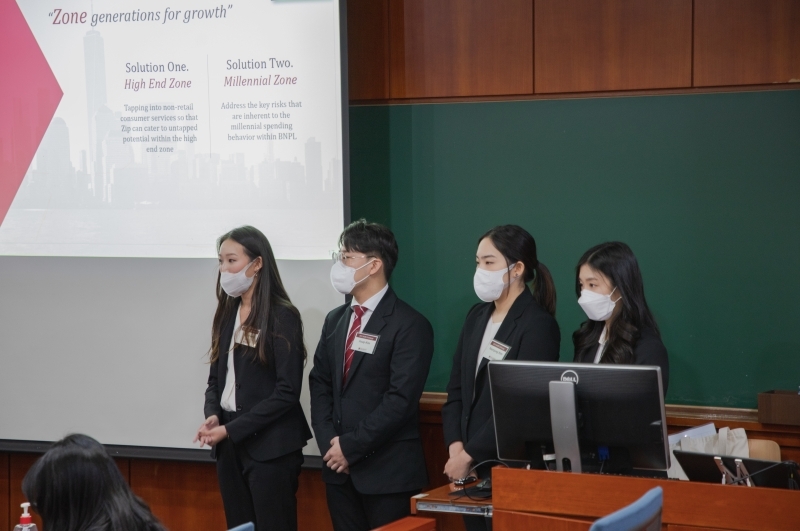
2021 KUBS Challenge – “A Fierce Competition of Ideas”   Korea University Business School (Dean=Johngseok Bae) held the “2021 KUBS Challenge” on Friday, November 12, at the LG-POSCO Building. KUBS Challenge is a contest where teams, each consisting of four business school undergraduate students, analyze a business case in a limited amount of time and make a presentation. In this year’s competition, 48 students from 12 teams participated and showed their case analysis skills. In this year’s KUBS Challenge, the participants were to analyze the case of the Australian business Zip, which is a BNPL (Buy Now, Pay Later) company. Their mission was to analyze the factors that make the BNPL industry attractive and to suggest a strategy for Zip to compete with major competitors in the BNPL and the credit card industry. During the preliminary round, the 12 teams spent 24 hours analyzing the business case and then submitted a recorded video of the presentation and their presentation slides. Out of the 12 teams, four teams advanced to the finals: △Kkanbu △KU Tigers △Crimson & Company(Crimson & Co.) and △Asya Consulting. In the final round of the contest, each team was given 10 minutes to present the results of their analysis and 7 minutes for Q&A. △Professor Tony Garrett △Professor Youngkyu Kim and △Professor Sunwoo Hwang participated as judges of the contest. After the presentations, the judges made their final decisions – the third prize went to teams “Kkanbu” and “Asya Consulting,” the second prize went to team “KU Tigers,” and the first prize went to team “Crimson & Company.” Team “Crimson & Company,” which won the first prize in the competition, was given the opportunity to participate in the “UW Global Business Case Competition 2022” hosted by the University of Washington in 2022. Team “KU Tigers,” which won the second prize, will be participating in the “32nd Annual Scotiabank International Case Competition” hosted by the Western University of Canada. Lastly, team “Kkanbu” will be participating in the “2022 RSM STAR Case Competition” hosted by the Erasmus University of Netherlands. The three teams will be subsidized with participation fees, airline tickets, and accommodations, and will be given special training before the international competition. Meanwhile, team “Crimson & Company,” the winner of the first prize, commented that “Although it was tiring due to the lengthened competition period, we were able to invest a lot of time.” “We are proud that our efforts paid out well and achieved a good result,” they added. They expressed their determination to participate in the international competition by saying that “We will do our best to win the international competition.”   Aritlce | Sangbong Chung (College of Political Science and Economics, Department of PSIR 17th)

2021.12.06 Views 4255

‘2021 Fall CHOO CHOO DAY’ successfully held, full with student entrepreneurs’ ideas

  ‘2021 Fall CHOO CHOO DAY’ successfully held, full with student entrepreneurs’ ideas ‘2021 Fall CHOO CHOO DAY,’ hosted by KUBS(Dean = Bae, Johngseok), Startup Station(Director = Hojung Shin), Crimson Startup Support Center, and KU Holdings was held at the Media hall SBS studio of on November 12th. CHOO CHOO DAY is a Demo Day in which the public can examine the business models and visions that the five startups of the KUBS Startup Station have developed during the past year. This event marked the 10th anniversary of CHOO CHOO DAY and was broadcasted live on the Startup Station’s Youtube channel, where investors, future entrepreneurs, and startup personnel could participate via live chat messages. KUBS dean Bae, Johngseok delivered a welcoming speech. “The growth process of a startup is in line with the ultimate goal of business management, which is contributing to a better life for all humanity. I support the five teams who aim to contribute to the common good of humanity.” Next, Professor Jungbien Moon, the director of Iljin Center for Startup Incubation, gave an opening speech. Director Moon mentioned that the total valuation of startups that graduated from the Center has surpassed 110 billion KRW, and said “this achievement is the result of the hard work and dedication of all youths who have been with the Startup Station.” “I applaud the five teams who have worked hard to change the world amidst the COVID-19 pandemic.” Before beginning the presentations of the five teams, CEO Park Sang Joon of D&I Fabis, serviced as Brunnel (3rd class of KUBS Startup Station and Iljin Center for Startup Incubator), gave a speech. Mr. Park said, “I realized that startups must understand the customer and find ways to strengthen teamwork.” He cheered the teams and said, “please welcome the five teams, who have worked hard for today.” This CHOO CHOO DAY consisted of five teams: △ ‘Kilo(CEO = Oh Hyung Jun)’ servicing ‘Miligram,’ a convenient diet recording service for healthy weight loss △ ‘Tingle(CEO = Nam Gyung Bin)’ servicing a child-tailored English learning platform for homes △ ‘EnoughYou(CEO = Lim Seung Hyuk)’ running a mobile healthcare platform for nutrition management of infants/toddlers △ ‘Mealing(CEO = Lee Su Bin)’ running a meal lifestyle sharing platform that allows users to easily imitate meals in photos △ ‘FitNavi(CEO = Lim Dae Hyun)’ operating a tailored weight-training program service based on scientific evidence and on-field experience. Each participating team was given a short introduction time of one minute along with their main presentation. Teams held Q&A sessions by receiving questions from on-site panel speakers and live chatting. The event was concluded with a closing speech from the Director of KUBS Startup Station, Hojung Shin. Director Shin introduced himself as the stationmaster of the Startup Station and explained that “CHOO CHOO DAY was aimed to become the benchmark of university incubation that develops the precious ideas of students into companies.” “Thank you to all of the five teams who enabled us to maintain this reputation,” he said. Lastly, director of Iljin Center for Startup Incubation Jungbien Moon gave closing remarks. “I still remember how I stood at the podium wearing a tie on the very first CHOO CHOO DAY. While organizing this event, I was grateful and relieved to learn that our future depends on smart, passionate entrepreneurs.” He thanked all participants and said, “I will temporarily be absent due to my sabbatical year, but my heart will be with you.”   Editor | Jung Young Hee (Media and Communication ‘20) Photographer | Cho Eun Bi (Business ’20)  

2021.11.30 Views 3400

  • 첫페이지로
  • 86
  • 87
  • 88
  • 89
  • 90
  • 마지막페이지로