TOP

KUBS News

Total 1427

Turning Financial Data into Research - Special Lecture on Exploring Bloomberg Data for Academic Rese

"Turning Financial Data into Research" Special Lecture on Exploring Bloomberg Data for Academic Research     The Bloomberg Terminal contains one of the world's most comprehensive collections of financial market data. However, transforming that information into meaningful research variables requires multiple steps, from exploring available data and verifying variable definitions to extracting data and constructing research datasets. To help students navigate this process, Korea University Business School (KUBS) held a special lecture titled "Financial Data Exploration and Research Applications Using Bloomberg" on Friday, May 15, at the LG-POSCO Building. The session was led by Dr. Ha-yeon Park of the Korea University Business Administration Education and Research Group for BK21 FOUR and was attended by KUBS graduate students. The Bloomberg Terminal is a widely used financial data platform that provides access to real-time market information, company data, and financial analytics. During the lecture, students learned how to search for and extract financial data using both the Bloomberg Terminal and its Excel Add-in, while also exploring how Bloomberg data can be effectively applied to academic research. Dr. Park introduced the basic structure of the Bloomberg Terminal and demonstrated practical methods for exploring financial data. She guided students through the process of identifying research variables and verifying their definitions, emphasizing that carefully confirming variable names, definitions, and available options before downloading data is essential for ensuring research accuracy. She then explained how to extract data using the Excel Add-in and organize Bloomberg data into structured datasets suitable for empirical research. In the latter part of the lecture, Dr. Park demonstrated how Bloomberg data can support academic research by drawing on several case studies, including examples from her own work. She explained how ETF-related data can be identified, extracted, and organized according to different research objectives. She also advised students not to rely exclusively on Bloomberg, noting, "Rather than using Bloomberg as a single data source, I recommend using it for the types of data in which it has particular strengths." She emphasized the importance of cross-checking Bloomberg data with other databases whenever appropriate. The lecture provided students with a practical overview of how financial data can be translated into research—from developing research questions and selecting appropriate variables to constructing reliable datasets. By following the entire workflow, participants gained a clearer understanding of how Bloomberg data can be explored, evaluated, and incorporated into academic research. The lecture also reflects Korea University Business School's recent expansion of its Bloomberg Terminal infrastructure. As part of a financial data hub established through a KRW 1 billion donation from Eugene Investment & Securities, KUBS increased the number of Bloomberg Terminals from one to twelve—the largest Bloomberg Terminal installation among universities in Korea. Nine terminals have been installed in the Sudang CLC Lounge, while the remaining three are available through remote-access accounts.     The Bloomberg Terminal is one of the most widely used financial data platforms in investment banking, asset management, equity research, and other finance-related fields. Hands-on experience with the platform provides students with valuable practical skills that can help them transition into careers in the financial industry. Students who complete the Bloomberg Market Concepts (BMC) certification may also find it beneficial when preparing for the CFA examination or applying for internships in finance. With the expanded infrastructure significantly improving access throughout the semester, more students now have the opportunity to work directly with real-time market data in their coursework, research projects, and academic studies. KUBS Student Press Reporting by Chaewoo Lee Photography by Jinyoung Park

2026.07.22 Views 322

CDTB Colloquium held…"The Digital World that Startups Create and the Role of VC."

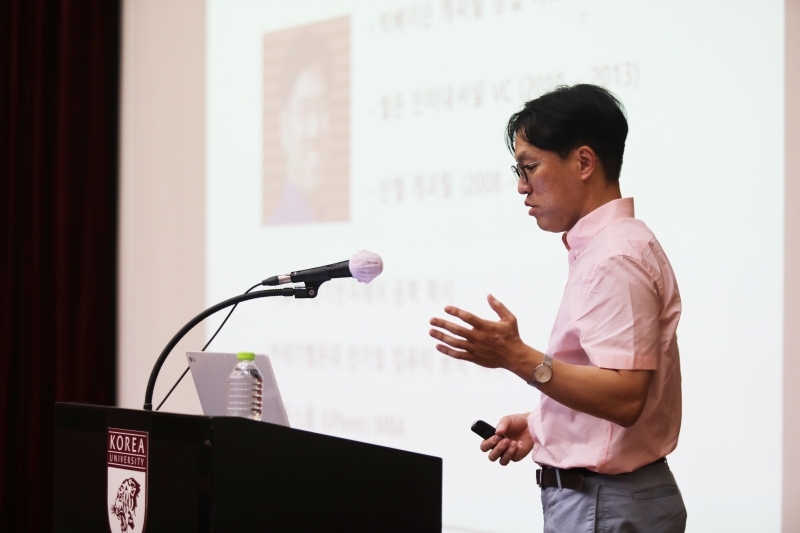
CDTB Colloquium held…"The Digital World that Startups Create and the Role of VC."    The Colloquium organized by the Korea University Business School (Dean = Johngseok Bae) Center for Digital Transformation & Business (Center Director = Byungjo Kim, hereinafter CDTB), was held on July 15th(Fri) at the SUPEX HALL of LG-POSCO Building. The lecture, which was conducted both online and offline, was given by Yoon Pilgu, CEO of Big Basin Capital, under the theme of "The Digital World that Start-ups Create and the Role of Venture Capital (VC)."      CEO Yoon Pilgu explained the symbiotic relationship between Venture Capitals and startups by introducing examples of startups such as Uber and Airbnb, which have achieved explosive growth based on Silicon Valley, and venture capitals invested in each company. CEO Yoon said, "Venture Capital has a system that provides capital to startups and recovers investment when startups are listed or sold," adding, "It may seem to be a relationship linked only by capital, but we strive to create more than capital in the process of startup growth."   In the middle of the lecture, the content of the lecture covered starting up a company in the Digital Transformation era. CEO Yoon Pilgu talked about ideas, people, and capital, which are elements of start-ups, but emphasized, "All startups have technical elements, but in the end, people make technology, thus the most important thing is people." Also, he said, “Investing in startups itself is a risk.” and that " Even though it is difficult to predict the market situation, if there is a lack of product quality and the ability of the team to sell, we should fill it quickly and reduce risks."     At the end of the lecture, CEO Yoon summarized and introduced the entire industry, including venture capital's △ business characteristics △ capital sources △ division of labor, and wrapped up the lecture with a description of the successful strategies of startups invested by Big Bason Capital. After the lecture, Village Baby CEO Lee Jungyoon, who received investment from Big Bayson Capital, came up to the podium to briefly explain Village Baby's start-up, process, and differentiation strategies. After 20 minutes of Q&A, the Colloquium ended.

2022.07.25 Views 4347

KU AICG-KCMI Joint Symposium Held

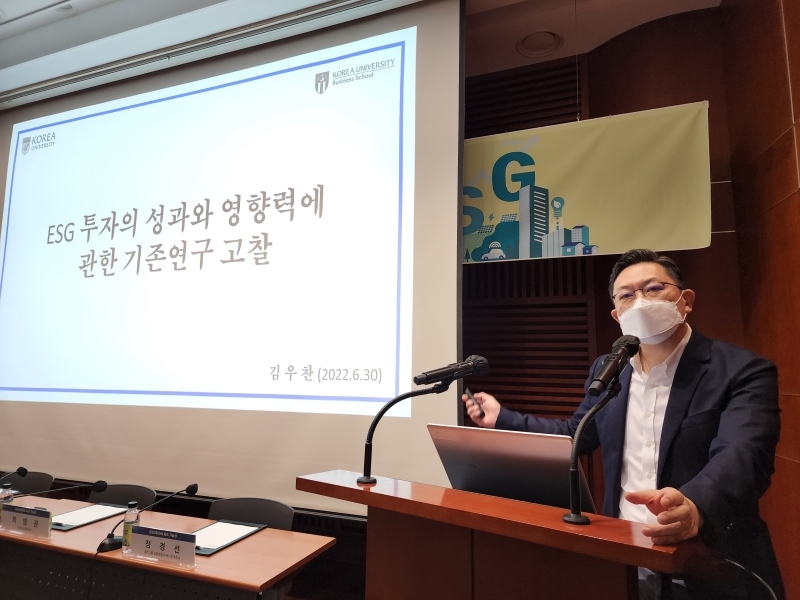
The AICG-KCMI Joint Symposium co-hosted by the Asian Institute of Corporate Governance (Director = Park Kyung Suh) and the Korea Capital Market Institute (Head = Shin Jin Young) was held on the topic of "Sustainability of ESG Investment." The symposium, held at the Yeouido Financial Investment Center on June 30th, held various discussions on the "Sustainability of ESG investment returns," which are the main background of ESG (Environmental, Social, and Governance) management.    Starting with the opening speeches of Park Kyung Suh, Director of AICG and Shin Jin Young, Head of KCMI, Hwang Sunwoo, professor from KUBS, hosted the main event. In the presentation, each speaker gave a presentation under the theme of △Kim Woochan, professor from KUBS, "A Study on the Performance and Influence of E&S Investment” △ Nam Jaewoo, a researcher at KCMI, “ESG Investment and Profitability of Public Pension Fund” △ Na Hyun Seung, professor from KUBS, “ESG management and stock price returns of domestic companies.”      Professor Kim Woochan of Korea University said, "Investment in the E&S Engagement method will also realize a positive (+) excess return in the future through ‘Study on the Performance and Influence of E&S Investment (investment considering environmental and social value factors).’” In addition, once capital market participants efficiently reflect E&S information in stock prices and fully recognize the gravity of the E&S problem, investment in selective E&S method will be revealed as a negative excess return and investment in the E&S integration method will be zero excess return. In addition, it was diagnosed that the E&S engagement method will be effective in improving the E&S performance of the investment target company, but the selective E&S method and the integration method will not be effective.      Nam Jaewoo, a researcher from KCMI, said, "The driving force behind domestic ESG investment is the public pension fund, including the National Pension Service." In addition, it was emphasized that the fiduciary duty for pension subscribers can be recognized only if the long-term stability and sustainability of the return on investment are improved from a financial perspective.      Professor Na Hyun Seung of Korea University analyzed the impact of corporate ESG management on stock price returns in the face of an economic crisis in which asset value changes rapidly due to the COVID-19 virus. Although the cross-sectional analysis results differ depending on the control variables used, it was found that if corporate characteristics before the COVID-19 were controlled using panel regression and double difference method, stock price returns increases compared to the previous period as ESG evaluation, especially the Enviormental(E) evaluation, os better. Through this, a positive empirical basis for the impact of ESG on shareholder value was presented.      After the presentation session, Lee Inhyung, a member of KCMI, continued a panel discussion involving academic experts. △Yeo Eunjung (Professor of Chung-Ang University) △Lee Dongseop (Director of the National Pension Service Investment Management Trustee's Responsibility Office) △Jung Kyungsun (Co-founder/managing partner of Sylvan Group) △Choi Youngkwon (CEO of Woori Asset Management) participated as debaters.

2022.07.15 Views 4077

Interview with the 54th KUBS Student Council, Horizon "We want to make a good culture

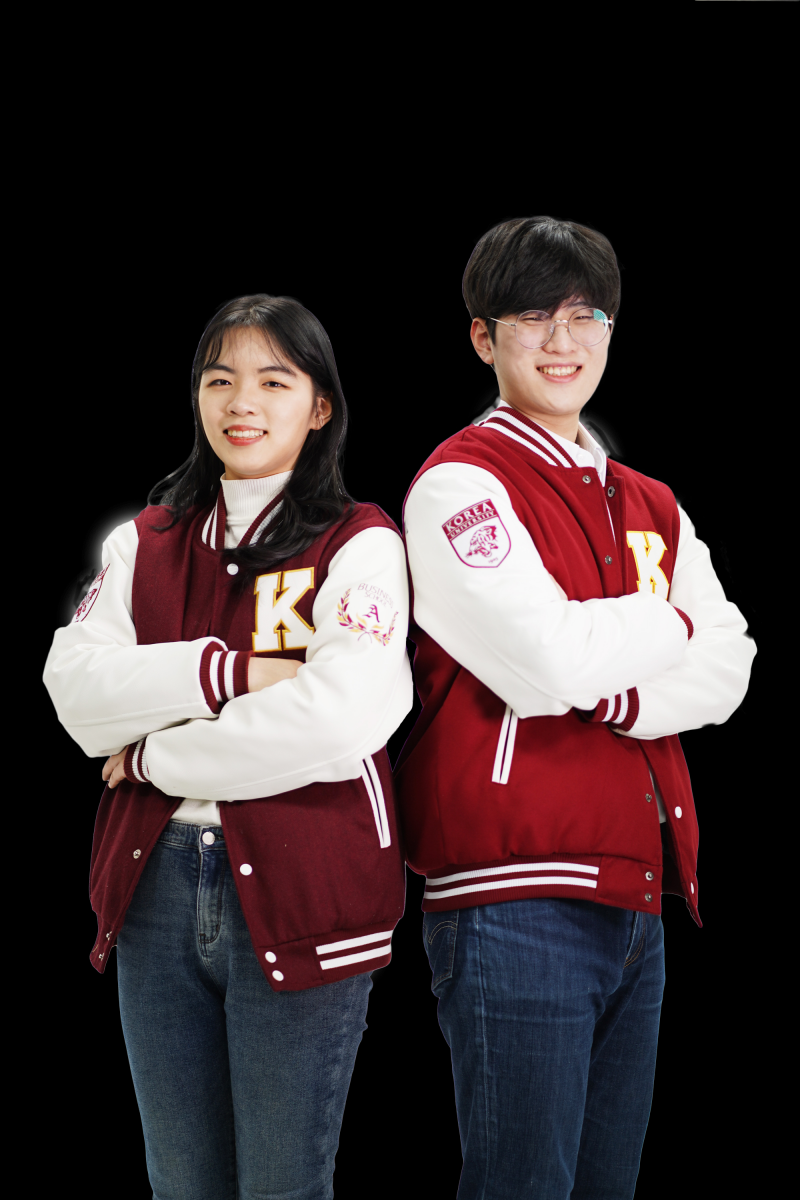
Interview with the 54th KUBS Student Council, Horizon "We want to make a good culture and pass it on to the next Student Council" In the 54th KUBS Student Presidential Election held online from 0:00 on March 17th to 18:00 on March 19th, the campaign "Horizon" was elected with a final turnout of 21.40% and an approval rating of 90.02%. We met with Dongin Choi (Business ’21), the 54th Student President of KUBS, and Yoonjin Oh (KUBS ‘20), the Vice Student President, to hear their thoughts on winning the election and future plans.     Q1. It has been about 3 months since the election of the Student President of KUBS. Tell me about the "initial determination" you had of the time when you decided to run for the student president. Student president Dongin Choi(hereinafter referred to as Choi): Hello, I am Dongin Choi, and I was elected student president of KUBS in March. I think the important value of the student council elections these days is 'return to pre-COVID-19', but I had a slightly different idea. As COVID-19 continued for more than two years, people who knew well about previous student associations and events gradually disappeared and new students flowed in. Then, I thought that I should try something new with people who have never been in college, rather than going back to the past. I ran for student president because I'm convinced that it's a good time to change the wrongs of the past traditions and try out innovative and diverse things. Vice Student President Yoonjin Oh(hereinafter referred to as Oh): Hello, I'm Vice Student President Yoonjin Oh. I was interested in student society, but I had no experience in student council when I was in 1st and 2nd grade. Since the next student council usually came out of this student council, what I could do without experience in the student council was "running," and I ran with the student president because we had similar thoughts.   Q2. The name of this student council is "Horizon," is there a special reason why you chose it? Choi: "Horizon" is related to the three core values pursued by this student council: "Innovation," "Horizontality," and "Openness." Watching the sun rise and fall over the horizon, I thought of the first value of innovation. This is because the space where the old things go down and the new sun comes up, and the place where "extinction" and "creation" take place is the horizon. And it has a vast image that doesn't know where the end is, so it is suitable for the value of 'horizontality’ and ‘openness.'   Q3. What is the biggest change since the election of "Horizon"? Oh : I've been thinking about why people aren't interested in the student community, and why it's hard to get engaged in student council. Due to the existing structure of the student council, it was difficult to enter the student council if you did not join the student council in the first grade, and there is a burden of having to work throughout your term. Also, the entry barrier is higher because there are fixed titles of director and member of the branch and the hierarchy is clear. Therefore, since the period of election headquarters, we have emphasized "horizontality" and "openness" in our group. And in order to structurally change the organization of the student council, we introduced a "recruitment by semester" system. Choi : Usually, if the structure of the student council is a system that has a director of a branch, members of the branch, and had to spend time during the term even if it was unwanted, the Horizon would recruit 3 times, dividing 1 year into 1st semester, vacation, and 2nd semester. It is conducted regardless of their grade, gender, age, student status, etc. and does not select directors and members based on the existing eight branches, and selects teams of special role : Finance, Communication & Design, and Business planning and Operation. At the beginning of each quarter, the project manager (PM) and staff will be decided. Anyone can become a "PM" and carry out tasks autonomously, and we aimed to operate very openly so that everyone would put in their efforts because it would be worth it in the long run, not just in a single task, and it would help the students’ career, too.     Q4. What is your most important pledge in the student council? Choi: Basically, I think each person has different perspectives of important value, so I don't think we can conclude that one is more important. Personally, I'm interested in starting up a business, so Hackathon or Case Competition, where I'm in charge of PM, is important, but for others, it can be "preparing for the festival" or "academic seminar." Since the business that everyone manages is different, not one is more important, but everything is important. Only different priorities. These thoughts seem to be related to the horizontality and openness that the student council is going for. With one leader in charge of everything, it is difficult for the members and the leader. I believe the organization where each leader takes the lead and carries out their own business responsibly will be much healthier, and that will increase interest in the student community.    Q5. Is there anything you want to improve at KUBS? Oh: When I ask myself, "Are our students making good use of the great infrastructure at KUBS?" I don't think that's the case. Although all the business school spaces are open, there are many students only in the lounge or cafe, and the building still feels empty. Accordingly, the student council is also conducting the KUBS Onboarding Challengers. KUBS Onboarding Challengers is a program that helps new students adapt well to and actively enjoy school life in a somewhat chaotic and disconnected university life due to the COVID-19. Participants will pay a certain amount of deposit and perform various challenges related to KUBS, and only students who have achieved all of the challenges will be eligible for a refund. We hope that KUBS Onboarding Challengers will be activated so that everyone can use the school without any burden, and it would be good if the KUBS administrative office can actively help us to make good use of the excellent infrastructure.   Q6. What kind of student council do you want to create for the rest of your term?  Choi: I want to play a role in passing on good cultures and habits to the next generation rather than 'I will complete something!' during my remaining term. Since I have the idea of "passing on the flow of change," I am thinking about how the next student council can be launched well and how the desirable changes I think can be continued. Oh: I hope it's a year when it's known as 'A different student council has started.' I want to persuade students of the three values that are fundamentally proposed by "Horizon", and create a student council that they recognize that we really wanted to realize these values.   Q7. Please say something to the students who will read your interview. Choi : Thank you for reading through the interview. If you are a student who was interested reading this, I am sure you are a promising person who is interested in the student council. Recruitment for the second semester of the student council "Horizon" will be held at the end of August, so please check out our Instagram account (@kubs_jps)! (laughs)  

2022.07.11 Views 3898

[KUBS Teaching Committee] Let`s listen to the Winner of the Lecture Award!

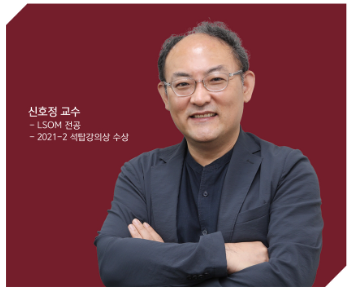
"Active intervention is necessary for education… I become a ‘Jolly Dictator.’"   In order to improve the overall quality of teachers' teaching skills and techniques and share good examples of teaching, KUBS has established "KUBS Teaching Committee" in 2021. The Teaching Law Committee runs several sessions, including △how does the professor in the next classroom teach? △ Hear it from the Lecture Award winner △Introduction to teaching techniques and is striving to provide teaching methods that meet the educational demand. In the , we would like to disclose some of the teaching methods of the KUBS professor through the " Let's listen to the winner of the Lecture Award!" session, and in the June issue, we share an interview with Professor Hojung Shin among the winners of the 2021-2 Seoktap Lecture Award.     Q1. Congratulations on winning the Seoktap Lecture Award for the second semester of 2021 [Operations Management]. Please briefly introduce the subject. Companies use capital and labor to produce value. The study of the process of value production is 'Production Management'. Basically, it is a subject that deals with the process and system of implementing customer value in a system using capital and manpower.   Q2. What do you think the students liked about this class? I think the first one is communication. Basically, I think education should be based on "human contact," so I think it was naturally revealed in class that I like people. The second reason is that it was educated through 'active intervention'. If possible, we are trying to actively intervene and clearly instruct students in the direction that "this is right, this is not right." And I tend to teach all the contents on the syllabus. I tried to develop their ability to solve problems by adding appropriate "challenge" to guide students' potential instead. If you are a student at KUBS, I think it is important to instill that mindset because you are already qualified as a "game changer" or "game setter." I tried to create a class that mixes the appropriate ratio of challenge and the story of the world.    Q3. Those who are good at teaching like you must have some concerns. What are some things that didn't go well or that needed some improvement in this course? Actually, it was difficult to communicate during online classes. I think it was more difficult because I was teaching English. So I spent a little more time after class, taking questions in Korean for 5-10 minutes. Also, before class, I used to access it about 5 minutes earlier and play various music for warm-up. And since it's a non-face-to-face class, I have to look at the camera, but there were many times when I didn’t get to do that. So students would go, "Where are you, professor?" "Is there someone next to you?" (laughs) I like face-to-face classes much better, where you don't have to worry about the camera angle, because I can receive the energy from people directly.     Q4. What do you have in mind the most when you teach a lecture? I think two things are important. It's "Clarity of Presentation" and "Fairness in Grading". First, I think “clarity of presentation” is important in that the lecture should be clean and clear. I think visuals account for more than 35% of the lecture power, so I tend to pay a lot of attention to making teaching materials. I also value 'fairness in grading'. I cover up the students' names and grade them only with scores, and I share the grading results with everyone. Rumor has it that I am one of most generous-grading professors in business school, but I also give out a lot of D and Fs. I run the class thinking that it is fair to give good grades to those who work hard and bad grades to those who don't. It may be unfortunate for students, but I'm a professor who can never negotiate on grades.   Q5. What is unique about your class? I teach all the basic models in areas like strategic demand forecasting. Even without SAP programs, I teach them to know all the problems if they can add and subtract using Excel. I often meet students who used this data to report it and received compliments at companies, and I feel very proud at those times. And in the case of exams, I make problems so that students who have studied hard will feel they are too easy, but too difficult to those who have not studied. My principle is to fill out one sheet of Cheating Sheet and bring it to the exam. I think organizing a sheet is much more helpful to study, and this method was also used by my Ph.D. teacher.   Q6. What is your general review of your lecture or your philosophy of education? I'm a ‘Jolly Dictator.’ Basically, I think education should be a system in which one teacher teaches a majority, and as I said before, "active intervention" is necessary. I think I might be a typical "kkondae(Korean slang: someone who lectures others in a condescending way)" these days. However, because I enjoy and like to communicate, I think I may seem like a "jolly dictator."

2022.07.11 Views 4511

「Korea University MBA 30-30 Alma School Development Committee」 Launched

「Korea University MBA 30-30 Alma School Development Committee」 Launched     The Korea University MBA 30-30 Alma Development Committee (hereinafter referred to as the MBA 30-30 Development Committee) held the launching ceremony on May 3rd(Tue). The MBA 30-30 Development Committee is a committee formed mainly by the MBA Alumni Association and aims to establish internal and external fundraising leadership to achieve the goal of Asia's No.1 and Global No.30 Business School by 2030. The ceremony was attended by Johngseok Bae, dean of KUBS, along with the former MBA Association President Hyunsik Chung, and 34 people, including former MBA association members and students. On this day, Johngseok Bae, dean of the KUBS, said in his welcoming speech, "Thank you for your active efforts for the development of your alma mater even in a difficult situation at both home and abroad." "We are honored to participate in the 30-30 Project for the development of our alma mater," Chairman Hyunsik Chung said. "We will actively support the successful implementation of the 30-30 Project." In the future, the MBA 30-30 Development Committee will encourage leading donations during the fundraising campaign and cooperate to find potential donors and form appropriate relationships. In addition, it has the meaning of the alumnus themselves contributing to their alma mater becoming world's 30th-largest Business University by participating in the development of school development and realizing development. 

2022.07.11 Views 4121

Stage 3 LINC Project, Final Selection of Korea University

Korea University was finally selected as the "3-stage Leaders in INdustry-university Cooperation (LINC3.0)" by the Ministry of Education and the Korea Research Foundation. The LINC 3.0 project is a comprehensive support project for Industry-university cooperation, which is promoted to continuously upgrade the performance of the first and second stages of LINC projects and create an industry-university cooperation ecosystem where universities and industries grow together. In the case of the "Technology Innovation Leading Type," which includes KUBS, an average of 5.5 billion won will be provided to Korea University annually for 22-27 years (6 years, 3+3). Total of 15 schools nationwide applied for the Technology Innovation initiative, three in the Seoul metropolitan area, △ Korea University △ Sungkyunkwan University △ Hanyang University, and 10 in other region, △ Kangwon University △ Gyeongsang National University △Kyungpook National University △Pukyong National University △ Pusan National University △ Chonnam National University △ Jeonbuk National University △ Chungnam National University △ Chungbuk National University △Pohang University of Science and Technology has been selected. KU's LINC 3.0 project will set its vision to "create a future knowledge industry through the establishment of an integrated industry-university cooperation platform" and carry out the project with the aim of "building a sustainable global industry-university cooperation model." KUBS plans to create an environment for active industry-university works and provide support for fostering talents, technology development, and commercialization. In addition, in order to induce active participation of students and industries, programs such as student-led career development activities, Startup Essentials, and strengthening network will be promoted. Through this, KU is expecting to increase the employment rate by more than 2%p every year and increase the participation of students and industries in various programs provided by KUBS such as career design, job competency development, and career guidance programs.

2022.07.11 Views 5852

  • 첫페이지로
  • 76
  • 77
  • 78
  • 79
  • 80
  • 마지막페이지로