TOP

KUBS News

Total 1433

[SK Awards Interview] Professor Minjae Koo: In an Era of Uncertainty, Diverse Cultural Backgrounds

[SK Awards Interview] Professor Minjae Koo: In an Era of Uncertainty, Diverse Cultural Backgrounds Improve Forecast Accuracy Uncertainty does not affect everyone equally. As U.S. firms faced growing import competition from China, most analysts saw their forecast accuracy decline. Yet some were less affected than others. Professor Minjae Koo focused on precisely that difference. His research suggests that the cultural context behind the numbers — and analysts’ own cultural backgrounds — can shape how information is processed in capital markets. Professor Koo, who joined Korea University Business School (KUBS) in 2025, received his second SK Award for the study, “Forecasting Under Uncertainty: Import Penetration and Analysts’ Cultural Advantage.” The study empirically examines how international competition affects the role of information intermediaries. In an era when geopolitical tensions have become a daily reality, the research shows that diversity can be more than a value — it can also provide a tangible competitive advantage. The following is an interview with Professor Koo about the research and the award. Q1. Congratulations on being recognized with the SK Awards. Could you share your thoughts on the award? First, I would like to express my sincere gratitude for this meaningful award. It is a great honor to have my research recognized at Korea University. I would also like to take this opportunity to extend my deep appreciation to my co-authors, who worked with me on this research, and to everyone who supported our work. Q2. Could you briefly introduce the research for which you received the award? This study analyzes how Chinese import penetration affects the earnings forecast accuracy of financial analysts covering U.S. firms. In particular, we examined whether Chinese analysts have an informational advantage in such an environment. Our empirical analysis shows that the more U.S. firms were affected by Chinese import penetration, the more analysts’ forecast accuracy declined overall. However, the decline in forecast accuracy was substantially smaller among Chinese analysts. This suggests that cultural background and contextual knowledge can improve analysts’ ability to process information in complex international competitive environments. Q3. What motivated you to begin this research? The international competitive landscape has shifted rapidly due to recent developments such as the U.S.–China trade tensions and the restructuring of global supply chains. I became interested in whether these macro-level changes might affect not only firm performance and corporate strategy but also how information is produced in capital markets. The study began with the question, “How do international economic shocks change the role of information intermediaries?” The research ultimately showed that cultural background can play an important role in complex international environments. Q4. What impact do you expect this research to have on society or industry? This study demonstrates the value that cultural diversity and expertise can bring to financial markets as globalization deepens and geopolitical risks increase. For companies and financial institutions, the findings highlight the importance of professionals with diverse cultural backgrounds and international perspectives, alongside strong technical capabilities. From a policy perspective, the study also highlights the role of human capital in reducing information asymmetry amid rising international tensions. Q5. Since joining KUBS in 2025, you have already received the SK Awards twice. Is there a secret behind these consecutive achievements? I wouldn’t say there is any particular secret. I believe these achievements were made possible by strong teamwork with my co-authors and constructive feedback from reviewers and editors. Through this study, I was reminded once again that research is not a solitary journey, but a collaborative process that becomes increasingly refined through diverse perspectives and constructive critique.   Q6. Many students today are interested in pursuing careers in accounting. What message would you like to share with them? Accounting is no longer just a discipline that records numbers. In class, I often refer to Nietzsche’s famous statement: “There are no facts, only interpretations.” I understand this to mean that even identical numbers can be viewed and interpreted differently through various lenses. In today’s increasingly dynamic and fast-changing world, I believe such interpretation can become even more complex. Therefore, I would encourage students interested in accounting careers — whether in financial accounting, auditing, or management accounting — to broaden their horizons. They should explore not only fields directly connected to accounting, such as international politics and ESG, but also subjects that may seem less related at first glance, including literature and philosophy. Doing so can help them develop stronger intuition and critical thinking skills. I believe a humanities-based perspective can be very helpful when making broader, more strategic decisions.   About the Paper :   In 2026, “Forecasting Under Uncertainty: Import Penetration and Analysts’ Cultural Advantage,” co-authored by Professor Minjae Koo of Korea University Business School, was accepted for publication in the Journal of International Business Studies. The paper also earned Professor Koo an SK Award. The study examines how analysts’ earnings forecast accuracy shifts as U.S. firms face mounting import competition from China and identifies cultural background as an important factor in information processing under complex international competition. The milestone is especially meaningful as it marks Professor Koo’s second SK Awards since joining KUBS in 2025.   “Forecasting Under Uncertainty: Import Penetration and Analysts’ Cultural Advantage” This study empirically analyzes how import competition from China affects the earnings forecast accuracy of analysts covering U.S. firms. The analysis finds that analysts’ forecasts grew less accurate as U.S. firms faced higher exposure to Chinese import competition. However, Chinese analysts were relatively less affected by this negative impact and delivering more accurate forecasts than their non-Chinese peers.   This informational advantage was even more pronounced when analysts had strong industry expertise or extensive experience covering Chinese firms, and it became stronger during periods of intensifying U.S.–China tensions. Furthermore, the study finds that investors recognized these differences and responded more strongly to forecasts issued by Chinese analysts. By demonstrating that cultural background and expertise can serve as important informational assets in international competitive environments, the study offers new insights into the role of information intermediaries in global capital markets.   ▶ View the full paper: “Forecasting Under Uncertainty: Import Penetration and Analysts’ Cultural Advantage”   KUBS Student Reporter Reporting and Photography by Yeontae Kim

2026.08.14 Views 875

The Powerful Leap of KUBS Baby Tigers… Welcome, class of 2023!

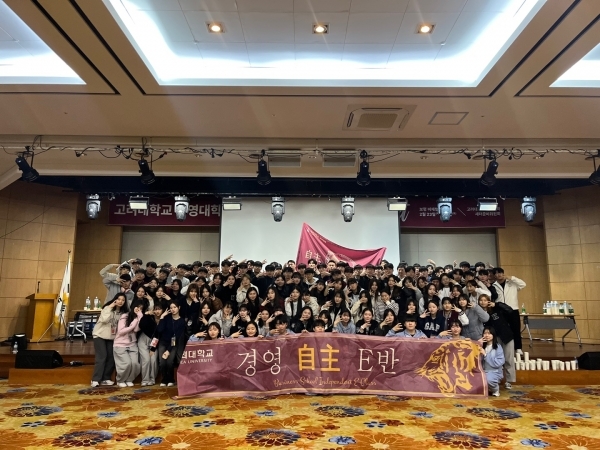
  The Powerful Leap of KUBS Baby Tigers… Welcome, class of 2023!   Last February was a busy month for KUBS, with events to welcome the incoming freshmen class for the 2023 academic year. Starting with the freshmen preview on Friday, February 3, KUBS held the Freshman orientation on February 23 to 25.       A total number of 360 freshmen entered KUBS for the 2023 academic year, consisting of 52.22 percent of male students and 47.78 percent of female students. On February 23 to 25, for two nights and three days, the KUBS emergency council held the 2023 Business School Freshmen Orientation (Freshmen OT) to help the freshmen quickly adjust to college and to instill a sense of pride and belonging as a member of the KUBS. Being the first in-person Freshmen OT in 4 years after the long COVID-19 crisis, the event provided a refreshing experience for not only the freshmen but also the current students. The event was especially significant because it transformed the subdued campus atmosphere, due to the pandemic, into being cheerful and lively.   In the 2023 Freshmen OT, attendants were first gathered in the KUBS LG-POSCO SUPEX hall for an overall introduction of the KUBS, then moved to Beache Palace in Boryeong, Chungcheongnam-do for the main program. Students had the time to experience the KU culture, enjoying the performance of Broaden, the KUBS dance club, U&I, the KUBS rock band, and recreational games. Furthermore, on the second day of the event, the students were divided into groups A, B, C, D, and E so that the students could get closer to one another.   “The Freshmen OT allowed students to learn the knowledge needed for school life as well as to socialize with KUBS classmates,” said Jeongwon Je, freshman participant of the 2023 OT. He shared “Through the cheering sessions, recreational activities, and more, we were able to establish the identity of Korea University."    The Freshmen pre-orientation was held on Friday, February 3, for students who were unable to attend the Freshmen OT, The Pre-OT allowed freshmen to socialize and acquire various information through programs such as school introduction, campus tour, club introduction, and more.   Meanwhile, Korea University held the 2023 entrance ceremony on Thursday, March 2 at the Hwajung Gymnasium. Approximately 7,000 people filled the Korea University Hwajung Gymnasium including freshmen from all departments, their parents, as well as freshmen from KUBS. Congratulating the newly admitted freshmen, the Korea University Acapella club LoGS presented a delightful show. Prior to the main ceremony, from 10 a.m., the Korea University Cheerleaders provided a time for the freshmen to experience the energetic and bold cheer moves unique to Korea University.    

2023.03.28 Views 3694

ESG Research Center holds ‘ESG Colloquium: Public Institutions and ESG Management Outlook for 2023”

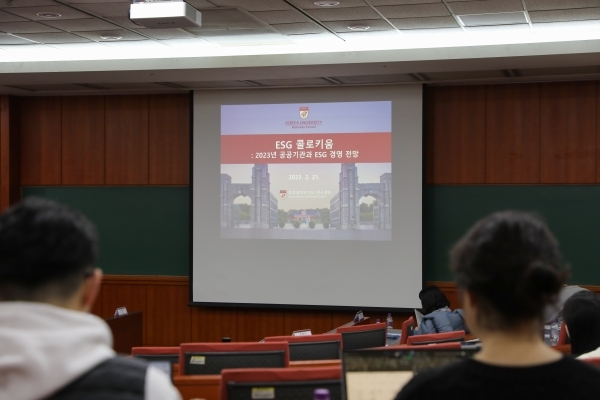
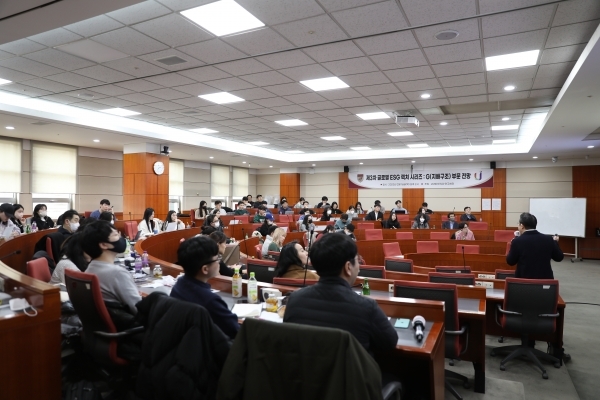
  ESG Research Center holds “ESG Colloquium: Public Institutions and ESG Management Outlook for 2023”   ESG should be applied to public institutions as well Discussion on ESG Management outlook for 2023       “ESG Colloquium: Public Institution and ESG Management Outlook for 2023”, hosted by KUBS ESG Research Center (Head= Professor Jaehyuk Lee) was held at Korea University LG-POSCO Hall on last 21st. The event was held to analyze the research results on ESG management in public institutions and to facilitate interdisciplinary research on ESG, as the importance of ESG management has been emphasized and required in public institutions as well. This event was followed by △Introduction to events and guests △ESG interdisciplinary research contest winner presentation △ Presentation and discussion on the outlook of the 2023 public institution management △ Presentation and a discussion on the necessity of ESG evaluation in a public institution.     In the first session “ESG interdisciplinary research contest winner presentation”, presentations were made by the winning teams (3 teams) of the “Public institution ESG management facilitation plan’ contest which was hosted by ESG Research Center in 2022. △ Let’s Try Team (Saerom Lee, Kijoon Jung, and Jeongjin Choi) on  ‘Analysis of ESG Management and support for SMEs on major public institutions’, △ ESG Wannabe Team (Yoojung Shin, Sieun Park, Bomi Lee, Junyoung Cheon, and Yujin Hyun) on ‘Promoting ESG in private companies of public institutions focusing on public procurement’ △ ESG KU TF Team (Junghyun Lee, Subin Seo, Suhyun Jo, Daeun Jung) on ‘Research on evaluation methods for ESG management for ESG management in public institutions focusing on energy institutions.’ Daeun Jung (Business’ 20) from the ESG KU TF team said “I was able to learn knowledge that had been ambiguous and the process of formulating strategies for the effective spread of ESG business”, and said “It was an honor to have this valuable experience of delivering the research results to related industry experts.     In the second session, ‘Presentation and discussion on the outlook of the 2023 public institution management were held. Professor Hyunsun Choi from Myongji University (former head of the Public Institution Management Evaluation Office at the Ministry of Economic and Finance) gave a presentation on ‘Direction of the ESG evaluation system and indicators for public institutions’ and raised concerns about the problem of 350 different public institutions using the same indicators to conduct management evaluations. In the panel discussion, Professor Yongjun Sung (Korea Univerisity Department of Psychology, former evaluation committee member of the public institution) and Jaehyuk Lee KUBS professor (Head of KU ESG Research Center) participated and pointed out that the monotonous management evaluation system of public institutions tends to focus on short-term performance. Professor Jaehyuk Lee said that “If management evaluation focuses on short-term evaluations, it may not be easy to expect public institutions to pursue voluntary innovation from a long-term perspective.”.    In the last third session, a presentation and panel discussion on the need for public institution ESG evaluation was held. Jeongyoon Park, the vice-director of the Institute for Culture and Community Research at Myongji University, gave a presentation on the ‘diagnosis of complementary directions for items for K-ESG guidelines for public institutions’. Vice-director Park diagnosed the current state of ESG practices in domestic public institutions and raised the need for establishing K-ESG guidelines specifically for public institutions. Professor Jaehyuk Lee and Yongsik Ok (President of the International ESG Association and professor of Environment and Ecological Engineering at Korea University) participated in the panel discussion. Professor Ok stated that “Environmental issues and governance issues are closely related.”, and ‘The interest and understanding of ESG-related committees in public institutions should be improved.”   During the closing remarks after the event, Professor Jaehyuk Lee pointed out the need for changes and innovation in public institutions to keep up with as the importance of stakeholders is being emphasized. He stated that “I hope that this colloquium today will serve as an opportunity to accelerate such changes.     

2023.03.28 Views 3770

General Graduate School hosts  ‘Best English Thesis Award Ceremony’

General Graduate School hosts  ‘Best English Thesis Award Ceremony’   Thesis selected through evaluation from 7 majors     “Best English Thesis Award Ceremony” hosted by the General Graduate School of Business Administration and International Business, was held on February 17th (Fri) in the Dean’s Office of Business Main Hall. KUBS Dean Sang Yong Kim, Associate Dean Woochan Kim, and 5 award winners attended the ceremony.   The best thesis was selected through rigorous evaluation by the selection committee after being recommended from six following majors: △Management △ International Management △Marketing △Accounting △LSOM △MIS. In this ceremony, no recommendations were made from the accounting major.     The total of 6 winners are the following: △Kisu Kim (MIS Master’s program) △Migeum Kim (LSOM Doctoral program) △ Joonhyuk Lee (Marketing Master’s program) △Sohee Im (International Management Doctoral program) △Jaehoon Jung (Finance Master’s program) △Yeseul Jo (Management Integrated Master’s and doctoral program), and no award winner from accounting major. Every winner will receive a plaque and a scholarship of 300,000 Won.   Dean Sang Yong Kim presented the plaques to the participants and congratulated the winners. He said, “The most essential competitiveness of KUBS comes from the research capabilities of the faculty along with master’s and doctoral students.”, and “We will encourage new researchers who achieve outstanding research results and invest in creating a better research environment.   

2023.03.28 Views 3656

“The interpretation and diagnosis of an AI model are a task for humans,” CDTB colloquium closing in

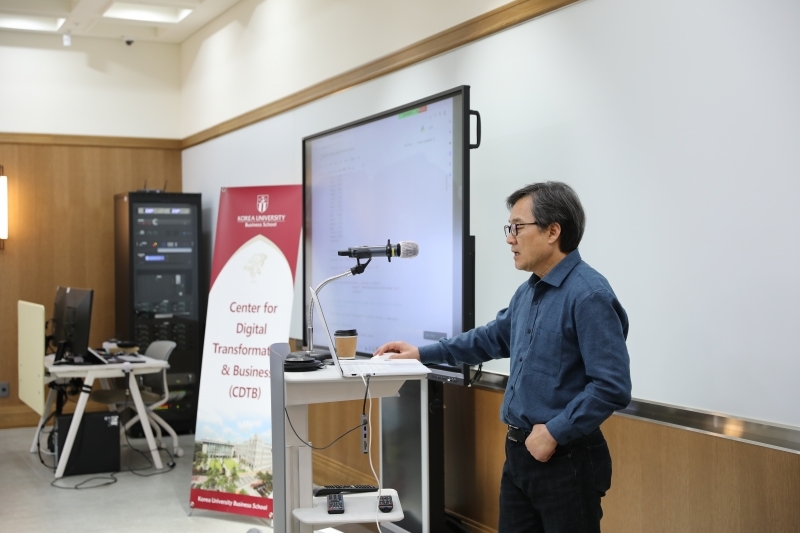
  “The interpretation and diagnosis of an AI model are a task for humans,” CDTB colloquium closing in success.   The ‘Explainable AI discussion’ proved. “Will bring an even greater impact than ChatGPT”   The Korea University Business school’s Center for Digital Transformation & Business (CDTB, director = Prof. Jae-hwan Kim) hosted a colloquium on the subject of “the explainability of AI models” at Korea University LG-POSCO hall, last Friday the 22nd. In the event, Professor Yu-sung Park from the Department of Statistics at Korea University was invited as an exclusive speaker. In his opening remarks, Professor Jae-hwan Kim’s shared greetings to to his gratitude to the students who attended this event despite their busy schedules.     He said that “There has been demand on the explainability of the AI-driven data, given the current situation in which we are early exposed to the significant role and action of AI,” hoping that “this serves as an opportunity to consider the utility this could provide to our research.” He added a word of encouragement for the students, saying “I believe this lecture would be a great help in developing a graduation thesis for the students who took the time to attend.”  The event took place both online and offline.  Under the main subject of “the explainability of AI models,” the colloquium aimed to discuss ways to create methods to explain an AI model based on the results generated by completed AI models. “Explianibity of AI models” refers to a series of processes and methodologies that allow human users to understand and trust the results and outputs of machine learning algorithms.     Beginning with an explanation of the concept of Libraries and the types of Explainers, the lecture was composed of a detailed explanation of the concept and types of specific libraries and Explainers, such as SHAP(Shapley Additive explainers), LIME(Local Interpretable Model-agnostic Explanations), Anchors, Counterfactual Explanations, and the proof of the underlying principles of the prediction process of the particular Libraries. Some of the most well-known Libraries were introduced in the lecture, such as ELI5, ALIBI, SHAP, LIME, for the open-source library that executes and visualizes the Explainer is currently in the development phase. Professor Yu-sung Park further helped the audiences’ understanding of the subject by explaining the underlying theories of each Library and providing the statistical proof data, conducted by himself, and detailed visual materials on the process. Professor Park stressed the meaning and importance of the topic, stating “While the prediction accuracy of ensemble learning or deep learning models consisting of numerous hidden layers are much better than that of traditional linear models, there are difficulties in explaining how it internally works to create the predictions… we must be able to intuitively understand the logic of these models and explain Al models on such basis.”    The lecture covered not only an academic proof of the Model but was followed by a proposal and discussion about the practical use cases of the model that has relevance with modern society. It also introduced a machine learning program that is useful to solve real-life cases such as health screenings and housing prices, for example, “what items of health screening could be improved to which degree in order to decrease the risk of cancer to below 5 percent,” along with its proof process.   At the end of the lecture, Professor Park repeatedly emphasized the implications of the explainablity of Ai models, noting that individual statistical data that AI cannot recognize can always exist. He claimed that “Therefore, it is the task of humans to diagnose the logical consistency of the AI model and propose solutions, regardless of the accuracy of the model itself.”        After the lecture, a discussion on how “explainable AI” can be meaningfully utilized mainly took place during the Q&A session with students. Concluding the lecture, Professor Park examined the prospects of the explainability of Ai models and its potential for development. Stating “the explainability of AI means that it can be used as a fundamental basis for hypotheses when companies hypothesize that certain factors of a product will affect sales,” he conveyed that “The explainability of AI provides fundamental evidence to support the usefulness of hypotheses by visualizing the impact of a single factor on the overall results.” Adding on, he expressed his optimism on the subject, predicting that “this provides a significant hint for the development of a new marketing theory and thus holds breakthrough potential enough to bring a greater impact than the recent issue of ChatGPT.”    

2023.03.28 Views 3701

“For sustainable development and transparent capital market” 2023 Global ESG Lecture Series Successf

  “For sustainable development and transparent capital market” 2023 Global ESG Lecture Series Successfully Finished   Scholars on domestic ESG gathered around to analyze and discuss urgent problems in corporate and industry.   ‘2023 Global ESG Lecture Series for the prospect of ESG management’ hosted by KUBS ESG Research Center (Head= Jaehyuk Lee) was successfully held in the LG-POSCO building on the following 3 days: 2nd, 9th, and 16th of this month. The lecture invited great scholars in each ESG field to share the main agendas regarding ESG of domestic enterprises and industries this year, and discuss action plans that academic and industrial fields can respond. Each session consisted of lectures on each component of ESG: ∆ Environmental ∆ Social ∆ Governance. In this lecture, professor Yongsik Ok from the Department of Environmental Science and Ecological Engineering who is currently president of the International ESG Association, Enkyung Lee UNGC (=UN Global Compact) Network Korea Chief and KUBS professor Woochan Kim gave lectures on each component of ESG management to all Korea University members. Each lecture introduced basic concepts and the latest research trend of ESG and analyzed key issues with prospects on ESG management. Also, the lecture aimed to educate ESG experts and improve their interest and understanding of ESG management among KU members.       On the 2nd, the series began with a lecture from Department of Environmental Science and Ecological Engineering professor Yongsik Ok on the prospect of E(environment) among ESG. With 76 participants, professor Ok introduced the concept of Net Zero, climate change, RE100, carbon neutrality, circular economy, and biodiversity. Also, he focused on the sustainability of business and understanding relationships of initiative, then assessed ESG report from a company along with finding improvement. Especially, he emphasized the importance of ‘sustainable spending’ in the post-COVID era and discussed the importance of eco-friendly, ethical values with the value of the green business. One student said “The lecture was of high quality and I liked the content of the presentation.”, and “QnA session after the lecture was a great help too.”    On the 9th, Enkyung Lee UNGC Network Korea Chief gave a lecture on prospects and responses to S (society). With 61 participants, Chief Lee mentioned  ∆ Reinforcing responses on regulation and announcements  ∆ Reinforcing ESG data management ∆ Staff Internalization, ESG company culture, and introducing UNGC activities. Especially she describes Sustainable Development Goals (SDGs) are all directly and indirectly reflect international human rights law and 92% out of 169 specific goals are related to key international human rights and labor standards. She also emphasized that companies should work on practical efforts to respect human rights and its legislation. Students showed satisfaction with the lecture through a survey after the lecture series. One student said, “I was interested in the UN and it was a meaningful time to learn something more deeply and apply it to the real world”.    On the last day 16th, KUBS professor Woochan Kim gave a lecture on the prospect of G (governance) among ESG. With 72 participants, professor Kim introduced the concept of enterprise governance, shareholder activism, inside a trading notification, mandatory tender offers, and cases on real companies. Based on that, professor Kim debated on insight for transparency, fair governance of a company, and ways to restore the trust of capital markets. After the lecture, students said “It was easy to understand and absorbing lecture.”, “We found it interesting with lots of real cases and hope these lectures also open on a regular basis.                                 Professor Yongsik Yong is a researcher in 3 fields including environmental ecology, engineering, biology & biochemical (HCR), and has been chosen to 2022 32 Most influential scientists in the world. Professor Ok published 107 highly cited articles, marking the record for Korean researchers. 95% of his articles are the product of international cooperation research programs and 91.4% of them have been chosen as the top 10% of articles in each field of study. Also, professor Ok and center head Jaehyeok Lee started the first forum with Nature that deals with ESG and global sustainability in August 2022.     Enkyung Lee UNGC Network Korea Chief who lectured on S (Society) had been appointed to the Ministry of Environment K-SDGs index work group researcher in 2018 and 2020. She also worked as ESG and gender diversity consultant for the Ministry of Gender Equality and Family, a member of the industry policy research sustainability subcommittee for the Ministry of Industry, a company, and human rights consultant for the Ministry of Justice, a member of Anti-Corruption & Civil Rights Commission council of public-private partnerships for integrity Economics subcommittee. Also, she continues her active writing including   ⌜Social Responsibility for UN and Company⌟, ⌜The World is My Mentor⌟.    Professor Woochan Kim who gave a lecture on G (governance) is a KUBS professor and at the same time ECGI (European Corporate Governance Institute) member studying research activities on corporation law and financial management. Professor Kim showed an empirical study on the economic effect of corporate governance innovation for the last 20 years using Korean corporate data. For his contribution to domestic corporate governance innovation, he won the grand prize in 2022 Korea Corporate Governance in the academic sector. 

2023.03.28 Views 3891

  • 첫페이지로
  • 66
  • 67
  • 68
  • 69
  • 70
  • 마지막페이지로