TOP

KUBS News

Total 1417

[Entrepreneurship Academy Lecture On-Demand] “Coding Now Done by ‘Vibe’”

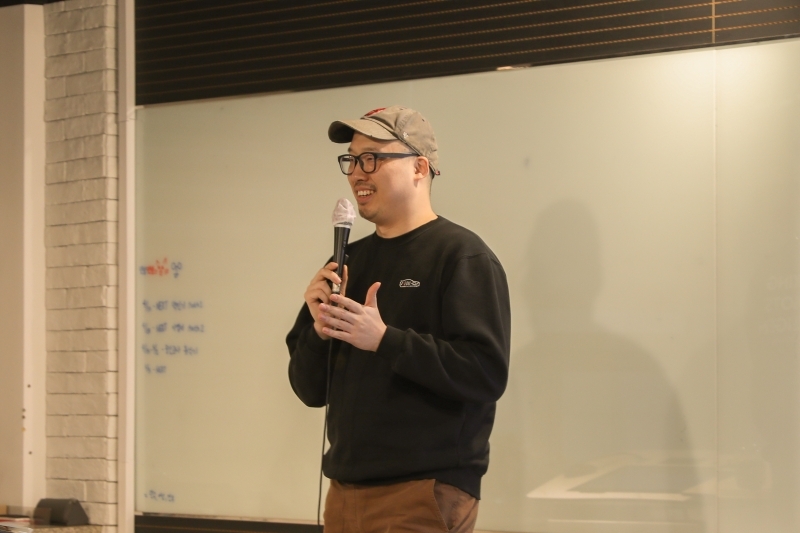
“Coding Now Done by ‘Vibe’”... Special Lecture on AX-Based Startup Insights   On March 17, the Entrepreneurship Academy Lecture On-Demand was held, hosted by Korea University Startup Institute. The session featured Malacca, an AX strategist and AX builder, who delivered a hands-on lecture titled “Vibe Coding Practice: From Planning to MVP Deployment (Gemini & Firebase),” combining AI-based development methods with real-world startup experience.    The lecture drew strong interest from students and was held across two classrooms in the Hyundai Motor Hall. Approximately 170 participants attended, reaching maximum capacity. Although each classroom accommodates around 100 people, attendance exceeded seating capacity, with even stair areas being utilized. To accommodate all participants, a live Zoom broadcast was conducted simultaneously, allowing students to join from both classrooms.      Participants were highly engaged in the hands-on session, following along with coding exercises during the lecture. Students had the opportunity to build simple programs in real time, gaining practical experience with AI-based development processes.    During the lecture, AI-based processes were introduced, emphasizing that AI is not merely a tool but a key driver of AX (AI Transformation), transforming corporate workflows and organizational culture. While highlighting the high productivity of AI “vibe coding,” Malacca also noted the need for safeguards such as “context engineering” and “harness” to address the challenges of maintaining complex systems. He further emphasized that the essence of entrepreneurship lies not in technology-driven thinking, but in validating hypotheses through customer interviews. He advised that “starting quickly, failing, and learning fosters a virtuous cycle of growth driven by execution.”      During the session, Malacca utilized “Jjap Slack,” a tool he personally developed using vibe coding, to facilitate real-time interaction through live comments, enabling participants to ask questions and receive feedback instantly. The session was particularly meaningful in that it was conducted using the same harness template provided to students, allowing them to work with programs at a level applicable to real-world practice.    This “Entrepreneurship Academy Lecture On-Demand 1” highlighted both the evolving role of developers in the AX era and the practical capabilities required for entrepreneurship, offering students integrated insights that bridge technology and business perspectives. The Korea University Startup Institute plans to continue expanding hands-on, practice-oriented startup education programs. 

2026.04.14 Views 13

“The interpretation and diagnosis of an AI model are a task for humans,” CDTB colloquium closing in

  “The interpretation and diagnosis of an AI model are a task for humans,” CDTB colloquium closing in success.   The ‘Explainable AI discussion’ proved. “Will bring an even greater impact than ChatGPT”   The Korea University Business school’s Center for Digital Transformation & Business (CDTB, director = Prof. Jae-hwan Kim) hosted a colloquium on the subject of “the explainability of AI models” at Korea University LG-POSCO hall, last Friday the 22nd. In the event, Professor Yu-sung Park from the Department of Statistics at Korea University was invited as an exclusive speaker. In his opening remarks, Professor Jae-hwan Kim’s shared greetings to to his gratitude to the students who attended this event despite their busy schedules.     He said that “There has been demand on the explainability of the AI-driven data, given the current situation in which we are early exposed to the significant role and action of AI,” hoping that “this serves as an opportunity to consider the utility this could provide to our research.” He added a word of encouragement for the students, saying “I believe this lecture would be a great help in developing a graduation thesis for the students who took the time to attend.”  The event took place both online and offline.  Under the main subject of “the explainability of AI models,” the colloquium aimed to discuss ways to create methods to explain an AI model based on the results generated by completed AI models. “Explianibity of AI models” refers to a series of processes and methodologies that allow human users to understand and trust the results and outputs of machine learning algorithms.     Beginning with an explanation of the concept of Libraries and the types of Explainers, the lecture was composed of a detailed explanation of the concept and types of specific libraries and Explainers, such as SHAP(Shapley Additive explainers), LIME(Local Interpretable Model-agnostic Explanations), Anchors, Counterfactual Explanations, and the proof of the underlying principles of the prediction process of the particular Libraries. Some of the most well-known Libraries were introduced in the lecture, such as ELI5, ALIBI, SHAP, LIME, for the open-source library that executes and visualizes the Explainer is currently in the development phase. Professor Yu-sung Park further helped the audiences’ understanding of the subject by explaining the underlying theories of each Library and providing the statistical proof data, conducted by himself, and detailed visual materials on the process. Professor Park stressed the meaning and importance of the topic, stating “While the prediction accuracy of ensemble learning or deep learning models consisting of numerous hidden layers are much better than that of traditional linear models, there are difficulties in explaining how it internally works to create the predictions… we must be able to intuitively understand the logic of these models and explain Al models on such basis.”    The lecture covered not only an academic proof of the Model but was followed by a proposal and discussion about the practical use cases of the model that has relevance with modern society. It also introduced a machine learning program that is useful to solve real-life cases such as health screenings and housing prices, for example, “what items of health screening could be improved to which degree in order to decrease the risk of cancer to below 5 percent,” along with its proof process.   At the end of the lecture, Professor Park repeatedly emphasized the implications of the explainablity of Ai models, noting that individual statistical data that AI cannot recognize can always exist. He claimed that “Therefore, it is the task of humans to diagnose the logical consistency of the AI model and propose solutions, regardless of the accuracy of the model itself.”        After the lecture, a discussion on how “explainable AI” can be meaningfully utilized mainly took place during the Q&A session with students. Concluding the lecture, Professor Park examined the prospects of the explainability of Ai models and its potential for development. Stating “the explainability of AI means that it can be used as a fundamental basis for hypotheses when companies hypothesize that certain factors of a product will affect sales,” he conveyed that “The explainability of AI provides fundamental evidence to support the usefulness of hypotheses by visualizing the impact of a single factor on the overall results.” Adding on, he expressed his optimism on the subject, predicting that “this provides a significant hint for the development of a new marketing theory and thus holds breakthrough potential enough to bring a greater impact than the recent issue of ChatGPT.”    

2023.03.28 Views 2887

“For sustainable development and transparent capital market” 2023 Global ESG Lecture Series Successf

  “For sustainable development and transparent capital market” 2023 Global ESG Lecture Series Successfully Finished   Scholars on domestic ESG gathered around to analyze and discuss urgent problems in corporate and industry.   ‘2023 Global ESG Lecture Series for the prospect of ESG management’ hosted by KUBS ESG Research Center (Head= Jaehyuk Lee) was successfully held in the LG-POSCO building on the following 3 days: 2nd, 9th, and 16th of this month. The lecture invited great scholars in each ESG field to share the main agendas regarding ESG of domestic enterprises and industries this year, and discuss action plans that academic and industrial fields can respond. Each session consisted of lectures on each component of ESG: ∆ Environmental ∆ Social ∆ Governance. In this lecture, professor Yongsik Ok from the Department of Environmental Science and Ecological Engineering who is currently president of the International ESG Association, Enkyung Lee UNGC (=UN Global Compact) Network Korea Chief and KUBS professor Woochan Kim gave lectures on each component of ESG management to all Korea University members. Each lecture introduced basic concepts and the latest research trend of ESG and analyzed key issues with prospects on ESG management. Also, the lecture aimed to educate ESG experts and improve their interest and understanding of ESG management among KU members.       On the 2nd, the series began with a lecture from Department of Environmental Science and Ecological Engineering professor Yongsik Ok on the prospect of E(environment) among ESG. With 76 participants, professor Ok introduced the concept of Net Zero, climate change, RE100, carbon neutrality, circular economy, and biodiversity. Also, he focused on the sustainability of business and understanding relationships of initiative, then assessed ESG report from a company along with finding improvement. Especially, he emphasized the importance of ‘sustainable spending’ in the post-COVID era and discussed the importance of eco-friendly, ethical values with the value of the green business. One student said “The lecture was of high quality and I liked the content of the presentation.”, and “QnA session after the lecture was a great help too.”    On the 9th, Enkyung Lee UNGC Network Korea Chief gave a lecture on prospects and responses to S (society). With 61 participants, Chief Lee mentioned  ∆ Reinforcing responses on regulation and announcements  ∆ Reinforcing ESG data management ∆ Staff Internalization, ESG company culture, and introducing UNGC activities. Especially she describes Sustainable Development Goals (SDGs) are all directly and indirectly reflect international human rights law and 92% out of 169 specific goals are related to key international human rights and labor standards. She also emphasized that companies should work on practical efforts to respect human rights and its legislation. Students showed satisfaction with the lecture through a survey after the lecture series. One student said, “I was interested in the UN and it was a meaningful time to learn something more deeply and apply it to the real world”.    On the last day 16th, KUBS professor Woochan Kim gave a lecture on the prospect of G (governance) among ESG. With 72 participants, professor Kim introduced the concept of enterprise governance, shareholder activism, inside a trading notification, mandatory tender offers, and cases on real companies. Based on that, professor Kim debated on insight for transparency, fair governance of a company, and ways to restore the trust of capital markets. After the lecture, students said “It was easy to understand and absorbing lecture.”, “We found it interesting with lots of real cases and hope these lectures also open on a regular basis.                                 Professor Yongsik Yong is a researcher in 3 fields including environmental ecology, engineering, biology & biochemical (HCR), and has been chosen to 2022 32 Most influential scientists in the world. Professor Ok published 107 highly cited articles, marking the record for Korean researchers. 95% of his articles are the product of international cooperation research programs and 91.4% of them have been chosen as the top 10% of articles in each field of study. Also, professor Ok and center head Jaehyeok Lee started the first forum with Nature that deals with ESG and global sustainability in August 2022.     Enkyung Lee UNGC Network Korea Chief who lectured on S (Society) had been appointed to the Ministry of Environment K-SDGs index work group researcher in 2018 and 2020. She also worked as ESG and gender diversity consultant for the Ministry of Gender Equality and Family, a member of the industry policy research sustainability subcommittee for the Ministry of Industry, a company, and human rights consultant for the Ministry of Justice, a member of Anti-Corruption & Civil Rights Commission council of public-private partnerships for integrity Economics subcommittee. Also, she continues her active writing including   ⌜Social Responsibility for UN and Company⌟, ⌜The World is My Mentor⌟.    Professor Woochan Kim who gave a lecture on G (governance) is a KUBS professor and at the same time ECGI (European Corporate Governance Institute) member studying research activities on corporation law and financial management. Professor Kim showed an empirical study on the economic effect of corporate governance innovation for the last 20 years using Korean corporate data. For his contribution to domestic corporate governance innovation, he won the grand prize in 2022 Korea Corporate Governance in the academic sector. 

2023.03.28 Views 3093

Takeoff to the wider world… KUBS 116th Graduation Ceremony Held

Takeoff to the wider world…  KUBS 116th Graduation Ceremony Held   KUBS 116th Graduation Ceremony was held on February 24th (Fri) in Korea University Inchon Memorial Hall. KUBS faculty members including Dean Sangyong Kim participated in this event. The main characters in the ceremony, KUBS graduates gathered in Inchon Memorial Hall and took the first step as global leaders.     KUBS Dean Sangyong Kim said in his speech “I would like to pay my best compliment to graduates who concentrated on their studies despite many hardships due to the COVID-19 pandemic.” Also, he said “I hope you be a leader who contributes to social minorities and community based on knowledge learned here in KUBS”   The ceremony was followed by a congratulatory speech from an alumnus, the Head of the Korea Franchise Association Hyunsik Jung, and a valedictory speech from graduate representative Dongkyu Jung (Business 18’). Mr. Jung said in his valedictory speech, “I was able to learn the great power of ‘together’ in KUBS.”, and “I hope all graduates achieve their dream with happiness in the future.”     ▶  Valedictory speech from graduate representative Dongkyu Jung (Business 18’)   The ceremony was followed by awarding of outstanding graduates. KU Dean Award was given to  △ Undergraduate Dongkyu Jung △ Korea MBA Seungmin Shin. And KUBS Dean Award was given to △Executive MBA Seokyong Yang △ Korea MBA Hana Yang △ Finance MBA Yoosang Do   And the diploma was given to all graduates by KUBS Dean Sangyong Kim himself. The ceremony ended after the graduation congratulatory ceremony graduates threw graduation caps together and singing the school song. This year, degrees were given to the following number of students △  Bachelor’s degree 423 △ Master’s 85  △ Ph. D. 13, and  △ MBA 269.

2023.03.28 Views 2592

‘Takeoff to become a global entrepreneur’…The 1st class of Unicorn Express finished successfully…

‘Takeoff to become a global entrepreneur’…The 1st class of Unicorn Express finished successfully…   The 1st class of ‘Unicorn Express’ hosted by Korea University Business School (Dean=Sangyong Kim) Startup Station (Head=Hojung Shin) and supervised by Korea University LINC3.0 Enterprise organization (Manager= Kwanyoung Lee) finished successfully with many accomplishments.     Unicorn Express, which opened for the first time this year, was designed to support the global capabilities of KU startups and those going overseas. The program also aimed to teach global entrepreneurship to outstanding pre-entrepreneurs (undergraduates) as part of the ‘Leaders in Industry-university Cooperation Part 3 (LINC 3.0)’ program. Also, it had a mentoring program to educate entrepreneurs by pairing 10 startups to 10 pre-entrepreneurs (undergraduates) one by one. 10 startups that participated in the 1st class of Unicorn Express were selected by early startups from KUBS Startup Station and Anam Campus Town. The selected startups went through systematic education through mock global IR (investor relations). Also, pre-entrepreneurs were selected through fierce startup competitions, indicating that 41 teams participated in the preliminary rounds. The program then selected 10 undergraduates among the 12 teams which made it to the final rounds. These pre-entrepreneurs were paired with selected companies to learn startup know-how in the field. Also, they visited the United States from the 6th to the 11th of January to strengthen global startup capabilities along with participating in lectures from Silicon Valley entrepreneurs and Startup Summit programs.     On the first two days, the 1st class of Unicorn Express went through expert mentoring like English speech and peer group mentoring based on their mock IR experience. On Day 3, they visited Silicon Valley known as the heart of US startups for entrepreneurship lectures from global enterprises like Apple, Google, and HP.   On Day 4, they participated in the ’82 Startup Summit’ event. 82 Startup is a meeting for Korean entrepreneurs and investors in the United States or aiming to enter the US market. 82 Startup Summit is the biggest event for Korean entrepreneurs can get lectures from global startup founders and investors along with building a network with them. In this 82 Startup Summit, NC Soft CEO SongEi Yoon, SendBird CEO Dongshin Kim, and ZEPETO CEO Jay Lee joined as lecturers to discover the future industry of the global market and insight into the new market area.     On Day 5, the class invited VC(Venture Captial) and CVC(corporate venture capital) experts from Silicon Valley to hold a special lecture. The lecturer is ‘Mitchell Weinstock’ from ‘HP Tech Ventures’, which is a CVC under the global IT enterprise HP and gave a lecture on the theme of ‘Strategic Investing working with Corporate Venture Capital’.     On the last Day 6, the class went through investment and feedback on examples of success and failure, market entering strategy, and implications of global enterprises with a similar business model. The first class of Unicorn Express was able to strengthen their global startup capabilities through activities like global venture capital and accelerator expert lectures, building networks with global enterprises, and research on the global leading model. Pre-entrepreneur Heecheol Jung (Business 20’) who participated in this class of Unicorn Express said “It was a meaningful experience for me to visit Silicon Valley with a dream of starting a global startup as a KUBS student.” Also, he said “It was impressive to get real advice from the lectures in the startup session including ’82 Startup’.     KUBS Startup Station will keep working on joint business so that pre-entrepreneurs and oversea venture investors and oversea mentors can exchange-cooperate with each other all the time. In addition, the Unicorn Express class will also be hosted every year.

2023.03.28 Views 2826

 “You are now proud KU Alumni!” KUBS 2nd Class of ESG-AMP and 94th Class of AMP Completion Ceremony

 “You are now proud KU Alumni!” KUBS 2nd Class of ESG-AMP and 94th Class of AMP Completion Ceremony Successfully Held   The completion ceremony of the 94th Class of Korea University Business School (Dean=Sangyong Kim) Advanced Management Program (hereinbelow AMP) and the 2nd Class of ESG-AMP was held. From that day, 41 students from the 94th Class of AMP and 20 students from the 2nd Class of ESG-AMP successfully finished their studies and became KU alumni.     The completion ceremony of the 2nd ESG-AMP Class was held at 4 PM on Feburary 15th (Wed) at the SUPEX Hall of the LG-POSCO Building. KUBS Dean Sangyong Kim, Associate Dean Janghyuk Lee, Center head Bokyung Bae, Head Professor Jungbin Moon, and Alumni Association president of the 1st ESG-AMP Jongsu Han and Vice President Minae Kim attended the ceremony while the ceremony started with an address from KUBS Dean Sangyong Kim. He said “Congratulations on completing the course with your passion in a busy schedule”, and “I’ll try my best to make KUBS become your pride.”. Center Head Bokyung Bae cheered the students by saying “Although ESG values like environment, society, and governance may seem not realistic right now, you did a very important study from a broad perspective.” In the congratulatory address. Head Professor Jungbin Moon said “I was able to feel the high passion of the class while doing ESG-AMP together.”, and “ I hope we stay in touch with your long-lasting passion.” The ceremony was followed by a congratulatory address from the Alumni Association president of the 1st ESG-AMP, Jungsu Han, and a valedictory address from the Alumni Association president of the 2nd class Youngjun Joo. President Han congratulated the students by saying “There were many moments that ‘It’s good that I learned this” in my daily life after graduating ESG-AMP.” President Joo said “It’s my honor to be here representing 20 of the 2nd Class” and “I would like to appreciate all the effort of KUBS members including colleagues and the faculty. Certificate of completion was given to President Youngjun Joo as a representative, and the award was given to △ Dean Award: Youngjun Joo △Achievement award: Dongrok Kim, Miok Yang, Jonghun Lee △ Exemplary Award: Kyungja Oh, Shinhee Hwang △ Excellence Award: Yongsik Cho △ Grand Award: 5 including Jihyeon Kang.  The award for group projects: Liberty, Justice, Veritas Awards were given to each Group 2, 3, 1. The event ended after Alumni Scholarship Delivery Ceremony, singing the school song, and the completion ceremony.    Also, the completion ceremony of the 94th Class of AMP was held at 4 PM on February 20th (Mon) at the SUPEX Hall of the LG-POSCO Building. Prior to the ceremony, students shared their memories by watching the video showing activities of the last 6 months. Many guests participated in the ceremony including KUBS Dean Sangyong Kim, AMP Head Professor Bokyung Bae, AMP Alumni Association President Dongseok Lee, and many AMP Alumni executives. Dean Sangyong Kim congratulated the students in his speech by saying “I hope you become a leader spreading a good influence on society.” President Dongseok Lee, who graduated from the 55th Class of AMP, said “I am looking forward to your active participation in the Alumni Association activities with KU spirit of Liberty, Justice, and Veritas.” Also, he said, “I will continue the reputation of the best AMP with you together.” Head Professor Bokyung Bae who is finishing her 4 years AMP head professor career until this 94th Class of AMP started her address by saying “Today is a historical day.”. She said “It was my honor to spend my last school career in my alma mater, and I was always nervous and learned a lot thanks to the passionate 94th Class of AMP.”, and added, “I believe in you and at the same time I will try my best to be your proud head professor.”   Alumni President of the 94th Class Sungkwi Jung said in his valedictory address, “I had a very special experience on the AMP”, and “Let’s make the future values of global business by sharing our experience and knowledge even after graduation.”. The ceremony was followed by awarding Certificate of Completion and awards. The certificate was given to Yoonkyu Choi as a representative, and the award was given to △ Dean Award: Sungkwi Jung, △Achievement Award: 12 with Junsik Ahn △Exemplary Award: 9 with Moonseok Kim △ Excellence Award: 8 with Kwangno Park △ Grand Award: 7 with Jiyoung Kang △ Class Award: Class 3. The Alumni Achievement plaque was awarded by Alumni President Sungkwi Jung and Secretary General Saeyoung Jung. After that, AMP Alumni Secretary General Yongwu Kim explained about AMP Alumni and was followed by joining the Alumni, delivering the Alumni flag and scholarship fund. The completion ceremony of the 94th Class of AMP ended after all sang the school song and throwing their graduation caps.

2023.03.28 Views 2601

Korea University 21st President Dr. Dongwon Kim  Inauguration Ceremony Held 

Korea University 21st President Dr. Dongwon Kim  Inauguration Ceremony Held            - Teach students with a problem-solving curriculum with the principle of convergence - Diversification of knowledge production and delivery agents - Expansion of the beneficiary of knowledge benefits and revolutionary improvement of the knowledge delivery method - Completing the 120th-anniversary project in 2025is the most important mission     The Korea University Foundation held the inauguration ceremony for Dr. Dongwon Kim, the 21st president of Korea University at 11 AM on February 28th in Korea Univeristy Inchon Memorial Hall. Dr. Dongwon Kim (Business’ 78) obtained a bachelor’s degree in KUBS and a master’s and Ph.D. in labor relations from the Univeristy of Wisconsin, United States. Since then, he has devoted himself to research and mentoring for 26 years as a professor at Korea University. He has also held various positions at the university including the head of the Office of General Affairs, head of the Office of Planning & Budget, Dean of the Graduate School of Labor Studies, Dean of Business School, and Dean of the Graduate School of Business Administration. Also, he has been active in various organizations including the president of the International Labor and Employment Relations Association, vice chairman of the Association of KU Economic Scholars, government-related agent, and external director for a large corporation.      Jaeho Kim, the chairman of the Korea University Foundation said “President Dongwon Kim has proposed strategies to promote finance, education, research, and administration to overcome the crisis in front of us and make a quantum leap toward the future. It is most important to implement these crisis management strategies together.” He continued “We have to shake off the helplessness that has permeated us since the Pandemic. We do not have time to hesitate. Above all, we must devote ourselves fully to educating the main players of the future industrial revolution such as AI, big data, robotics, and blockchain. Universities have a mission to educate new talent with creativity and innovation for the future of Korea. Therefore, talents for the 21st century cannot be made with 19th and 20th-century educational methods. As President Kim emphasized, education should now shift from the supplier-centered to the demand-centered approach. The reforming process for creative and integrated education may be painful, but education will die if we fail to achieve this.” He added to the new president and KU members by saying, “Reform cannot be made only with the president himself so all members must cooperate and be together. Please follow the leadership and give full support to our new president”.     Dr. Dongwon Kim, the newly appointed 21st president of KU said in his inauguration speech “Through its history, Korea Univeristy has already contributed to society as an entity that solves many national problems. Now, Korea University is facing a new challenge toward the great honor to become a university that contributes to the future of humanity beyond the national society.  As the 21st president, I hope that Korea University will reflect on its original mission and role, achieve a university revolution that overcomes the current crisis, and open a new Renaissance era for the university. We KU will lead the way and pioneer that path. He also emphasized three directions in which KU should move forward.    Firstly, he said, “We will drastically change the content of the knowledge produced and transmitted by universities. Only through openness and convergence can we provide solutions to complex social problems. We will therefore reorganize the production and flow of knowledge based on the principles of convergence and teach future generations through a problem-solving curriculum. Secondly, “We will further diversify the producers and transmitters of knowledge reflecting the increasing complexity and social diversity. The future university should foster fundamental and pure academic studies to seek the veritas of the university’s essence, while at the same time producing practical experts who can be immediately deployed in industry and society. Universities, industries, and society should work together to contribute to national development and global competitiveness. The world is rapidly integrating and we have experienced that no pandemic or trade barrier can block the irresistible wave of globalization. We will actively recruit world-class scholars as professors to create and spread knowledge that transcends national boundaries and select more outstanding foreign students of more diverse nationalities to teach them as global leaders.     Finally, he mentions expanding the target for knowledge beneficiaries and improving methods of knowledge dissemination saying that “In order to respond to the rapidly changing economic and social environment, we will develop and operate generation-specific educational programs that each age group needs, especially for educational demands of middle-aged people in an aging society. We will open degree and non-degree courses that are useful for career transition or startup and promote social contribution programs in the form of talent donations for social minorities and small businesses according to each department and college. Also, he proposed the blueprint saying “The outbreak and progression of COVID-19 has brought about a revolution in knowledge delivery methods, extreme counterpoints between the limitations of face-to-face education and the possibilities of online education. KU will make every effort to maximize the target and effectiveness of knowledge delivery by using new educational methods and advanced technology as much as possible. We will build an innovative metaverse platform to operate degree programs, micro degrees, and non-degree programs so that Korean language users from all countries and regions around the world can share the benefits of KU’s knowledge content.     ▶ Full text on inauguration speech (Click to see)   New president Dongwon Kim said “Along with the successful execution of this vision, the key task to be completed during my term is the 120th-anniversary project of KU founding. I hope to make this 120th anniversary a leap for Korea University to the world’s most prestigious university by gathering the strength of all its members. Based on the principle of ‘Strong KU’, I will resolve the long-awaited projects of each campus and department, and upgrade research and educational infrastructure. I will succeed and take this 120th-anniversary commemorative project as the most precious mission of my life which is to start a new 120 years towards the future of humanity beyond 120 years of history.   Myungho Seung, the president of the Korea University Alumni Association, said “As well as being a respected scholar, he has achieved many successes with rich experience and expertise in university administration and an innovative mind and bold driving force. It makes us have high expectations for our university’s bright future. President Dongwon Kim who has studied the system of ‘university’ more deeply than anyone else, is expected to present a long-term vision for the future of the country and humanity based on deep insights into the direction and fundamental values that universities should pursue in the future. He added “His emphasis on ‘service leadership’ with an attitude to respect and listen to others shows a model of the leader needed in this era. Efficient administration which breaks away from authoritarianism and old practices will be the basis to become the ‘Stong KU’. It is very delightful and honorable to have an excellent president with diverse capabilities as our university is growing as a global prestigious university and preparing for a new leap at a very important time.”  At the event, the Chairman of the Korea University Foundation Jaeho Kim, president of the Korea University Alumni Association Myungho Seung, former presidents Yoondae Eo, Pilsang Lee, Kisoo Lee, Byungcheol Kim, Jaeho Yeom and Jintaek Jung, Senior Secretary for Social Affairs Seunggyu Kang attended. Congratulatory videos from the president of Waseda Univeristy Tanaka Aiji, president of the University of Wisconsin Jennifer L. Mnookin, president of Yonsei Univeristy Seunghwan Seo, president of KAIST Kwanghyung Lee and president of POSTECH Moohwan Kim followed.

2023.03.28 Views 3257

  • 첫페이지로
  • 66
  • 67
  • 68
  • 69
  • 70
  • 마지막페이지로