TOP

KUBS News

Total 1417

‘KUBS 120 MARCH’ Campaign Nears 40% of Goal … Total Pledges Reach Approx. KRW 4.6 Billion

‘KUBS 120 MARCH’ Campaign Nears 40% of Goal … Total Pledges Reach Approx. KRW 4.6 Billion Three major large-scale pledges secured within four months of launch … Campaign continues through May 31     Korea University Business School’s KRW 12 billion fundraising campaign, “KUBS 120 MARCH,” has secured approximately KRW 4.6 billion in pledged donations within just four months of its launch, nearing 40% of its goal.   Since the campaign’s launch in January, when pledged donations stood at around KRW 2 billion, the total has more than doubled in just three months. From December 1, 2025, to March 29, 2026, total pledges reached KRW 4,652,317,231, with 324 participants, including corporations, alumni, faculty, staff, and students.       | Three major pledges secured … Alumni and corporations join forces    One of the most notable achievements is the securing of three major pledges. An anonymous donor pledged support for the research fund, Eugene Investment & Securities Co., Ltd. for the development fund, and Samyang Tongsang for scholarships. Alumni account for approximately 62% of total pledges, while corporations represent about 35%, jointly driving the campaign forward.   Group donations have also continued. Following the participation of the Class of ’81 alumni association, the Business School Class of ’79 Scholarship Committee (28 members), the KUBS Class of ’98 Alumni Night (126 participants), as well as faculty and staff, have also joined the campaign.      | Expanding participation across classes, generations, and professions    The donor base is highly diverse. Participation spans from alumni who entered in the 1970s to current students from the Class of ’26, as well as members of EMBA, DBA, and AMP programs, undergraduate alumni, and even alumni from the College of Medicine. From individual research labs and faculty bands to student councils, all corners of the Business School are actively engaging with the campaign, further broadening its base of participation.   This campaign is particularly meaningful in that it places value not only on the total amount raised but also on participation itself. From small contributions starting at KRW 10,000 to major gifts reaching KRW 1 billion, every act of giving becomes part of the shared legacy of KUBS’s 120-year history.    | Investing in the future campus… Advancing the 3C Trading Zone and 4Tech strategy    The funds raised are being used to realize the Business School’s future vision. Alongside the advancement of the “4Tech Strategy,” centered on AI, semiconductors, energy, and robotics, spatial innovation projects are also taking shape.   The Business School is already operating AI-focused tracks and 4Tech micro-degree programs, and continues to expand its educational and research capabilities with its largest-ever full-time faculty body of 95 members.   On the basement level of Hyundai Motor Hall, the “3C Trading Zone (tentative name)” is currently under development, with a trading demo day scheduled for early May. The space will also include an Art & Culture Room. Artist Uhm Jung-soon’s installation piece, K, the Noseless Elephant, has already been installed in the building.   Construction has also begun on an LED display in the lobby of LG-POSCO Hall, which will serve as a large-scale digital donor wall. An opening ceremony is scheduled following the conclusion of the campaign in May.   Dean Eonsoo Kim stated, “We have come this far thanks to the collective support of each and every member,” adding, “We hope more people will join us on this journey as we prepare for the next 120 years of the Business School.”   The “KUBS 120 MARCH” campaign will continue through May 31, 2026. Donations can be made via the official sponsorship page (box.donus.org/box/koreauniversity/KUBS120march).   As of December 1, 2025 – March 29, 2026 | Total pledged amount: KRW 4,652,317,231

2026.04.17 Views 445

`2023 Startup Express Summer Season` Concludes Successfully, Paving the Way for a Better World

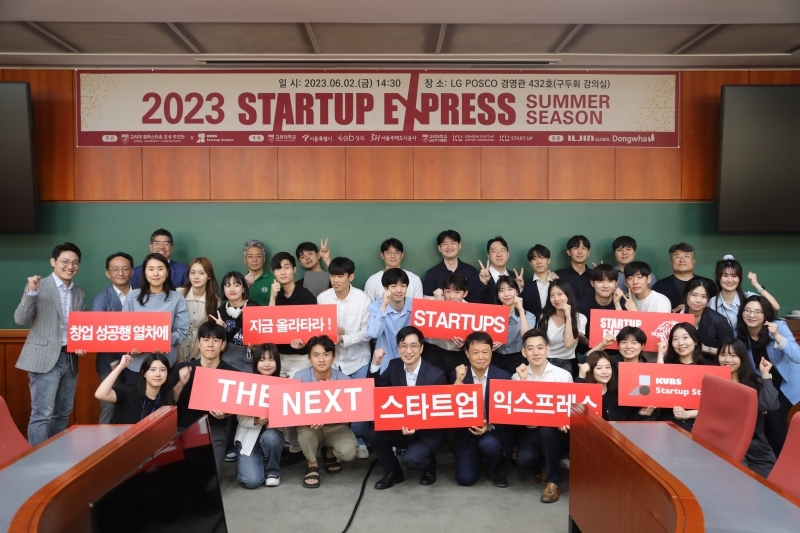
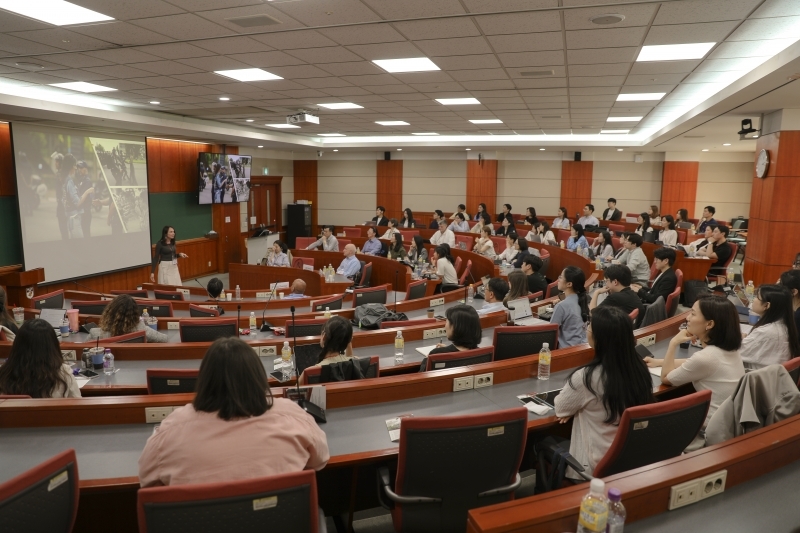
  '2023 Startup Express Summer Season' Concludes Successfully, Paving the Way for a Better World    On June 2nd, the '2023 Startup Express Summer Season' (hereinafter referred to as ‘competition’) hosted by the Startup Research Institute (Director= Jungbien Moon) of Korea University Business School (Dean= Sang Yong Kim) was successfully held at LG-POSCO Hall. 'Startup Express' is a student startup competition held every summer and autumn, organized by the Seung Myung Ho Entrepreneurship Education Center. Its purpose is to propose creative business ideas based on entrepreneurial spirit and innovation, as well as to discover startup teams with excellent business viability.      The judges for this competition included △Jungbien Moon, Director of the Startup Research Institute, △Jae Ho Jeong, Director of the Iljin Startup Support Center △Jin Kyu Park, Director of the Seung Myung Ho Education Center, as well as △Seung Pyo Lee, Director of the Iljin Global R&D Center △Won Kyung Yoo, Team Leader of the Business Planning Team at Hankook Ilbo △Jun Hyun Hwang, Team Leader of the Online Services Team at Donghwa Enterprise △Myung Choel Shin, Partner at Kingsbay Capital and Professor at Korea University Business School △Ji Seung Baek, Manager at SK C&C and △Seung Il Lee, CEO of PentaFlow.    The event commenced with a welcome speech delivered by Jin Kyu Park, the director of the Seung Myung Ho Entrepreneurship Education Center, and also provided an introduction to the event. Director Park stated, "The teams selected in today's competition will have the opportunity to enter the Seung Myung Ho Entrepreneurship Education Center," and added, "If they grow for one year, they will eventually participate in Choo Choo Day and enter the actual market." He described the event as "the glorious beginning of that process." Director Park further expressed his pride, stating, "Currently, Korea University has 113 resident companies, and our Startup Research Institute continues to produce companies that receive investments and grow steadily after graduation of each generation. I hope that today's participating teams will also embark on this path together and achieve positive outcomes."      In the competition, 12 teams selected through preliminary evaluations presented their business ideas. These included △AI-based self-introduction feedback service (Generative Lab) △post-processing managing SaaS platform for traffic insurance (DELPER) △self-development planner service through gamification (OV Land) △platform for exploring and saving hot spots through short-form content (Unboxing Dreams) △preventive and diagnostic service for canine patellar luxation (Barun Pet) △demand-responsive mobility service based on taxis (HOXI Mobility) △used equipment trading platform (Space Jump) △operating and management platform for dog daycare centers (Walga) △blockchain smart contract monitoring/auditing/cybercrime prevention service (Block Security Chain), △closed social network service that delivers family photos to the elderly (Mili Log) △dating platform utilizing AI technology and learning-based algorithms (SPAD) and △’four-cut’ photobooth photo archiving service(Photorage).      The event comprised a 5-minute idea presentation and a 5-minute Q&A session for each team. The judges evaluated each teams based on their △problem definition △business model △capabilities and △determination to select the teams for entry. Among the teams, Barun Pet received the Seung Myung Ho Entrepreneurship Award, and Block Security Chain was awarded the Iljin Startup Award, propelling them onto the 'Startup Express,' the path to entrepreneurial success in the second half of 2023. Furthermore, eight teams, including △Space Jump △DELPER △Unboxing Dreams △Walga △Generative Lab △SPAD △Photorage and △HOXI Mobility, received encouragement awards for their remarkable efforts.      After the conclusion of the competition, Jungbien Moon, Director of the Startup Research Institute, expressed, "Everything in the world is difficult and scary," and underscored the significance of taking a stand. He emphasized, "The most important thing is to position oneself with strong determination. If you prepare with unwavering resolve, there will be ample success awaiting you in the future." Moon further added, "Even if you didn't e,erge as winners today, our goal extends beyond triumph in this competition. We aim to reach the unicorn stage. Korea University will continue to provide more opportunities to access shared workspaces like 'The Stage,' so do not give up."        Meanwhile, the two teams that received the Seung Myung Ho Entrepreneurship Award and Iljin Startup Award will be granted operating expenses. Additionally, all the teams, including the recipients of the encouragement awards, will have the opportunity to enter the Iljun Startup Support Center at the Startup Research Institute. Once admitted to the center, each team will benefit from ongoing guidance and support provided by mentors consisting of seasoned entrepreneurs, industry experts, and venture capitalists. They will also have access to systematic entrepreneurial education programs aimed at further enhancing their skills and knowledge. 

2023.06.20 Views 3717

Intense Discussion Between Overseas Scholars and Domestic Marketing Academis, Successful ‘2023 KUBS

  Intense Discussion Between Overseas Scholars and Domestic Marketing Academis, Successful ‘2023 KUBS International Marketing Symposium’     On the 12th, numerous marketing professors and graduate students from across the country visited KUBS (Dean= Sang Yong Kim). The ‘KUBS Internation Symposium of Marketing (thereinafter Marketing Symposium)’ which began in 2005 as part of the 100th anniversary celebration of Korea University, took place in Room 412 of the LG-Posco Business building. The marketing symposium featured three presentations from overseas scholars and panel discussions under the theme “Consumer Behavior: Social Media, Political Ideology, and Marketplace Dignity’.       First, Professor Jeff Inman, the Albery Wesley Frey Professor at the University of Pittsburch in the United States, gave a presentation. Professor Inman in highly respected as a scholar in the field of consumer behavior research, having served as the editor-in-chief of the Journal of Consumer Research, the leading academic journal in the marketing field, as well as the president of the Association for Consumer Research and the Society for Consumer Psychology. In this symposium, he presented on the topic “What Drives Consumer Voting Behavior on Social Media? The Role of Posting Style Matching and Profile Matching.”     Professor Inman analyzed real data from SNS platforms in Japan and review sites in the United States to study consumer behavioral responses (e.g. liking posts) to social media posts. According to research, the “posting style congruence effect,” which indicates that the more the attributes of a post (such as length, sentiment, length of emojis and photos) match the attributed of a person’s previous posts, the more likely the recipient is to react to the post and the “profile congruence effect”, which shows that the more the geographic and demographic profiles of the send and recipient align, the more positive response, were found. Professor Inman stated that “these research findings not only contribute to social media marketing and interpersonal communication theoretically, but also provide practical insights to platforms and marketers.”       Next, Professor Manoj Thomas, the Nakashimato Frey Professor at Cornall University in the United States, presented on the topic ‘Political Ideology Predicts Price Negotiation’. Professor Thomas is known for his expertise in pricing strategy and is the associate editor for renowned academic journals in the field of marketing, such as the Journal of Consumer Research and the Journal of Marketing Research. According to Professor Thomas, “Political ideology has emerged as a significant factor in shaping individual identities, and I aimed to investigate the role of political ideology in influencing individual behavior beyond the political domain.”    Using various research methods, Professor Thomas found the fact that compared to progressive-minded consumers, conservative-minded consumers exhibit a greater tendency to engage in price negotiation due to their strong belief in free market ideology. He presented the role of the free market ideology as a determining factor in price negotiation and particularly emphasized the significance of demonstrating that the universal concept of political ideology also has a significant impact on economic behavior.        The final session was led by Professor Cait Lamberton, the Alberto I. Duran President's Distinguished Professor at the University of Pennsylvania, who presented on the topic of "The Drive for Marketplace Dignity: The Case for and Consequences of a Third System." Professor Lamberton serves as the co-editor-in-chief of the prestigious academic journal, ‘Journal of Marketing’ and is a highly influential scholar, not only having published numerous papers but she also has received several research awards. She stated, “I began this research with the question of whether human dignity exists and is applicable in marketing situation.”      Furthermore, Professor Lamberton stated, "Consumer dignity is composed of three dimensions: first, symbolic visibility and recognition as a human being; second, agency in making choices and exerting control; and third, justice and fair treatment in receiving equal treatment.” She stated that “consumer dignity can be realized in marketing situations, and the extent to which dignity is perceived, leads to different responses to marketing activities.” Additionally, she proposed that “the concept of dignity is related to consumer information processing and in addition to the widely known System 1 (automatic and heuristic processing) and System 2 (systematic and controlled processing), a third processing system based on dignity can operate.”         After the completion of paper presentation sessions, an open-format comprehensive discussion took place between the overseas scholars and the audience. The moderator and the audience raised various questions and issues regarding marketing and consumer behavior research as a whole, and the overseas scholars generously shared their experiences, insights and advice.     Meanwhile, Professor Gangseog Ryu, who participated in this marketing symposium, expressed his satisfaction saying “Even in the United States, only a few universities organize similar academic events, but we Korea University Business School holds this symposium every year. This is something to be proud of as a member of KUBS and I hope this tradition and culture of valuing research will continue.”      

2023.06.12 Views 2895

"The First & The Best," The Allure of Korea University Business School 

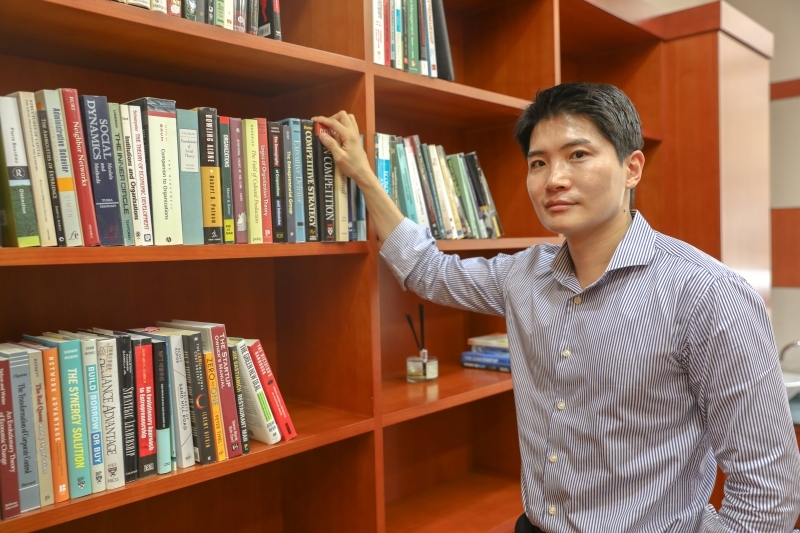
  "The First & The Best," The Allure of Korea University Business School    [New Faculty Interview for the 2023-1 Semester] Professor Lee Kyu-han    The KUBS (Dean. Kim Sang-yong) appointed two new faculty members, Professor Lee Kyu-han (MIS) and Professor Lee Jae-min (Management) in March 2023. In light of this, the Business News conducted an interview with the newly appointed professors, Lee Kyu-han and Lee Jae-min, to introduce their aspirations to the readers.    Professor Lee Kyu-han graduated from Seoul National University with a major in Business Administration and obtained a master's degree in MIS from the same university. He earned his Ph.D. from the University of Arizona in the United States. From 2021, he served as an assistant professor at W. P. Carey School of Business - Arizona State University. In March 2023, he joined the KUBS as a professor of MIS.      Q. Please introduce yourself, Professor Lee Kyu-han.    A. Hello, I'm Lee Kyu-han, who joined Korea University in March 2023. I started majoring in Management Information Systems (MIS) during my master's degree. There are various branches within MIS. For example, it involves studying the effects of certain variables based on quantitative economics and understanding human behavior based on surveys. I have been conducting research on developing deep-learning models. In terms of domains, I am also striving to conduct research on socially impactful issues such as misinformation.    Q. What prompted you to choose Business Administration? Do you have any specific reasons?    A. Business Administration is a field that allows for various career paths. When I was young, I didn't know what I wanted to do, so I wanted to pursue an open field of study. The KUBS itself is divided into seven majors; like this, It is an open and diverse field of study, so I chose it to explore what I could excel in.    Q. As mentioned earlier, Business Administration offers various career paths. Was there any specific reason for choosing an academic career after undergraduate studies?    A. During my undergraduate years, I had several internship experiences. I gained experience in various industries, including duty-free shops, IT venture companies, and large corporations such as LG Electronics. Of course, internships alone cannot provide extensive experience, but I could indirectly understand corporate life and work.    Being an academic allows me to pursue the fields I'm interested in and provides autonomy. I have a habit of seeking and working on tasks on my own rather than being assigned specific tasks. Therefore, I felt that being an academic was more suitable for my aptitude, and that's why I chose an academic career.    Q. What led you to join KUBS?    A. I had always thought that someday I would return to Korea. I didn't expect to come back so soon. I didn't want to miss the opportunity to join KUBS because it is considered the best business school in Korea. Fortunately, I was given a good opportunity and was able to take up the position.    Q. What do you think is the appeal of KUBS, which is evaluated as the best business school in Korea?    A. I believe it is the excellent students, senior professors, and strong support. The composition of the senior professors was great. KUBS values diversity in research areas and backgrounds, which is very appealing to me. I also found many aspects to learn from the research achievements of senior professors. Additionally, I felt that it would be rewarding to teach the best students in Korea. In terms of research, I felt that it would be an environment where I could excel.  Assuming that we consider the education and research system in the US as an advanced system, KUBS’s' educational and research environment is not significantly different from that of the US. I think the students' level is higher than most schools in the US. "The Best" is a word that adequately describes the appeal of the Department of Business Administration at Korea University.    Q. Can you introduce the courses you currently teach?    A. I am currently teaching "Data Management and Knowledge Management" as an undergraduate course. It is an English lecture and can be considered fundamental in the field of Data Analytics (DA). From the perspective of the data analytics process, it can be understood that I am teaching the basic knowledge required for storing and developing foundational data. Data management and knowledge management are the fundamental courses in data analytics.  I also include coding in my lectures. This aspect makes it somewhat similar to mathematics because you need to understand the principles to apply them. While it is important for me to teach the principles well, I believe it is meaningful to show how they are applied even if students don't fully understand them. Therefore, I make an effort to show them roughly how it is utilized, even if they don't understand it 100%.    Q. As a professor at Korea University's College of Business, what kind of research achievements would you like to demonstrate?    A. I plan to continue the research I mentioned earlier. Along with that, I want to explore areas I haven't previously studied. For example, although I have focused on advancing AI models and deep learning models, I now want to examine how AI or deep learning models affect people. As this is slightly different from the areas I have been researching, I would like to receive a lot of help from senior professors.    Q. What does KUBS mean to you as Professor Lee Kyu-Han sees it?    A. Personally, I would like KUBS to be like "paint" or a "palette." I had the opportunity to talk to first-year students at the mentoring day for advising professors. When I asked them, "What do you want to do?", I received a few standardized answers. For example, professions like Certified Public Accountants (CPA).  Of course, I’m not saying that professions like CPAs are bad. They can pursue their creativity and feel a sense of fulfillment in those occupations. However, I hope that undergraduate students would explore various experiences rather than having a specific occupation in mind from the first year. In that aspect, if KUBS could provide a foundation for such explorations and offer a variety of colors, it would be great to be described as "paint" or a "palette."    Q. What kind of professor do you want to be remembered as by your students or disciples?    A. I don't necessarily want to be remembered as a great mentor, but it would be nice if students remember me as a professor who taught them something relevant to their practical experiences. I have noticed among my friends, who are now in their mid-30s or later, that they are engaging in various tasks and projects independently.  The common story they share is that what they learned during their undergraduate studies has a direct or indirect relevance to their current work. At that time, they might have wondered if such knowledge would be useful. If students have similar thoughts in the future, I would be happy to be among the list of professors who come to mind. 

2023.06.09 Views 2927

Embracing Challenge, Change, and Innovation: Korea University Business School is the “Entrepreneursh

  Embracing Challenge, Change, and Innovation: Korea University Business School is the “Entrepreneurship Spirit”    [Interview with New Faculty Members for the 2023-1 Semester] Professor Lee Jaemin    Korea University Business School (Dean. Kim Sangyong) appointed two new faculty members, Professor Lee Kyuhan (MIS) and Professor Lee Jaemin (Business Administration), starting in March 2023. The KUBS News presents an interview with the newly appointed faculty members, Professor Lee Kyuhan and Professor Lee Jaemin, to introduce their aspirations and more to the readers.    Professor Lee Jaemin obtained his bachelor's degree in Business Administration and master's degree from Seoul National University and later earned his Ph.D. in Management and Entrepreneurship from INSEAD University in France. Since 2016, he has served as an assistant professor at Imperial College Business School in the United Kingdom, and in March 2023, he was appointed as a professor (Business Administration) at KUBS.      Q. Could you introduce yourself, Professor Lee Jaemin?    A. I am Lee Jaemin, newly appointed to the Business School for the 2023 academic year. This semester, I am teaching Venture Management, and in the second semester, I will be teaching "Organizational Design and Competitive Advantage."    Q. Is there a reason why you chose to study business administration?    A. Back when I was a student, there weren't many opportunities to choose a dual degree or a double major. So, the major I chose when I first entered university continued until graduation. Although there are excellent fields of study such as law and economics, I was attracted to the appeal of business administration.    What I find attractive about business administration are its diversity and inclusiveness. Fundamentally, business administration solves problems unique to management using theories developed from economics, psychology, and sociology. Especially, the approach of resolving new corporate-related issues in society faster than anyone else is a characteristic of business administration. Because of these characteristics and the diversity and inclusiveness of business administration, I chose to study it.    Q. Did you have a reason to pursue an academic path after your undergraduate studies?    A. During my undergraduate and master's programs, I was involved in small-scale entrepreneurial activities. Through entrepreneurship, I had various curiosities, and I realized that I value "autonomy" more than I thought. It's not about the time spent on work, but about being able to think and live freely about the direction of any work. So entrepreneurship suited me, and I wanted to research topics I was interested in and determine the research methods myself. Of course, there are guidelines, but there is a lot of autonomy in making choices. I chose academia because it provides autonomy.    Q. What motivated you to join Korea University Business School, and what do you find attractive about it?    A. It has been over 10 years since I left Korea. During that time, I observed how prestigious business schools in Korea were evolving from a distance. In the case of Korea University Business School, it had sincerity, a strong desire for development, and a "challenging spirit" to embrace new things. It didn't fear change and progressed with a clear direction.    I liked KUBS's proactive approach to constant improvement and challenges. I found it the most appealing, and I thought of returning to my home country and teaching students. At that moment, a good opportunity arose, and I was able to join the KUBS    Q. Could you introduce the courses you are currently teaching?    A. I teach "Venture Management" as an undergraduate course. When students bring in business ideas, I aim to identify any problems they may have and provide solutions to address those problems. I give feedback on whether the problems they identify are specific to their target audience or if they need to broaden or narrow their perspective. Instead of giving them the answers, I encourage them to conduct their own research and contemplate the solutions themselves.    So although they may not be able to use it immediately, I hope that the content they learned in my class will come to mind and be helpful when they contemplate the direction they should take. That's why I try to focus on providing practical things as much as possible. I want to be a "reference book" that students can turn to first when they have concerns or questions related to entrepreneurship or my lectures.    Q. As a professor at KUBS, what research achievements do you hope to demonstrate?    A. Korea University Business School provides much support and encouragement to publish in reputable journals recognized worldwide. They have various systems in place to support this, and I want to publish as many papers as possible in leading journals with the name of Korea University on them.    Q. What does KUBS mean to you?    A. I would say "entrepreneurial spirit." I have been keeping an eye on Korea University Business School since my undergraduate days, and it is the first business school in Korea that has introduced advanced systems, and it is the best business school. It is a business school that truly deserves the title of "The First & The Best." The LG-POSCO Building, for example, was an extremely innovative building at the time.    KUBS always has a clear vision of continually moving forward. I believe that generating goals and visions, finding directions, identifying problems, and solving them are very similar to the entrepreneurial spirit. Constantly challenging, changing, and adapting is the characteristic and identity of KUBS, so I would like to express it as an "entrepreneurial spirit."    Q. What kind of professor do you want to be for your students or disciples?    A. We must respect the diversity of individuals because everyone is different. So, I don't think it's my place to tell them "how to live." I want to be someone who delivers practical and substantial content that they can actually refer to when they come to a point of contemplating their career in the future. Even if they pursue different professions later on, the moment of contemplating whether to start a business or not is bound to come.    When that moment comes and they start pondering with the faint memory of what I taught, I want to be remembered as a professor who can provide practical materials that they can look into first. 

2023.06.09 Views 3637

“I want to help so they can study all they want” … Cumulative Donation of 8.4 Billion KRW, Philanthr

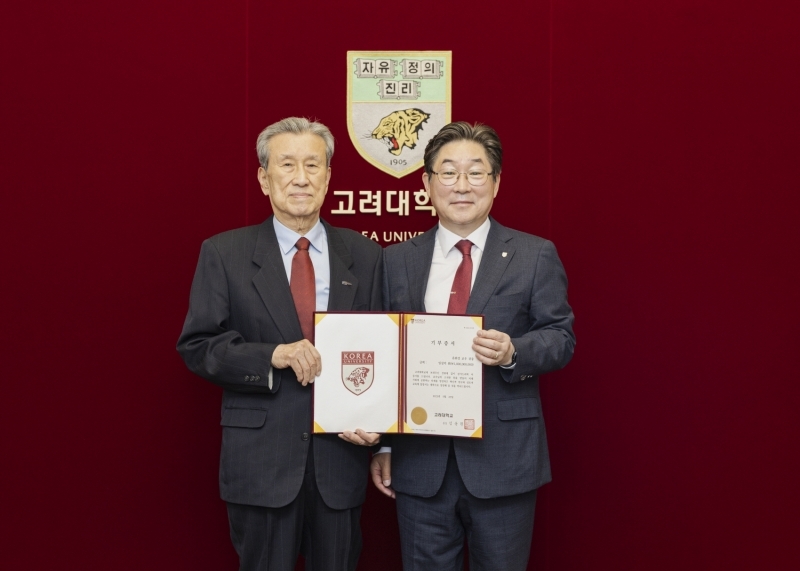
  “I want to help so they can study all they want” … Cumulative Donation of 8.4 Billion KRW, Philanthropist, Alumnus Hwisung Yu    2023 May, made an additional donation of 1 billion KRW to his alma mater Korea University, 500 million KRW was allocated to the development of the Business School      In 2011, Hwisung Yu, who donated 1 billion KRW to his alma mater Korea University for the Hyundai Motor Business Building Fund, is also known as the ‘donation king’. Not only did he donate 1 billion KRW in 2011, but he also contributed 1 billion KRW in 2015 for a development fund and in 2017, he also donated an apartment (worth 2.4 billion KRW at the time) in Seoul Seochogu. In 2022, he made an additional donation of 1 billion KRW to welcome the new year.     The donation king’s donations are not offer yet. He visited Korea University once again to donate another 1 billion KRW. On May 25th, a “Insung Fund Donation Ceremony” took place at the main building of Korea University, with President Dongwon Kim, Dean, Sang Yong Kim, Vice President for Development and External Affairs Hojeong Shin attending. During the ceremony, alumnus Hwisung Yu expressed his thoughts saying, “Because I have struggled through studying while working earning money, when I see juniors struggling, it touches my heart. I want to help them study all they want without financial worries.”        The reason why alumnus Hwisung Yu was able to donate a total of 8.4 billion KRW (2 billion KRW of which went to the Business School) to Korea University is because of his frugal lifestyle. Despite facing many difficulties after establishing Joheung Construction, he overcame difficulties with perseverance and passion, establishing himself as a successful entrepreneur. Throughout his life, alumnus Hwisung Yu has practiced a frugal lifestyle.    The 1 billion KRW donated by alumnus Hwisung Yu will be divided, with the Insung Fund and the Business School receiving 500 million KRW each. The Insung Fund, named according to the wishes of alumnus Hwisung Yu, combines the Chinese character ‘In’ from the names of alumnus Hwisung Yu’s mother and grandmother and the Chinese character ‘Sung’ from alumnus Hwisung Yu’s own name. The Insung Fund is names in recognition of its various forms, such as the Insung Scholarship Fund, Insung Research Fund, and Insung Research Award. It is highly valued and meaningful because it supports all members of Korea University including not only students but also faculty members and even research advancement.     As a gesture of gratitude towards alumnus Hwisung Yu who dontated 10 billion KRW to the Hyundai Motor Business Hall Fund, the Business School named Room B204 of the Hyundai Motor Business Hall as the ‘Hwisung Yu Lecture Room.”       Furthermore, the Insung Research Award, established to support the research conducted by faculty members of the Business School, aims to recognize, and support faculty members who engage in innovative and groundbreaking research in the field of business that contributes to the creation of future literature and achieves publication in top international journals. Selected as “Insung Researchers”, these faculty members received up to 30 million KRW to support their research endeavors. In 2017, the Business School held the Insung Research Award ceremony, and professors Dongseop Lee, Chris Changwha Chung, Kihoon Kim, and Ji-Woong Chung were awarded the Insung Research Award.      Meanwhile, the Business School plans to utilize the Business School Insung Fund donated by Hwisung Yu for purposes such as professor recruitment, aiming to achieve the goal of becoming a Global Top30, Asia No.1. business school. 

2023.06.09 Views 2491

  • 첫페이지로
  • 61
  • 62
  • 63
  • 64
  • 65
  • 마지막페이지로