TOP

KUBS News

Total 1416

Department of Business Administration, Graduate School, Korea University Recruiting New Students

Department of Business Administration, Graduate School, Korea University Recruiting New Students for Fall 2026… Applications Open Until April 9   A new opportunity is opening for those seeking to advance both their research direction and career development. The Department of Business Administration at the Graduate School of Korea University has begun accepting applications for domestic students for the Fall 2026 intake, with the application deadline set for 5:00 PM on Thursday, April 9.   As the business environment continues to evolve rapidly, the criteria for selecting a graduate program are also shifting. Beyond the name of the major, the strength of the research environment and academic network has become an increasingly important factor.    ▲ A group of full-time faculty members at Korea University Business School pose for a commemorative photo.    Korea University Business School boasts one of the largest research infrastructures in the country, supported by 95 full-time faculty members. This is considered a key strength, as it enables applicants to choose academic advisors who closely align with their research interests and topics. The faculty’s diverse expertise, spanning a wide range of subfields and research areas, provides a strong foundation for graduate students to conduct rigorous and advanced research.    As a research-oriented graduate school, Korea University Business School is also strengthening its interdisciplinary research environment to reflect rapidly evolving industries and societal needs. With a focus on the so-called “4Tech” fields—AI, semiconductors, robotics, and energy—the school is expanding the scope of business research beyond traditional boundaries and fostering the exploration of emerging challenges. Through this approach, students are able to analyze business phenomena from a more multidimensional perspective and develop their research questions into independent scholarly work.    Its research infrastructure is another key strength. Graduate students are provided with dedicated research spaces, including offices, seminar rooms, and lockers, along with access to data analysis software such as SAS, SPSS, STATA, and MATLAB. In addition, Korea University Library houses approximately 3.31 million volumes and 86,000 non-book materials, offering a comprehensive foundation for academic research.    In particular, students have access to major databases such as Bloomberg, Compustat, CRSP, WRDS, and LSEG Workspace. Recently, thanks to a donation from Eugene Investment & Securities, the number of Bloomberg terminals has been expanded to 12, further enhancing the research environment in finance and related fields.    Korea University Business School also offers a range of scholarship programs to support students in focusing on their research. These include full tuition coverage through research and teaching assistantships, as well as research scholarships under the BK21 program and merit-based scholarships. Approximately KRW 2.3 billion in scholarships are awarded annually, along with programs that encourage research activities, such as support for participation in international academic conferences.    For the Fall intake, the department will admit students to master’s, doctoral, and integrated master’s–doctoral programs in the following fields: Management, Global Business, Strategy, Finance, Information Systems (IS), and LSOM. The Marketing field will recruit only for doctoral and integrated programs, while Accounting and Business Analytics are excluded from this round of admissions.    The Fall admissions cycle is particularly meaningful as it provides another opportunity for applicants who have reassessed their academic or career paths following the Spring admissions cycle. For those who have further refined their research interests or career goals, this can serve as a strategic opportunity to select a research environment that best fits their needs.    Daeil Nam, Associate Dean for Research at Korea University Business School, stated, “As business studies become increasingly interconnected with industry, the importance of research environments and networks continues to grow,” adding, “We support our students in expanding their research and connecting it to real-world applications.”      ▶ Apply for Fall 2026 Domestic Graduate Admissions at Korea University ◀ 

2026.04.13 Views 42

[Interview] Professor Kihoon Kim on His New Book 『Platform Business in the Age of AI』

[Interview] Professor Kihoon Kim on His New Book 『Platform Business in the Age of AI』     “Even in the era of AI, the success principles of platform businesses remain valid, but the impact of AI on platform businesses is significant.”  Even as AI technology fundamentally reshapes the business paradigm, the essence of platform businesses remains unchanged. Professor Kihoon Kim’s new book, 『Platform Business in the Age of AI』, offers deep insights into the structure and evolution of platform business models and the transformative effects of AI. Through this book, Professor Kim seeks to present the core principles of platform strategy and a future-oriented perspective.    Q. What motivated you to write 『Platform Business in the Age of AI』?  A. The idea first came to me in 2012 when I participated in a seminar at Gyeongsang National University. Rather than presenting an academic paper, I had been invited to explain the concept of platform economy and strategy in a way that undergraduate students could easily understand. After spending an entire day traveling to and from Jinju, I thought to myself, “If I organize this material into a book, I could share this knowledge with a much wider audience.”  I began writing in earnest about three years ago. On a flight back from an academic conference in the U.S., I listened to an audiobook of Malcolm Gladwell’s MasterClass on writing. As I listened, I felt a strong conviction that the time had come for me to write a book. After years of contemplation, that moment marked the true beginning of this project.    Q. What are the core messages you aimed to convey through this book?  A. First and foremost, I emphasize that no matter how advanced AI becomes, the fundamental structure and survival principles of platform businesses remain valid. A platform essentially serves as an intermediary that connects Group A and Group B. The rules of survival and competition that arise from this structure remain largely unaffected by the advent of AI.  Another message I wanted to convey is that while many people associate platform businesses with innovation, I believe the term evolution is more appropriate. For example, American Express originally began as an express delivery company and, over the course of nearly 100 years, evolved into a credit card platform business. Many platform models grow not through sudden innovation, but through gradual, long-term evolution.  Finally, many startups and manufacturing-centered conglomerates still tend to think, “We have nothing to do with platform strategy.” I believe that mindset needs to change. Just as Apple evolved from a computer manufacturer into a platform company through the iPhone OS and App Store, manufacturers today can no longer regard themselves as unrelated to platform strategy. Korean companies—Samsung included—should actively explore opportunities to enter platform businesses by leveraging their existing customer bases.    Q. How do you see AI technology impacting platform businesses?  A. The most immediate impact of AI is the enhancement of matching technologies. Platforms like YouTube and Amazon, which actively leverage AI, analyze user behavior data to deliver more precise and personalized services. This, in turn, boosts user loyalty and further solidifies the dominance of leading platforms.  At the same time, AI is likely to accelerate user multi-homing, thereby increasing the survival chances of new platforms. For example, when searching for real estate listings, users in Korea often use four major apps: Zigbang, Hogangnono, Naver Real Estate, and Dabang. Even if these apps dominate the market, a new platform that leverages AI to offer a better user experience could still attract users—at least until the incumbent platforms catch up with similar AI features.  Another notable change is that generative AI could serve as a direct touchpoint between customers and platforms. For instance, if a user says, “I want to travel to Disneyland in LA,” current AI systems might simply create an itinerary. But in the near future, AI could evolve into a full-service assistant that even books flights. In such a scenario, AI becomes the intermediary between the customer and the travel platform, fundamentally transforming how platforms are used.    Q. How do you interpret the spread of generative AI and its effect on the platform market?  A. Generative AI has the potential to emerge as a new kind of player in the platform market. Take KakaoTalk, for instance—it built a large user base by offering free messaging, and later expanded into a full-fledged platform by adding features such as digital gifting and content sales. In a similar vein, generative AI tools like ChatGPT could leverage their massive user base to integrate with various platform services or even create entirely new ecosystems.  Ultimately, generative AI is both a technology with built-in platform capabilities and a potential launchpad for developing new platforms.    Q. What advice would you give to Korea University Business School students on how to approach this book?  A. If you're new to platform business, I recommend reading Chapters 1 through 6 to build a solid understanding of the basic concepts and structural foundations. These chapters are designed to help readers grasp the core principles in a step-by-step manner.  For students who already have some background knowledge or are interested in launching a platform-related startup, Chapters 7, 8, and 9 will be especially valuable. Chapter 7 presents a range of platform evolution cases, Chapter 8 explores how traditional companies have successfully transitioned into platform-based models, and Chapter 9 analyzes the impact of AI on platform ecosystems. These chapters offer practical insights that can help readers deepen their understanding and apply what they’ve learned to real-world situations.    Q. What was the most difficult or memorable part of writing this book?  A. The most difficult part was staying committed and seeing the manuscript through to the end. At times, I questioned whether people would actually find the book engaging. During those moments, my family’s support was a tremendous source of motivation. More importantly, I was able to keep going because I believed the book could offer unique value to readers.  While many books on platform business are rich in information, they often fall short in providing actionable insights or practical guidance. I wanted to make complex concepts easier to grasp—not through one-sided explanations, but by presenting real-world examples that readers could relate to and empathize with. In particular, I tried to convey the core of platform business through stories that reflect the actual experiences of companies and users, so that readers could understand the subject more naturally and intuitively.    Q. Do you have any upcoming research or writing plans?  A. I plan to continue my research on the platform economy while also exploring, from an academic perspective, how AI is reshaping business. These days, it’s clear that many people are deeply interested in the impact of AI—just take a look at the variety of books lining the shelves at bookstores. From technical guides on how to use AI to general interest books on its societal implications, AI is a topic of widespread fascination. My next goal is to delve into how AI is influencing both the business world and our daily lives, and to capture those insights in a future book.  I also run a YouTube channel called Kihoon Kim’s Business Insight, where I explain topics such as platforms, technology, and business strategy in a simple and engaging way. For stories that didn’t make it into the book or insights on the latest trends, I hope to reach more people through this channel. If you’re interested in platforms, AI, or business strategy, I encourage you to check it out.   ▶ [Click here to visit Kihoon Kim’s Business Insight YouTube channel] 

2025.06.09 Views 3183

Interview with the Recipient of the SK Research Paper Award – Professor In Joon Noh 

Interview with the Recipient of the SK Research Paper Award – Professor In Joon Noh      In 2025, a research paper co-authored by Professor In Joon Noh of Korea University Business School, titled "Evaluating Quality Reward and Other Interventions to Mitigate US Drug Shortages" (co-authors: Sergey Naumov, In Joon Noh, Hui Zhao), was published in the Journal of Operations Management (Vol. 71, Issue 3) and received the SK Research Award.  The study was highly acclaimed for its quantitative assessment—using a system dynamics model—of the effectiveness of the “Quality Reward” policy recently proposed by the FDA to address the ongoing drug shortages in the United States, a problem that has persisted for over a decade.    Q1. Congratulations on publishing your paper in an SK Tier 1 journal. Could you share your thoughts on this achievement?  A. I’m very pleased and grateful that the paper I began working on in late 2020 has finally been published after a lengthy process and multiple rounds of revision.    Q2. Could you briefly introduce the main content and background of your paper?  A. Drug shortages have long been a challenging and persistent issue in the United States. Interestingly, the root cause of this problem is closely tied to the unique characteristics of pharmaceutical products. Unlike general consumer goods, patients are unable to directly evaluate the quality of medicines. As a result, ‘low price’ often becomes the dominant criterion for product selection, rather than ‘high quality.’  Due to this market characteristic, pharmaceutical manufacturers tend to prioritize cost reduction over quality investment once they obtain initial approval from the U.S. Food and Drug Administration (FDA). This dynamic leads to severe price competition, declining profitability, and ultimately, quality degradation—creating a vicious cycle that results in repeated supply disruptions.  In this study, we use a system dynamics simulation to examine the potential impact of a “Quality Reward” policy—a mechanism recently proposed by the FDA and several industry experts and scholars. This policy aims to quantitatively rate the quality level of pharmaceutical products and provide incentives based on those ratings, thereby addressing the underlying causes of drug shortages.    Q3. What motivated you to start this research?  A. Before beginning my doctoral studies, I worked as a quality engineer in the semiconductor division at Samsung Electronics. That experience led me to pursue research related to quality management. Fortunately, during my PhD, I had the opportunity to collaborate with the U.S. Food and Drug Administration (FDA) on several projects aimed at improving pharmaceutical quality. These collaborations sparked my interest in exploring the broader issues of drug quality and shortages in the U.S. market.  This particular study was my first independent research project after completing my PhD and starting my academic career at a university in the United States. Unlike the projects I conducted with the FDA during my PhD—many of which were under the guidance of my advisor—this paper was initiated jointly with my new faculty colleagues. That’s why the publication and this award feel especially meaningful to me.    Q4. What societal or industrial impact do you expect from this research?  A. This study, Evaluating Quality Reward and Other Interventions to Mitigate US Drug Shortages, quantitatively evaluates the recently discussed “Quality Reward” policy in comparison with existing measures that have been implemented to address drug shortages. In addition, it examines the potential unintended consequences of the Quality Reward approach and proposes strategies to mitigate them.  I hope this research will serve as a valuable reference for policymakers working to implement such incentive-based frameworks and ultimately make a meaningful contribution to resolving the ongoing issue of drug shortages.    Q5. What are your future research plans or areas of interest?  A. My current research focuses on pharmaceutical quality and drug supply shortages. Moving forward, I plan to expand the scope of my work to include healthcare service domains such as hospitals and nursing homes. Now that I have returned to Korea, I also intend to study the Korean pharmaceutical and healthcare industries more closely.    Q6. Do you have any advice for students?  A. No matter where you work or what profession you choose, I believe it’s important to maintain a spirit of curiosity and a mindset geared toward improving the situation around you. If you approach your work with that attitude, meaningful opportunities will naturally follow—whether in your current role or along a new career path.    Summary of Professor In Joon Noh’s Paper:    「Evaluating quality reward and other interventions to mitigate US drug shortages」 Drug shortages have posed a serious threat to public health and the healthcare system in the United States for over a decade. While previous studies have examined the causes and consequences of these shortages, relatively few have explored potential policy solutions. This study uses a system dynamics model to assess the long-term effects of two existing policy interventions—accelerated drug approval processes and incentives for manufacturers to expand production—alongside the more recently proposed “quality reward” initiative in the U.S. generic drug market. The analysis finds that while the existing interventions may provide short-term relief, their long-term effectiveness is limited. In contrast, the quality reward policy demonstrates greater potential for sustainably mitigating drug shortages. However, it also carries the risk of creating monopolistic supply markets. To address this concern, the study proposes a mechanism for publicly disclosing quality information. As the first study to quantitatively compare the long-term effects of the quality reward and other existing policies—and to explain the structural mechanisms underlying their outcomes—this research offers important insights for strengthening the resilience of the drug supply system. 

2025.06.09 Views 2412

[Interview] Professor Jeunghyun Kim Publishes SK Tier 1 Paper

[Interview] A Simulation Strategy to Reduce Judicial Delays in India – Professor Jeunghyun Kim Publishes SK Tier 1 Paper      Q1. Congratulations on publishing a paper in an SK Tier 1 journal. How do you feel about this achievement?  I am truly honored and grateful to have my paper published in an SK Tier 1 journal. There were numerous challenges and iterations throughout the research process, but it is deeply rewarding to see these efforts culminate in publication in a prestigious international journal. What feels especially meaningful is that the findings were finalized at the right time and shared through such a respected platform. I hope to continue conducting research that offers genuine academic value.    Q2. Could you briefly introduce the main focus and background of your paper?  This study focuses on addressing the severe judicial delays experienced by the Supreme Court of India by proposing an operations strategy. Known globally for its chronic case backlogs, the Indian Supreme Court presented an opportunity to analyze a complex real-world issue from a service operations perspective. I collected actual case data from the Court’s official website and developed a simulation model that incorporates various operational scenarios.  Importantly, the model reflects the Court’s real-world operational structure, including both regular and holiday work schedules. Rather than suggesting a simple increase in personnel, the research demonstrates how improvements in operational methods alone can significantly reduce trial delays.    Q3. What motivated you to pursue this research?  This research didn’t originate from a particular social mission. I’ve always found fulfillment in solving complex problems—and if that process happens to benefit society, all the better. This project followed that same spirit.  Judicial delays in the Supreme Court of India extend far beyond legal concerns; they represent systemic inefficiencies that affect the broader society. In India’s labor-intensive economy, a delayed ruling can halt or disrupt economic activity. Some individuals are unable to start jobs due to unresolved legal issues, and contractual disputes may take anywhere from 300 days to three, or even ten years to resolve. Recognizing these structural inefficiencies, I set out to analyze the problem quantitatively and explore actionable improvements.    Q4. What potential impact do you think this research could have on society or industry?  This study highlights how optimizing the operational aspects of judicial systems can bring broad societal and economic benefits. Legal delays lead to postponed decision-making and stalled activity at every level—individuals, businesses, and governments alike.  Our simulation results show that, with the adoption of appropriate operational strategies, average trial delay times can be reduced by as much as one-third. Although the exact economic impact has not been quantified, a reduction of that magnitude would likely produce meaningful improvements across society. I believe enhancing judicial efficiency is a critical task that advances both fairness and productivity.    Q5. Could you share your future research plans or areas of interest?  Many business research projects are inspired by real-world developments. For example, the emergence of Uber spurred numerous studies on matching algorithms and pricing strategies. My approach differs slightly: rather than beginning with a specific application, I ask which kinds of problems can be addressed using a given analytical method.  Going forward, I plan to continue exploring the practical relevance of my methodological tools. My work is method-driven rather than problem-driven—but if the method proves effective in solving real-world challenges, I consider that a meaningful academic contribution.    Q6. Do you have any advice for junior researchers or students?  Above all, I encourage you to broaden your perspective. The world is full of compelling, high-impact problems—but without a wide field of view, you may never discover them. Staying attuned to what’s happening beyond your immediate environment is essential.  Also, don’t avoid difficult challenges. Each problem requires its own suitable set of tools—its own methodology. If you stick only to what you’re comfortable with, you may miss opportunities to solve important issues. I recommend that students step outside the business school and engage with courses in mathematics, industrial engineering, economics, and beyond.  You don’t need to master every subject. Sometimes just knowing that a certain method exists can completely change the way you understand a problem and dramatically expand the scope of your research. I firmly believe that a broad intellectual curiosity and a balanced learning approach are the foundation of impactful research.    Summary of Professor Jeunghyun Kim’s Paper  “Service Operations for Justice-on-Time: A Data-Driven Queueing Approach”  A lack of resources in judicial systems can lead to trial delays, hinder economic growth, and ultimately erode access to justice. This study examines the Supreme Court of India through the lens of service operations and proposes realistic strategies for improvement.  The Indian Supreme Court operates under a structure where the same judge repeatedly reviews a single case—a system that can be modeled as a case management queue. Based on actual case data, the research team developed a simulation model that realistically represents the two-phase judicial process: pre-admission and post-admission. The model reflects actual conditions, including shared judicial capacity across phases and non-working days such as holidays.  The study found that inefficiencies arise from misalignment between case scheduling and judicial capacity, as well as from rigid calendaring systems. However, by introducing more flexible scheduling, average trial delays could potentially be reduced by up to 65%.  This research offers a data-driven and operationally feasible alternative for enhancing judicial system performance and delivering more timely and equitable legal services. 

2025.05.26 Views 3046

Entrepreneurship Academy Lecture by Attorney Joongil Cho

Understanding Startup Investment Contracts from the Other Side – Entrepreneurship Academy Lecture by Attorney Joongil Cho      The Entrepreneurship Academy lecture hosted by the Korea University Business School Startup ㄴStation was held on Tuesday, May 13, in the KOLON Lecture Room (Room B307) of Hyundai Motor Hall. The lecture, titled “Startup Investment Contracts – Understanding from the Other Side,” was delivered by Joongil Cho, a partner attorney at SHIN & KIM LLC and an expert in corporate law and transaction structure design. He also serves as a member of the Venture and Startup Legal Support Special Committee of the Korean Bar Association.    The lecture was based on real-life advisory cases, focusing on the key aspects of investment contract structures that entrepreneurs must understand and how to approach contracts from an investor’s perspective. “Why is the investor asking for this clause? You must be able to ask yourself that question.” said Cho, emphasizing throughout his talk that understanding ‘the investor’s logic’ is the foundation of any negotiation.      He cited common clauses frequently found in investment contracts—such as △non-compete agreements, △stock option restrictions, △limitations on the issuance of new shares, and △mandatory dividend provisions—emphasizing that “understanding the structure and underlying logic of the contract is more important than the specific wording.”  Cho also pointed out that “When founders are overly focused on securing investment, they tend to overlook important details,” and stressed the importance of thorough due diligence prior to signing. He advised entrepreneurs to examine whether △trade secrets are sufficiently protected, △the terms violate any existing agreements, △the founder is being exposed to excessive personal liability, and △the investor’s commitment to the deal is genuine.    Drawing on his extensive advisory experience—from M&A cases involving major Korean platform companies such as Kakao, Netmarble, and NAVER to early-stage startups like SEMIFIVE and B GARAGE—Cho outlined common pitfalls that founding teams often overlook in investment contracts. He concluded the lecture by emphasizing, “It’s critical to clearly and convincingly communicate to investors what you want—and why you need it.”      A student currently preparing to launch a startup shared their thoughts, saying, “It was a valuable opportunity to revisit the contract process from the investor’s perspective, rather than solely from the standpoint of a startup.” The student added, “It gave me a clearer sense of which elements need to be negotiated in real investment discussions.”  The Entrepreneurship Academy is a special lecture series planned and operated by the Startup Institute of Korea University Business School. It aims to provide aspiring and early-stage entrepreneurs with practical insights by inviting seasoned founders and industry experts with hands-on experience.  Korea University Business School will continue to support the growth of student entrepreneurs and enhance its connection with the startup ecosystem through a variety of ongoing programs. 

2025.05.26 Views 2178

KUBS Carves Its Name on the Global Stage: 1st Runner-Up at 2025 UW GBCC 

KUBS Carves Its Name on the Global Stage: 1st Runner-Up at 2025 UW GBCC      Students from Korea University Business School (KUBS) demonstrated their outstanding problem-solving and presentation skills on the global stage by securing 1st Runner-Up in the Long Case division at the 2025 Global Business Case Competition (UW GBCC), held at the University of Washington in April.  The UW GBCC is a prestigious international business case competition where top business students from around the world are challenged to develop strategic solutions to real-world business problems within a limited time frame. The competition is renowned for testing analytical thinking, strategic creativity, and communication skills under pressure.  Representing KUBS were four students: Junhee Park (Class of ’22), Seoyeon Ko (’22), Oscar Javier Castillo Vazquez (’22), and Seokjun Oh (’21). The team was mentored by Professor Tony Garrett, a specialist in marketing.      The competition consisted of two parts—a 5-hour Short Case and a 24-hour Long Case. Junhee Park participated individually in the Short Case, clinching first place in a multinational team. For the Long Case, the full KUBS team tackled the challenge of devising a revitalization strategy for Starbucks China. Their proposal included:  Implementing a low-cost operational model,  Introducing regionally tailored store formats, and  Forming strategic partnerships for digital transformation.  Their solution was praised by the judging panel for its strategic insight and feasibility.  To celebrate the achievement, Dean Eonsoo Kim of KUBS hosted the team on May 13 at the Dean’s Office. Dean Kim congratulated the students for their effort and emphasized the significance of institutional support in creating such learning opportunities.      “This achievement is not only a reflection of the students' talent but also the result of the learning environment and opportunities KUBS has consistently nurtured. We will continue to support our students to challenge themselves and grow globally,” said Dean Kim.    Professor Tony Garrett commented:  “The students delivered a compelling and well-analyzed presentation within the limited time. It was an impressive demonstration of critical thinking and teamwork that resonates on the global stage.”    [Reflections from the Team]  Junhee Park (Team Leader)  “This experience allowed me to grow by transforming business challenges into practical strategies. Leading the team and working on both the storyline and strategic direction was incredibly rewarding. Winning the 5-hour Short Case with an international team was also an unforgettable moment. Although we missed the grand prize, being invited to present again in front of Starbucks executives at their headquarters was a huge honor. I'm truly grateful to KUBS and Professor Garrett.”   Seoyeon Ko  “Applying what I learned in class to real-world problems was a fulfilling and enjoyable experience. Competing with students from various countries was a great stimulus. I focused on validating our strategy through deep analysis, which broadened my industry understanding. I'm deeply thankful to the International Affairs Office and our mentor for making this possible.”    Oscar Javier Castillo Vazquez  “I’m thrilled that our five weeks of intense preparation with teammates and our professor paid off. Being invited to present to 150 Starbucks executives was an especially meaningful moment. This wasn’t just a competition—it was a learning journey in business strategy and marketing that helped shape my career direction.”    Seokjun Oh  “My passion for business strategy began with KUBS Challenge in my freshman year and has grown through several competitions. This one stood out—we prepared like it was the real world, often working through the night. The intense preparation and discussions will stay with me long after graduation. I’m truly thankful to the KUBS International Affairs Office and my teammates. Go KUBS!” 

2025.05.26 Views 2749

A Heartwarming Gathering Across Generations – KUBS Hosts ‘Faculty Appreciation and Reunion Day’ 

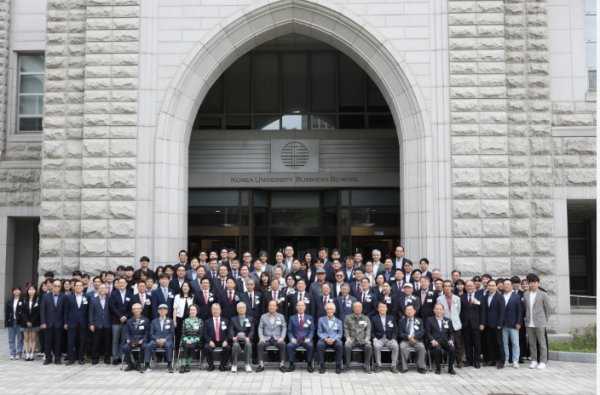
A Heartwarming Gathering Across Generations – KUBS Hosts ‘Faculty Appreciation and Reunion Day’      On Wednesday, May 14, Korea University Business School (KUBS) held the ‘KUBS Faculty Appreciation and Reunion Day’ at Young-Il Ahn Hall on the 6th floor of LG-POSCO Hall. The event was organized to express gratitude to senior faculty members who have devoted themselves to the school’s development over the years and to foster communication and camaraderie among professors across generations.    A total of 11 former professors and over 60 current faculty members attended, creating a warm and intergenerational atmosphere. Professors gathered to reconnect, share memories, and reflect on the past, present, and future of KUBS. The attending senior faculty included △ Ho Jin Kang, △ Wan-Soon Kim, △ Ick-Soo Kim, and △ Jang Rho Lee (Global Business), △ Hyoung Koo Moon, △ soosik Shin, and △ Jin Kyu Lee (Management), △ Joon Yong Shin, △ Kwan hee Yoo, △ Manwoo Lee (Accounting), and △ Young-Sup Yun (Finance).      In the opening ceremony, Dean Eonsoo Kim stated, “KUBS owes its current standing to the deep dedication and passion of our senior faculty. We are committed to carrying on that spirit and striving for academic and educational advancement.” He also highlighted recent accomplishments, saying, “KUBS has achieved remarkable results in the latest QS rankings, placing in the top 40 globally in ‘Marketing’, ‘Business & Management Studies’, and ‘Accounting & Finance’, and we will continue to work diligently to improve.”    Representing the former faculty, Professor Wan-Soon Kim delivered a greeting, stating, “KUBS has continuously evolved, but at the core has always been the devotion of our professors. I am deeply grateful to the junior faculty and KUBS for organizing this event.” He added, “Today, my son is here with me, and my entire family graduated from Korea University. I take great pride in saying Korea University is the best university in Korea.”      During the luncheon, Professor soosik Sin offered a toast, wishing for the continued honor and prestige of KUBS, as well as the health and scholarly growth of all attendees. He also presented one of his authored books as a gift to a professor couple, sharing a heartfelt gesture.    As the final part of the event, commemorative gifts were presented to the senior professors in appreciation of their service. Following the ceremony, the retired faculty visited the newly established faculty office in Room 525 of LG-POSCO Hall, where they witnessed firsthand the ongoing transformation and advancement of KUBS.      KUBS plans to continue expanding opportunities for intergenerational academic bonding and meaningful dialogue among faculty members through similar gatherings in the future. 

2025.05.26 Views 1983

  • 첫페이지로
  • 26
  • 27
  • 28
  • 29
  • 30
  • 마지막페이지로