TOP

KUBS News

Total 1417

‘KUBS 120 MARCH’ Campaign Nears 40% of Goal … Total Pledges Reach Approx. KRW 4.6 Billion

‘KUBS 120 MARCH’ Campaign Nears 40% of Goal … Total Pledges Reach Approx. KRW 4.6 Billion Three major large-scale pledges secured within four months of launch … Campaign continues through May 31     Korea University Business School’s KRW 12 billion fundraising campaign, “KUBS 120 MARCH,” has secured approximately KRW 4.6 billion in pledged donations within just four months of its launch, nearing 40% of its goal.   Since the campaign’s launch in January, when pledged donations stood at around KRW 2 billion, the total has more than doubled in just three months. From December 1, 2025, to March 29, 2026, total pledges reached KRW 4,652,317,231, with 324 participants, including corporations, alumni, faculty, staff, and students.       | Three major pledges secured … Alumni and corporations join forces    One of the most notable achievements is the securing of three major pledges. An anonymous donor pledged support for the research fund, Eugene Investment & Securities Co., Ltd. for the development fund, and Samyang Tongsang for scholarships. Alumni account for approximately 62% of total pledges, while corporations represent about 35%, jointly driving the campaign forward.   Group donations have also continued. Following the participation of the Class of ’81 alumni association, the Business School Class of ’79 Scholarship Committee (28 members), the KUBS Class of ’98 Alumni Night (126 participants), as well as faculty and staff, have also joined the campaign.      | Expanding participation across classes, generations, and professions    The donor base is highly diverse. Participation spans from alumni who entered in the 1970s to current students from the Class of ’26, as well as members of EMBA, DBA, and AMP programs, undergraduate alumni, and even alumni from the College of Medicine. From individual research labs and faculty bands to student councils, all corners of the Business School are actively engaging with the campaign, further broadening its base of participation.   This campaign is particularly meaningful in that it places value not only on the total amount raised but also on participation itself. From small contributions starting at KRW 10,000 to major gifts reaching KRW 1 billion, every act of giving becomes part of the shared legacy of KUBS’s 120-year history.    | Investing in the future campus… Advancing the 3C Trading Zone and 4Tech strategy    The funds raised are being used to realize the Business School’s future vision. Alongside the advancement of the “4Tech Strategy,” centered on AI, semiconductors, energy, and robotics, spatial innovation projects are also taking shape.   The Business School is already operating AI-focused tracks and 4Tech micro-degree programs, and continues to expand its educational and research capabilities with its largest-ever full-time faculty body of 95 members.   On the basement level of Hyundai Motor Hall, the “3C Trading Zone (tentative name)” is currently under development, with a trading demo day scheduled for early May. The space will also include an Art & Culture Room. Artist Uhm Jung-soon’s installation piece, K, the Noseless Elephant, has already been installed in the building.   Construction has also begun on an LED display in the lobby of LG-POSCO Hall, which will serve as a large-scale digital donor wall. An opening ceremony is scheduled following the conclusion of the campaign in May.   Dean Eonsoo Kim stated, “We have come this far thanks to the collective support of each and every member,” adding, “We hope more people will join us on this journey as we prepare for the next 120 years of the Business School.”   The “KUBS 120 MARCH” campaign will continue through May 31, 2026. Donations can be made via the official sponsorship page (box.donus.org/box/koreauniversity/KUBS120march).   As of December 1, 2025 – March 29, 2026 | Total pledged amount: KRW 4,652,317,231

2026.04.17 Views 404

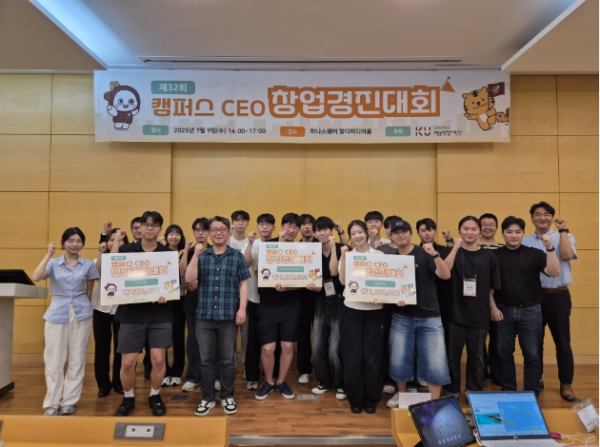
Startup Idea Takes the Lead — KUBS Students Win 1st Place in Campus CEO Competition 

Startup Idea Takes the Lead — KUBS Students Win 1st Place in Campus CEO Competition      Once again, the creativity and execution skills of KUBS students have been demonstrated. In the first semester of 2025, a student team from Korea University Business School—composed of Hyunjun Ko, Byungchan Kim, Jaewook Shim, and Kiyong Choi—secured 1st place in the Campus CEO Startup Competition, showcasing their practical business capabilities.  The Campus CEO Startup Competition is Korea University’s flagship startup idea contest, hosted annually by the Crimson Startup Support Center. The competition is open to students enrolled in entrepreneurship-related courses. Teams are nominated by course instructors and selected through a document screening process to advance to the final round, where the top-performing teams are awarded based on their presentations.      The winning team—Hyunjun Ko (Class of 2019), Byungchan Kim (Class of 2021), Jaewook Shim (Class of 2021), and Kiyong Choi (Class of 2021)—took part in the course BUSS306: Strategic Technology Commercialization, where they developed and refined their business idea. Based on their professor’s recommendation, they entered the competition and impressed the judging panel with their differentiated business model and highly feasible strategy. After a highly competitive final round, the team earned the top honor among all finalists.  Professor Jinyoung Kim, who supervised the course, commented:  “Startup classes are less like traditional lectures and more like juggling practice—not where the professor juggles alone, but where each student holds their own ball and learns to juggle together. The Ourtube team showed remarkable commitment throughout the course, transforming failures into assets for growth. They were truly impressive.”  Student Hyunjun Ko shared,  “The project started with forming a team and a short pitch in class. Thanks to the professor’s recommendation, it naturally led us to the competition. Balancing startup preparation with job searching was tough, but our strong teamwork got us through to the end.”  Student Jaewook Shim added,  “Our first pitch was a real challenge, but through repeated practice, I was able to improve my presentation skills significantly. The feedback we received during the competition was the most valuable takeaway.”  This victory is especially meaningful as KUBS has produced winning teams in the competition for two consecutive years. In the first semester of 2024, Project SPS, a team that included Hunhee Cho (Class of ’19), also from the same course, won 2nd place. These back-to-back achievements highlight the excellence of KUBS’s practice-based entrepreneurship education.  A representative from the Crimson Startup Support Center stated:  “The students’ continued success—driven by creativity and execution—is highly encouraging. We will keep expanding practical entrepreneurship education and support programs to foster more innovative student ventures in the future.” 

2025.08.06 Views 2341

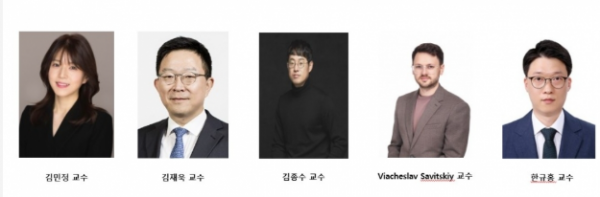
Seoktap Teaching Award Recognizes Five KUBS Faculty Members for Fall 2024 

Seoktap Teaching Award Recognizes Five KUBS Faculty Members for Fall 2024    Five professors from Korea University Business School (KUBS) have been honored with the Seoktap Teaching Award for the second semester of the 2024 academic year.  The recipients are: Jaewook Kim, Jongsoo Kim, Kyuhong Han, Minjung Kim, and Viacheslav Savitskiy (listed in alphabetical order).  The awarded courses are as follows:  △ Jaewook Kim – Business-to-Business Marketing △ Jongsu Kim – Strategic Management (English-taught) △ Kyuhong Han – Marketing Research (English-taught) △ Minjung Kim – International Business (English-taught) △ Viacheslav Savitskiy – Business Economics (English-taught)   The Seoktap Teaching Award has been presented since the first semester of 2004 as part of the "Teaching Evaluation Incentive System," which aims to improve the quality of instruction and enhance the learning environment.  Recipients are selected based on the average scores from student course evaluations conducted at the end of each semester. The award is given to full-time faculty members whose courses rank in the top 5% of: △ among major courses offered by each college,  △ among liberal arts courses across the university, and △ among English-taught courses within each academic division.  In addition, some of the awardees were interviewed to share their teaching philosophies and instructional approaches. Full interviews are available through the links below:  Awardee Interviews  Minjung Kim: “I Prefer Wrong Answers” – Why Professor Minjung Kim’s Class Is Special  Jongsoo Kim: “Strict Yet Kind” - Professor Jongsoo Kim on His Teaching Philosophy and Seoktap Award  Viacheslav Savitskiy: “I Read Students Through Their Eyes” - Professor Viacheslav Savitskiy’s Communication-Centered Teaching Method 

2025.08.06 Views 2143

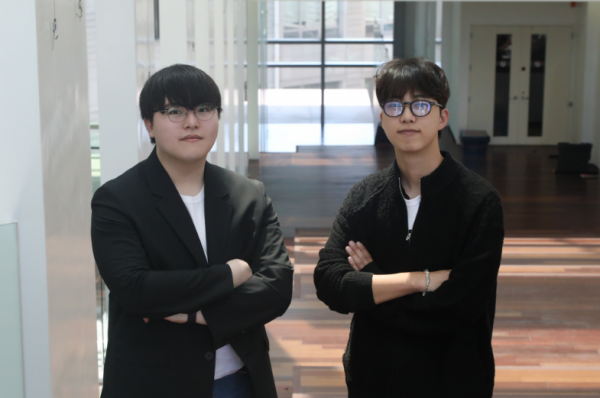
[Interview] Behind the Scenes of Preparing ‘Hosang Daedongje: PANTHERA

[Interview] A Festival Made Together, A Tradition Continued Together – Behind the Scenes of Preparing ‘Hosang Daedongje: PANTHERA’  The signature festival of Korea University Business School, Hosang Daedongje, is returning this year with a fresh new subtitle: PANTHERA. In particular, this year’s festival carries symbolic significance that goes beyond being a mere student event, as it is being prepared in celebration of Korea University’s 120th anniversary in 2025.  With the festival now scheduled for September, the name Daedongje officially adopted, and joint planning underway with the university administration, this year’s Hosang Daedongje is set to bring many changes. To learn more about these developments and the preparations behind them, we sat down with Student Council President Jeho Choi and Vice President Seungmin Yoo to hear the behind-the-scenes story and their vision for the future of the festival.    Q1. What is the biggest difference in this year’s Hosang Daedongje compared to previous years?  -President Jeho Choi:  The biggest change is the timing. In previous years, the festival was typically held in May, but this year it has been moved to September. It wasn’t originally planned in connection with the university’s 120th anniversary. Rather, the Student Council began organizing the event independently, and through discussions with the university administration, it naturally developed into a collaborative effort.    -Vice President Seungmin Yoo:  There has been a tendency for many events to be concentrated in the first semester, so we wanted to create a meaningful festival for the fall semester as well. Since 2025 marks the 120th anniversary of Korea University, preparing a festival that also commemorates this milestone made the planning even more meaningful.    Q2. What meaning and message are embedded in the name “Hosang (虎商)”?  -President Jeho Choi:  Hosang is a compound of Ho (虎)—the tiger, which symbolizes Korea University—and Sang (商), meaning business. It embodies the identity and pride of the Business School. The official name this year is “Korea University Business School Hosang Daedongje: PANTHERA”, with Panthera being the Latin term for tiger. In the past, we simply used the name “Hosangje,” but to elevate it from a one-time event to an established brand, we decided to add “Daedongje.” Upon reviewing past materials, we found records where the term “Hosang Daedongje” was used, so we felt it wouldn’t seem unfamiliar.    -Vice President Seungmin Yoo:  The term Hosang may feel unfamiliar to students who entered the university after the COVID-19 pandemic. We felt the need to rebrand it in a more intuitive and persuasive way. By adopting “Daedongje,” a common naming convention for university festivals, we restructured the name as “Hosang Daedongje.” Just as the name suggests, we hope students can feel the unique symbolism and pride associated with Korea University Business School.    Q3. What was your main focus when planning this festival?  -President Jeho Choi:  Our primary goal was to create a festival that everyone could enjoy together. We didn’t want it to be an event catered to only a select group of students, but rather one that all members of the Business School could take part in and feel a sense of belonging to.    -Vice President Seungmin Yoo:  Instead of centering the festival around just a few main events, we aimed to encourage broad participation through a diverse range of programs. In addition to booths, pubs, and performances, we also prepared a garden party on the Business Lawn to ensure there was something for everyone to enjoy.    Q4. Who are you working with to prepare this festival, and how are the roles divided?  -President Jeho Choi:  The Student Council is taking the lead in planning the festival, and externally, we’re working closely with the 120th Anniversary Committee, the Dean’s Office, and the Public Relations Team. The festival preparation team is organized into five departments, which collaborate organically based on their respective roles.    -Vice President Seungmin Yoo:  Each department operates according to its designated responsibilities.  △ The Planning & Operations Department manages booths, pub operations, safety protocols, and overall coordination. △ The Stage Production Department is in charge of planning the main performance and stage-related programs. △ The Finance & Partnerships Department handles collaboration with external vendors and manages the budget. △ The Art Direction Department oversees festival branding and visual content production. △ Lastly, the Career Events Department organizes career-related programs such as the garden party and competitions, in collaboration with the university administration. Thanks to each team fulfilling its role diligently, the festival preparations have been progressing smoothly and reliably.    Q5. What has been the most difficult part or unexpected challenge in the preparation process so far?  -President Jeho Choi:  The most unexpected part was that we ended up preparing the festival in collaboration with the Business School administration. It was initially planned as an independent student initiative, but in pursuit of a richer, more meaningful event, the administration offered enthusiastic support—and we’re truly grateful for that.    -Vice President Seungmin Yoo:  As the scale of the festival expanded, it evolved from a student-led event into one closely connected to the university as a whole. This naturally brought about administrative and logistical challenges. It hasn’t been easy to take full responsibility for all aspects of the process from a student’s standpoint, but we’ve done our best to approach it with a strong sense of responsibility.    Q6. What are some of the main programs planned for this year’s Hosang Festival?  -President Jeho Choi:  In addition to booths, pubs, and stage performances, an academic forum is scheduled to commemorate the 120th anniversary of Korea University. We plan to invite selected award recipients and create an opportunity for meaningful interaction with alumni.    -Vice President Seungmin Yoo:  On the second day of the festival, a garden party will be held on the Business Lawn. It will bring together graduates and current students, and in a time when such intergenerational exchange is increasingly rare, we hope it will serve as a meaningful occasion for connection.    Q7. How are you promoting and communicating to encourage student participation?  -President Jeho Choi:  We’re approaching the festival’s naming and design with care to ensure it isn’t seen as “an event only for those already interested.” Our goal is to establish it as a recognizable brand that all students can relate to and feel a part of.    -Vice President Seungmin Yoo:  We’re running dedicated social media accounts and using card news and video content as promotional tools. During the festival, we also plan to set up photo booths around the Business School campus to create a welcoming environment where students can naturally engage with the festivities.    Q8. What message would you like to convey to Business School students through this festival?  -President Jeho Choi:  Through this festival, I hope students can feel a sense of pride in being part of the Business School and experience the joy of coming together as a community. More than just an event, I hope it becomes a lasting and meaningful memory.    -Vice President Seungmin Yoo:  It’s rare—even compared to other colleges—to have a college-level festival of this scale. I hope this festival becomes a symbolic event that bridges the past, present, and future, allowing students to feel proud of being part of a tradition they are helping to carry forward.    Q9. As President and Vice President, what thoughts or sense of responsibility have you felt while preparing this festival?  -President Jeho Choi:  As many former presidents have said, the festival is the largest and most impactful event during a Student Council term. With that comes a deep sense of responsibility—but also immense fulfillment. I’m especially grateful to our Vice President, who has stood by me throughout this journey, and to every member of the executive committee who has been working so hard to make this festival a success.    -Vice President Seungmin Yoo:  While the festival itself lasts only a short time, its preparation takes months of effort behind the scenes. At every step, I’ve been thinking about how we can better reach and connect with our fellow students. I’ve received tremendous support from the President and all the executive committee members, and I sincerely thank each and every one of them for their dedication and teamwork.    Q10. What moment are you personally looking forward to the most in the festival?  -President Jeho Choi:  I see the stage performance as the climax of the festival. It’s the moment where all our hard work comes together, so I’m especially eager to see how the students respond. I’m also looking forward to the new university-hosted program on the second day, which is being introduced for the first time this year.    -Vice President Seungmin Yoo:  While I’m also excited about the stage events on the first day, I’m personally most looking forward to the garden party on the second day. It’s rare to have an occasion where juniors and seniors come together like this, and I hope it becomes a meaningful moment that leaves lasting memories.    Q11. Any final words to fellow Business School students?  -President Jeho Choi:  To those who will join us in the future: I’ve never once regretted choosing Korea University Business School. My campus life has been incredibly rewarding, and I truly believe our school excels both academically and in spirit. To my fellow students—thank you for placing your trust in me. I will do my best to prove that your choice was the right one.    -Vice President Seungmin Yoo:  We’re working hard to live up to the trust you’ve given us. To future students: I hope you make the most of all the unique opportunities that only Korea University Business School can offer. Enjoy every moment to the fullest.    Q12. Any advice or encouragement you’d like to give to the next student council who will plan the future festival?  -President Jeho Choi:  Since the festival hasn’t concluded yet, I hesitate to give concrete advice—but if I could offer some encouragement: a festival is one of the few events where you get to see real-time reactions from your peers, and that makes the experience incredibly rewarding. I hope you keep that in mind and prepare with excitement and anticipation.    -Vice President Seungmin Yoo:  It may be challenging to match the budget or scale of this year’s Daedongje, but by incorporating meaningful elements—such as career or academic content like the second-day program—you can create something with even greater depth. Most importantly, never forget the effort and dedication of your fellow executive members. Support and encourage one another throughout the process. 

2025.08.01 Views 2297

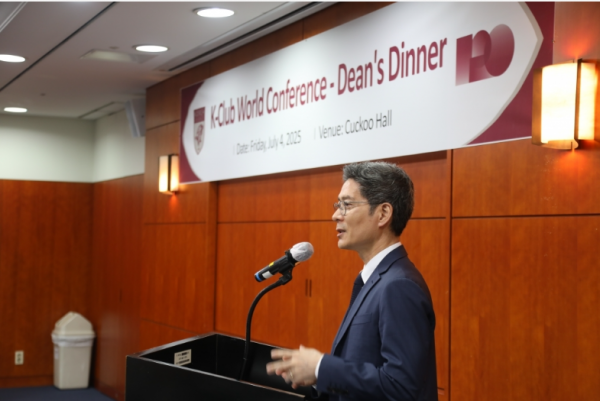
The World Met at K-CLUB: Discussing Global Leadership at Korea University Business School 

The World Met at K-CLUB: Discussing Global Leadership at Korea University Business School  On Friday, July 4, Korea University Business School (KUBS) successfully hosted the K-Club World Conference, a global platform for academic exchange that featured diverse academic sessions and a dinner with distinguished scholars from both Korea and abroad. Gathering researchers and experts from around the world, the conference provided a valuable opportunity to share academic insights and explore avenues for collaboration toward a sustainable future.  In his welcoming remarks, Dean Eonsoo Kim of Korea University Business School stated,  The year 2025 marks both the 120th anniversary of Korea University and a pivotal moment for the K-CLUB program to take a major leap forward,” he said. “Through exchanges with scholars who are producing outstanding research across the globe, Korea University will establish itself as a central hub in the global research collaboration network.  One of the highlights of the event was Theme 9: Insight and Foresight of Business & Industry, held in Room 312 of the SK Future Hall. This session brought together global scholars from various fields of business for an in-depth discussion on the future of industries and sustainable management. Prof. Jay Hyuk Rhee, Director of the ESG Research Center, served as the session chair and led the discussions, while the presenters contributed diverse perspectives on the key challenges confronting contemporary business and management practices, facilitating vibrant academic exchange.  In Session 1, Professor Darjan Karabašević delivered a presentation on the application of Multi-Criteria Decision-Making (MCDM) techniques in business and management. Professor Mustafa Tevfik Kartal examined the impact of environmental changes on sustainability. Professor Umair Akram explored the relationship between artificial intelligence and consumer behavior, while Professor Sunil Kumar proposed disruptive innovation as a strategy for achieving sustainable development.  Session 2 began with a presentation by Professor Ender Demir on strategic responses in an uncertain financial environment. Professor Mahmood Ahmad explored the potential of green finance and ecological innovation in overcoming the resource curse. Professor Gurmeet Singh reflected on his scholarly journey, sharing professional insights and experience. Professor Keng Boon Ooi introduced case studies highlighting innovation in industrial management through information systems. Lastly, Professor Justin Paul offered practical guidance on writing high-quality review papers, providing valuable research know-how.  After the sessions, participants were taken on a campus tour led by KUBE, the student ambassadors of Korea University Business School. The tour began at the KUBS Main Building, where they visited the KUBS Wall of Honor and reflected on the significance of major donors' names and their dedicated contributions to the school's advancement. They then moved to the Startup Station, where they explored the hands-on environment that supports student entrepreneurship, along with the innovative educational programs offered there. At the Hyundai Motor Hall, participants observed how the donor names engraved on the staircase wall embody a culture of voluntary giving that sustains the school’s long-term growth. Finally, at the LG-POSCO Hall, they learned that the building was designed by the same architect behind the Shilla Hotel, and experienced first-hand how its hotel-quality spatial design expresses the school’s educational philosophy and identity. The tour received a highly positive response as it allowed participants to experience the school’s rich heritage, future-oriented vision, and the symbolic values embedded in its architecture and spaces.  In the evening, the Dean’s Dinner, held at Cuckoo Hall, brought together domestic and international faculty members for a warm and meaningful gathering that extended beyond academic exchange, fostering a sense of camaraderie and friendship. The dinner provided a relaxed and welcoming setting for scholars from diverse cultural backgrounds to engage in dialogue, with vibrant discussions on potential joint research and ongoing collaboration.  The K-Club World Conference served as a symbolic event that encapsulated Korea University Business School’s commitment to global leadership, sustainability-driven scholarship, and knowledge-based international cooperation. It reaffirmed KUBS’s status as a knowledge hub that bridges academia and practice, and connects Korea with the global community. Looking ahead, KUBS will continue to expand its foundation for sustainable growth and international collaboration in an evolving global landscape, striving to become a leading global platform for education and research for future generations. 

2025.08.01 Views 2845

[Interview] Professor Taewon Park’s CEMS Skill Seminar – Learning “Real Business” Through Field Expe

[Interview] Professor Taewon Park’s CEMS Skill Seminar – Learning “Real Business” Through Field Experience     Field-based education that allows students to directly observe and engage with corporate transformation and innovation is drawing increasing attention. Korea University Business School’s (KUBS) CEMS Skill Seminar reflects this trend by offering students a unique opportunity to experience real-world business environments firsthand. The seminar was planned and led by Professor Taewon Park—Vice Chairman of Hancom Inc. and Board Member of Chung-Ang University—who used the transformation of Doosan Group as a central case study to emphasize the importance of practical, experience-driven business education that goes beyond theory. KUBS Business Weekly sat down with him to learn more about what “real business” means in today’s educational landscape and what he hopes to cultivate in future global business leaders.   1. What inspired you to design and lead the CEMS Skill Seminar? Each year, I teach a course on “Transformation” to students in the G-MIM program, focusing on how businesses evolve across generations. In particular, I use the case of Doosan Group, where I have built my career, to illustrate how corporate strategies shift and adapt over time. Doosan, founded in 1896, is one of the oldest companies in South Korea.   The company began as Park Seung-jik Store, a dry goods shop, in its first generation. In the second generation, it expanded horizontally and vertically, focusing on OB Beer and other B2C consumer goods businesses. In the third generation, Doosan underwent major restructuring, selling off its consumer businesses including OB Beer, and pivoting toward B2B industries such as heavy industries and construction equipment. In its current, fourth generation, the company is undergoing another transformation, shifting its focus to next-generation energy (such as SMRs), smart machinery, and advanced technology industries.   This Skill Seminar was designed to help students understand how businesses, like Doosan, adapt their strategies in response to technological and societal change in order to survive and grow. At the same time, the course aims to enhance students’ practical understanding of business by introducing key terminology used in real-world corporate settings.   2. What kind of learning or insights did you hope students would gain through the field visits and company tours? Whether or not they come from a business background, most students are exposed to management primarily through theory-based courses. However, real-world business is far more complex and dynamic. In my lectures, I emphasize the “Real Business World,” sharing how companies actually operate. This program allowed students to see how theory is applied in practice through two on-site learning experiences. The first was a visit to Doosan’s headquarters in Bundang, where students observed the office environment and employees’ working styles, and toured the corporate history museum, which outlines how the company’s business evolved through each generation. The second was a two-day field trip to Changwon, where students visited five factories—including smart factories—and experienced Doosan’s cutting-edge manufacturing processes firsthand. They also had the opportunity to see high-level technologies such as small modular reactors (SMRs) and gas turbines up close, both of which are manufactured by only a few countries worldwide. Through these visits, students were able to gain a vivid understanding of global industrial competitiveness.   3. Were there any memorable moments or student reactions during the seminar? What left the deepest impression on me was how satisfied students were with aspects of the program beyond the classroom. During the on-site learning experience, students stayed comfortably in five-star hotel accommodations, each with a private room. We also provided a ten-course dinner paired with wine. After dinner, students naturally gathered and continued to socialize through second and third rounds of informal meetups. This gave them the chance to share stories they didn’t get to exchange during class, and to build a stronger sense of connection and belonging. Rather than just a corporate site visit, the seminar became a meaningful experience of shared learning and interaction. I believe experiences like this leave a lasting impression. Perhaps thanks to programs like this, Korea University ranked first among the 33 CEMS member schools worldwide last year. I believe the Skill Seminar played a meaningful role in achieving that recognition.   4. What are your hopes for the KUBS CEMS program and the Skill Seminar moving forward? I find it highly encouraging that Korea University’s international standing has been rising in recent years. As an adjunct professor who also works in the field, I believe the role of faculty with real-world industry experience is becoming increasingly important. Education grounded in practical experience helps students cultivate realistic judgment and a global business mindset. I hope that the CEMS Skill Seminar will continue to serve as a dynamic educational platform that bridges theory and practice, Korea and the world—enabling students to grow into globally competitive and practice-ready business leaders.

2025.07.31 Views 1891

  • 첫페이지로
  • 21
  • 22
  • 23
  • 24
  • 25
  • 마지막페이지로