TOP

KUBS News

Total 1433

[SK Awards Interview] Professor Minjae Koo: In an Era of Uncertainty, Diverse Cultural Backgrounds

[SK Awards Interview] Professor Minjae Koo: In an Era of Uncertainty, Diverse Cultural Backgrounds Improve Forecast Accuracy Uncertainty does not affect everyone equally. As U.S. firms faced growing import competition from China, most analysts saw their forecast accuracy decline. Yet some were less affected than others. Professor Minjae Koo focused on precisely that difference. His research suggests that the cultural context behind the numbers — and analysts’ own cultural backgrounds — can shape how information is processed in capital markets. Professor Koo, who joined Korea University Business School (KUBS) in 2025, received his second SK Award for the study, “Forecasting Under Uncertainty: Import Penetration and Analysts’ Cultural Advantage.” The study empirically examines how international competition affects the role of information intermediaries. In an era when geopolitical tensions have become a daily reality, the research shows that diversity can be more than a value — it can also provide a tangible competitive advantage. The following is an interview with Professor Koo about the research and the award. Q1. Congratulations on being recognized with the SK Awards. Could you share your thoughts on the award? First, I would like to express my sincere gratitude for this meaningful award. It is a great honor to have my research recognized at Korea University. I would also like to take this opportunity to extend my deep appreciation to my co-authors, who worked with me on this research, and to everyone who supported our work. Q2. Could you briefly introduce the research for which you received the award? This study analyzes how Chinese import penetration affects the earnings forecast accuracy of financial analysts covering U.S. firms. In particular, we examined whether Chinese analysts have an informational advantage in such an environment. Our empirical analysis shows that the more U.S. firms were affected by Chinese import penetration, the more analysts’ forecast accuracy declined overall. However, the decline in forecast accuracy was substantially smaller among Chinese analysts. This suggests that cultural background and contextual knowledge can improve analysts’ ability to process information in complex international competitive environments. Q3. What motivated you to begin this research? The international competitive landscape has shifted rapidly due to recent developments such as the U.S.–China trade tensions and the restructuring of global supply chains. I became interested in whether these macro-level changes might affect not only firm performance and corporate strategy but also how information is produced in capital markets. The study began with the question, “How do international economic shocks change the role of information intermediaries?” The research ultimately showed that cultural background can play an important role in complex international environments. Q4. What impact do you expect this research to have on society or industry? This study demonstrates the value that cultural diversity and expertise can bring to financial markets as globalization deepens and geopolitical risks increase. For companies and financial institutions, the findings highlight the importance of professionals with diverse cultural backgrounds and international perspectives, alongside strong technical capabilities. From a policy perspective, the study also highlights the role of human capital in reducing information asymmetry amid rising international tensions. Q5. Since joining KUBS in 2025, you have already received the SK Awards twice. Is there a secret behind these consecutive achievements? I wouldn’t say there is any particular secret. I believe these achievements were made possible by strong teamwork with my co-authors and constructive feedback from reviewers and editors. Through this study, I was reminded once again that research is not a solitary journey, but a collaborative process that becomes increasingly refined through diverse perspectives and constructive critique.   Q6. Many students today are interested in pursuing careers in accounting. What message would you like to share with them? Accounting is no longer just a discipline that records numbers. In class, I often refer to Nietzsche’s famous statement: “There are no facts, only interpretations.” I understand this to mean that even identical numbers can be viewed and interpreted differently through various lenses. In today’s increasingly dynamic and fast-changing world, I believe such interpretation can become even more complex. Therefore, I would encourage students interested in accounting careers — whether in financial accounting, auditing, or management accounting — to broaden their horizons. They should explore not only fields directly connected to accounting, such as international politics and ESG, but also subjects that may seem less related at first glance, including literature and philosophy. Doing so can help them develop stronger intuition and critical thinking skills. I believe a humanities-based perspective can be very helpful when making broader, more strategic decisions.   About the Paper :   In 2026, “Forecasting Under Uncertainty: Import Penetration and Analysts’ Cultural Advantage,” co-authored by Professor Minjae Koo of Korea University Business School, was accepted for publication in the Journal of International Business Studies. The paper also earned Professor Koo an SK Award. The study examines how analysts’ earnings forecast accuracy shifts as U.S. firms face mounting import competition from China and identifies cultural background as an important factor in information processing under complex international competition. The milestone is especially meaningful as it marks Professor Koo’s second SK Awards since joining KUBS in 2025.   “Forecasting Under Uncertainty: Import Penetration and Analysts’ Cultural Advantage” This study empirically analyzes how import competition from China affects the earnings forecast accuracy of analysts covering U.S. firms. The analysis finds that analysts’ forecasts grew less accurate as U.S. firms faced higher exposure to Chinese import competition. However, Chinese analysts were relatively less affected by this negative impact and delivering more accurate forecasts than their non-Chinese peers.   This informational advantage was even more pronounced when analysts had strong industry expertise or extensive experience covering Chinese firms, and it became stronger during periods of intensifying U.S.–China tensions. Furthermore, the study finds that investors recognized these differences and responded more strongly to forecasts issued by Chinese analysts. By demonstrating that cultural background and expertise can serve as important informational assets in international competitive environments, the study offers new insights into the role of information intermediaries in global capital markets.   ▶ View the full paper: “Forecasting Under Uncertainty: Import Penetration and Analysts’ Cultural Advantage”   KUBS Student Reporter Reporting and Photography by Yeontae Kim

2026.08.14 Views 926

The “Never-ending” network, ‘2019 Executive MBA CARE Program’

The “Never-ending” network, ‘2019 Executive MBA CARE Program’     ‘2019 E-MBA CARE (Continuing Alumni Reaching-out &Education, i.e. CARE) Program’, hosted by KUBS Executive MBA, was held at 19th April (Fri) in LG-POSCO Building room 433. Over 40 participants of EMBA graduates and members attended in the lectures.   The event began with the opening remark from the program director, professor Jae Uk Chun, addressing “I think the word 'CARE’ has a delicate meaning that contains a characteristic of human nature. I believe that all participants here will have a precious time, sharing significant ideas of various topics each other”. After that, Hee Ok Kang, the president of MBA Alumni took a speech saying “Considering that many members and graduates made a reunion tonight, I guess everyone is deeply contemplating for their own future. I truly wish every member of EMBA to become a tomorrow’s shining star”.   For this CARE program, former national baseball player No Jun Park, a current professor in Sports-leisure department of Woosuk University gave a lecture with a topic of ‘Looking at business management with the eyes of baseball’. The lecturer began his presentation telling “I have never been nervous when I played a baseball game in front of 40~50 thousand fans, but it is always not easy to deliver a lecture in my Alma Mater. I will try my best to make a fine approach between the Business leadership and baseball, which is a very rational sports for understanding the business management”. The lecture went through the contents of △Baseball rules and techniques △Baseball and the leadership.   E-MBA CARE, organized by KUBS MBA, periodically invites eminent professors for the special lectures in KUBS. The purpose of the program is to build-up a continuous academic environment for the MBA graduates, and to create a concrete network between the MBA members and graduates.  

2019.04.29 Views 4972

CEMS Interview with Lotta & Pietro

  CEMS Interview with Lotta & Pietro Introduction of CEMS Students: Lotta Mäki Lotta is a final-year CEMS MIM student from Aalto University, Finland, to whom South Korea is the 37th country visited. In addition to her CEMS degree, she is currently pursuing a double MSc degree in Business Analytics and Astrophysics.   Pietro Tansini Pietro is final-year student of CEMS and MSc in International Management from Bocconi University in Milan, Italy. He has worked and lived in 5 different continents with experiences ranging from start-up to multinational corporations. ​ ​ Questions : ​ a. Why did you choose CEMS? [Lotta] I first heard about CEMS as a freshman, but immediately knew that this was my place to be as I dreamt of an international career. The global network of like-minded students and over 70 corporate partners provide you with incredible opportunities during your MIM year, but it is also a community that will have your back for a lifetime. ​ b. What is special about CEMS students? [Pietro] CEMS does not only provide leading education in business, but is primarily a community of people who across generations share the same ambition to have a positive impact through their work. To me the innumerable occasions to meet and learn from each other are the real added value that makes CEMS a life-changing experience. ​ c. What is the value of CEMS network? / How did CEMS improve your network? [Lotta] CEMS has a strong community of people attending the program but also those who have already graduated - ranging from fresh graduates to top executives in large MNEs! Through CEMS network I have already gained valuable professional mentoring and even various job opportunities. ​ d. What can you tell us about the extracurricular activities you attended during your CEMS experience? [Pietro] Definitely CEMS Cup activities that were organized by CEMS Club Seoul! During the semester we split our cohort in 4 teams and had many occasions to collect points to our own team by participating for example a Pub Quiz or small daily recycling tasks during our Sustainability Week, and many others. It worked extremely well to bond with each other and create closer relations within the group! ​ e. What is the role of the CEMS Club? [Lotta] Every member school in CEMS Alliance has their own CEMS Club, which support global networking among students by arranging social activities both locally and overseas together with other CEMS Clubs. CEMS Club also co-operates with CEMS Corporate Partners to provide students with professional development opportunities. ​ f. What has CEMS taught you that you would have not learned otherwise? [Pietro] I think what is really unique about CEMS is the high exposure to corporate environment. It helps immensely to bridge the gap between student and work life. Beyond the professional aspect, even though I had traveled and lived in many countries, I found CEMS the best experience to learn how to be a really conscious citizen of the world. ​ g. What were your best CEMS experiences during the semester at KUBS? [Lotta] Highlights of this semester were definitely our two successful networking field trips in the APAC area. We visited CEMS Club Hong Kong together with CEMSies from Singapore and CEMS Club Tokyo together with CEMS students from Beijing! These trips really demostrated CEMS spirit at its best! ​   Interested to hear more about CEMS in Korea or wish to join our activities to have a sneak peek into the life of CEMSies? Feel free to contact us anytime at cemsclubseoul@gmail.com!      

2019.04.29 Views 8859

KUBS holds Startup Demo Day ‘2019 Spring CHOO CHOO DAY’

KUBS holds Startup Demo Day ‘2019 Spring CHOO CHOO DAY   Korea University Business School (Dean=Jae Wook Kim) will hold ‘2019 Spring CHOO CHOO DAY’ at KUBS LG-POSCO Building at 2 p.m. on May 10th (Fri). This event is a startup demo day where young entrepreneurs, who went through the startup nurturing program by moving into the KUBS Startup Station for 6 months, provide demonstrations and make public announcements of their own product and service. This year, about 300 people of investment parties concerned, university, public institutions, the press, private enterprise, and preliminary entrepreneurs are expected to attend the event.   The following 8 enterprises will make a presentation: △K Beauty Men's cosmetics brand 'Bold Box' which targets the Amazon market △’Enjoying Lions’ presenting DIY cocktail kit ‘Slodka’ △ Life investment platform startup 'TIKLE' △Global emoticon platform startup which provides diverse and unique emoticons around the world, 'StiPop' △ ’DBD Lab’, providing growth hacking tests to help increase business success probability' △'Skylab Entertainment' which develops fantasy and dreamy puzzle / adventure games △'Bilmey’, a contents creator which targets the Malaysian market with mobile video △'SOOHO', a security&compliance specialized startup for block chain business.   Anyone who is interested in the '2019 Spring CHOO CHOO Day' to be held on Friday, May 10 can apply through the link below. Detailed information on the event can be found on the Startup Station website or on Facebook.     KUBS Startup Station   Founded in September 2017, 'KUBS Startup Station' is the first Korean startup training and research institute established within the Business School, and is seeking excellent student entrepreneurs to support their growth to startups. Startup Station hold 'Startup Express', a self-operated startup contest, every semester, and all the residents are selected through a tough competition of more than 10 to1 and by a thorough examination of documents and interviews. The Startup Station provides practical support for pre-entrepreneurs through up to 5 million KRW support per company, Iljin Center for Startup Incubation on the 2nd floor of KUBS Main Building, and the young entrepreneurs education program at the Seung Myung-Ho Center for Entrepreneurship Education. It also consistently provides opportunities for networking, PR, and information-sharing with startup agencies and experts such as △Kim & Chang Law Firm, △Samil PwC, △Amazon Web Services, and △Y Crowdy Funding, which have MOU with KUBS.   ▶ 홈페이지: https://www.startupstation.kr ▶ 페이스북: https://www.facebook.com/kubsstartupstation

2019.04.29 Views 5225

[Startup Institute Lecture on Demand #1] "Startup, who are you going to work with?" - Manager Kim Su

[Startup Institute Lecture on Demand #1] "Startup, who are you going to work with?" - Manager Kim Sung-joon     This year’s first ‘Lecture on Demand,’ hosted by Startup Institute, was held on April 2 at the Seung Myung-Ho Center for Entrepreneurship Education in KUBS Main Building. Kim Sung-joon, manager of the SK Leadership Development Center, gave a lecture on . Kim Sung-joon, who has completed his Ph.D. in management at KUBS, is in charge of diagnosing and analyzing SK Group's executive capabilities and conducting research on startups and large companies. Manager Kim Sung-joon began his lecture by telling the story of how he could discover organizational culture in various parts of the company. "If you look at the composition of parking lots, daily interactions inside elevators, and the structure of the office, you can see how horizontal the organization is about its relationship," Kim said. "Given my past experiences of looking into different companies, I've come to think about how a startup should work and what kind of organizational culture a startup should have." During the lecture, he talked about what kind of person he would start his own business with and what kind of talent he would look for. "Startups are likely to be at odds at the planning stage," Kim said. "It is important to try to understand and complement each other, whether the process is intuitive or logical." He also cited examples of difficulties in finding and hiring talented people, adding that "organizational culture" is very important because culture affects thoughts and attitudes. “Startups should also focus on creating attractive organizational cultures," he added.      Every semester, Startup Institute provides startup education through its "Lecture on Demand," a working-level lecture series, and "Lecture Series," a special lecture series on startups and ventures. Classes are open courses, which means they are open to not only the employees of a tenant company but also anyone interested in starting a business. For related inquiries, you can contact the Startup Institute (02-3290-1699).

2019.04.29 Views 4646

2019 KUBS MBA Admissions Open

2019 KUBS MBA Admissions Open        Korea University Business School (Dean=Professor Jae Wook Kim) is now accepting applications for 2019 MBA admissions. Admissions are open for 3 MBA programs: △Global MBA/Global MIM △S³ Asia MBA.   Global MBA has three application rounds, and Global MIM has two application rounds. Global MBA and Global MIM are programs which equip students to academic and professional skills through a variety of global experiences. If candidates participate in programs at partner schools across the world, they are eligible for the award of degrees from both institutions.    S3 Asia MBA is an Asia-specialized MBA program and has only one application round. Candidates can study at 3 universities in 3 different countries in Asia — Korea University, Fudan University, and National University of Singapore (NUS). Candidates are eligible to graduate with 2 degrees, one from KUBS and the other from either Fudan University or NUS.   Both Global MBA and Global MIM will begin the application of the 1st round starting from the entrance information session which is  held on January 3 (Thu) 2019. The deadline for online application of the 1st round is  January 13 (Sun) 2019 17:00 and submission documents should be accepted the day after (January 14 (Mon) 17:00). The result will be notified on January 18 (Fri) 15:00 and shortlisted applicants will need to attend an interview on January 26 (Sat), then the final outcome will be released on February 1 (Fri) 15:00. The 2nd round of Global MBA and Global MIM's entrance information session is held on February 20 (Wed) 2019 19:00. Online application will be available until March 29 (Fri) 17:00 and documents can be submitted until April 2 (Tue) 17:00. Results of the 2nd round will be released on April 5 (Fri) 15:00 and shortlisted applicants will need to attend an interview on April 13(Sat), then the final outcome will be released on April 23 (Tue) 15:00. The 3rd round is conducted in Global MBA and S³ Asia MBA programs. The entrance information session will be held twice: March 9 (Sat) 2019 14:00(1st) & April 3(Wed) 2019 19:30(2nd) and will convey detailed information about  Global MBA/S³ Asia MBA program. Online applications of the 3rd round are due until April 26 (Fri) 17:00, submission documents are accepted until April 30 (Tue) 17:00. The result will be announced on May 10 (Fri) 15:00 and interviews for shortlisted applicants will be conducted on May 18 (Sat). The final outcome of Global MBA/S³ Asia MBA 3rd round will be released on May 29 (Wed) 15:00. Applications for the 2019 MBA programs can be made online via (https://bizapply.korea.ac.kr). Please contact the Department Office (02-3290-5365) for further information. ※The schedule in the attached file may change depending on the situation.  

2019.04.26 Views 6332

‘Faculty-Student Mentoring Day’: A Special Time with Academic Advisors

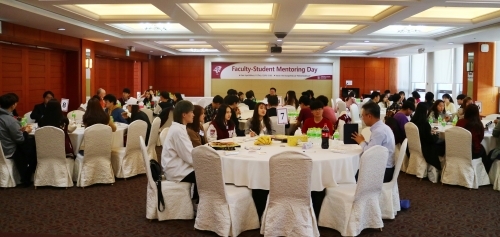
‘Faculty-Student Mentoring Day’: A Special Time with Academic Advisors Korea University Business School (Dean=Kim Jae Wook) held the ‘Faculty-Student Mentoring Day’ event for Spring 2019 on April 8th (Mon), 11th (Thu), and 12th (Fri) at Ahn Young Il Hall and Cuckoo Hall, LG-POSCO Building. The event was held for three days at Ahn Young Il Hall and Cuckoo Hall at LG-POSCO Building between 12:00 PM to 1:00 PM, and 54 faculty and 488 undergraduates participated.   After each student’s pre-application to the event, each student was able to freely attend the meeting and had lunch with their academic advisors in a comfortable atmosphere. In addition, group mentoring was held regarding matters which require advice such as academics, career, and scholarship. The students in attendance spoke not only with their academic advisors but also with other students sitting at the same table, revealing each other's current situation and concerns. Foreign students also participated together as mentees, actively communicating and sharing meaningful time. "As a freshman, I had many problems including my school life, but I think the advice I received from my professor helped me a lot," said Park Yong-chan (Undergraduate, admitted in '19), who attended the event on Tuesday. "As my professor said, I would like to seriously explore what I want, and do my best in that field and have no regrets." "I had a great time since I was able to hear many stories that helped senior students who are serious about their career," said Hong Chang-ui (Undergraduate, admitted in '14), who attended the meeting on Wednesday. "I was also very happy that my academic advisor, Professor Kim Jaehwan, created a happy atmosphere for mentee students."   The ‘Faculty-Student Meeting Day’ of KUBS is an event where professors and business students can meet and talk about their studies and careers. Business schools are holding events every semester to narrow the distance between faculty and students, and motivate students to study. The event, which began in 2011, has established itself as a mentoring program for KUBS based on students' high satisfaction.   지도교수 멘토링 만남의 날 사진 확인하기

2019.04.25 Views 5199

  • 첫페이지로
  • 121
  • 122
  • 123
  • 124
  • 125
  • 마지막페이지로