TOP

KUBS News

Total 1417

‘KUBS 120 MARCH’ Campaign Nears 40% of Goal … Total Pledges Reach Approx. KRW 4.6 Billion

‘KUBS 120 MARCH’ Campaign Nears 40% of Goal … Total Pledges Reach Approx. KRW 4.6 Billion Three major large-scale pledges secured within four months of launch … Campaign continues through May 31     Korea University Business School’s KRW 12 billion fundraising campaign, “KUBS 120 MARCH,” has secured approximately KRW 4.6 billion in pledged donations within just four months of its launch, nearing 40% of its goal.   Since the campaign’s launch in January, when pledged donations stood at around KRW 2 billion, the total has more than doubled in just three months. From December 1, 2025, to March 29, 2026, total pledges reached KRW 4,652,317,231, with 324 participants, including corporations, alumni, faculty, staff, and students.       | Three major pledges secured … Alumni and corporations join forces    One of the most notable achievements is the securing of three major pledges. An anonymous donor pledged support for the research fund, Eugene Investment & Securities Co., Ltd. for the development fund, and Samyang Tongsang for scholarships. Alumni account for approximately 62% of total pledges, while corporations represent about 35%, jointly driving the campaign forward.   Group donations have also continued. Following the participation of the Class of ’81 alumni association, the Business School Class of ’79 Scholarship Committee (28 members), the KUBS Class of ’98 Alumni Night (126 participants), as well as faculty and staff, have also joined the campaign.      | Expanding participation across classes, generations, and professions    The donor base is highly diverse. Participation spans from alumni who entered in the 1970s to current students from the Class of ’26, as well as members of EMBA, DBA, and AMP programs, undergraduate alumni, and even alumni from the College of Medicine. From individual research labs and faculty bands to student councils, all corners of the Business School are actively engaging with the campaign, further broadening its base of participation.   This campaign is particularly meaningful in that it places value not only on the total amount raised but also on participation itself. From small contributions starting at KRW 10,000 to major gifts reaching KRW 1 billion, every act of giving becomes part of the shared legacy of KUBS’s 120-year history.    | Investing in the future campus… Advancing the 3C Trading Zone and 4Tech strategy    The funds raised are being used to realize the Business School’s future vision. Alongside the advancement of the “4Tech Strategy,” centered on AI, semiconductors, energy, and robotics, spatial innovation projects are also taking shape.   The Business School is already operating AI-focused tracks and 4Tech micro-degree programs, and continues to expand its educational and research capabilities with its largest-ever full-time faculty body of 95 members.   On the basement level of Hyundai Motor Hall, the “3C Trading Zone (tentative name)” is currently under development, with a trading demo day scheduled for early May. The space will also include an Art & Culture Room. Artist Uhm Jung-soon’s installation piece, K, the Noseless Elephant, has already been installed in the building.   Construction has also begun on an LED display in the lobby of LG-POSCO Hall, which will serve as a large-scale digital donor wall. An opening ceremony is scheduled following the conclusion of the campaign in May.   Dean Eonsoo Kim stated, “We have come this far thanks to the collective support of each and every member,” adding, “We hope more people will join us on this journey as we prepare for the next 120 years of the Business School.”   The “KUBS 120 MARCH” campaign will continue through May 31, 2026. Donations can be made via the official sponsorship page (box.donus.org/box/koreauniversity/KUBS120march).   As of December 1, 2025 – March 29, 2026 | Total pledged amount: KRW 4,652,317,231

2026.04.17 Views 455

[Lecture Series #2] Lendit CEO Sungjoon Kim "Startup begins from empathy and consideration"

[Lecture Series #2] Lendit CEO Sungjoon Kim "Startup begins from empathy and consideration" The second Lecture Series of 2019 was held at KUBS Main Building 2F, KUBS Startup Station on April 30, 6:30 pm. Sungjoon Kim, CEO of Lendit, gave a lecture on the topic of "From Scientist to Designer, Now P2P Financial Entrepreneur." Lendit is an online platform that connects loans and investments; it has mediated more than 170 billion won over a four-year period and now has the highest market share among local P2P financial platforms.   First, Kim explained his somewhat unusual academic career. Kim graduated from science high school and studied biotechnology at KAIST. While in college, he by chance took a lecture on IDEO, a design firm that designed Apple's interface. With this incident, he felt a great attraction to design studies and changed his major to industrial design. He then studied product design at Stanford University. “After listening to the lecture, I came to realize that design is not just about aesthetic, but needs much more values than that,” Kim said. Recalling the lecture, he stressed the importance of "design thinking" in startups. Kim explained that the keyword for IDEO is “empathy and consideration,” and that design thinking is a way of empathizing with what people look for and being considerate of them to find a solution. Kim also stressed that many observations and experiments are essential. "If you are thinking of starting your own business, try various experiments to find problems through observation, to empathize and be considerate of other people," he advised. Kim stressed this mindset by explaining the early stage of Lendit. "At that time, I had to borrow money from the secondary banking sector since I had already failed in other startups, and I was asked for a very high interest rate of 22 percent," he said. "But when I used the online lending service from the U.S., I was asked to pay 7.8 percent, even though I was a foreigner. This is how I decided to start Lendit." Kim said. "It is better to start a business from an area to which you can relate easily or in which you can become a customer. Start with empathy for the problem, not the mere idea of having your own business,” he added.   The Q&A session was filled with questions from many prospective entrepreneurs. Among them, Seung-jun Park, a KUBS student, asked for advice regarding the difficulty of running a business as a college student. "It's hard to do something else when you launch a startup. If you are not in a hurry, it is not so bad to get a job before you start your own," Kim said. "In fact, you may experience a lot of things and build your know-how through your company life." Every semester, Startup Institute provides startup education through "Lecture on Demand," a working-level lecture series, and "Lecture Series," a special lecture series on startups and ventures. Classes are open courses, which means they are open to not only the employees of a tenant company, but also anyone interested in starting a business. For related inquiries, you can contact the Startup Institute (02-3290-1699).   스타트업 연구원 홈페이지: https://www.startupstation.kr 스타트업 연구원 페이스북:  https://www.facebook.com/kubsstartupstation

2019.05.13 Views 4329

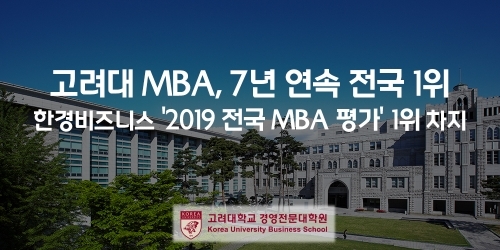
KUBS Tops the Nation's MBA Survey For Seven Consecutive Years

KUBS Tops the Nation's MBA Survey For Seven Consecutive Years     Korea University Business School (Dean=Jae Wook Kim) was ranked No. 1 in the 2019 National MBA Survey. This survey is conducted annually by the HanKyung Business and asks HR managers from the top 300 companies in Korea; KUBS has remained firmly on top of the throne for seven years. KUBS has not missed the No. 1 spot since 2013 when HanKyung Business first started its MBA survey in Korea, and this again proved that the KUBS has the best MBA program in Korea. This year's assessment targeted 15 universities: 13 schools that have been already certified by the Ministry of Education and 2 new schools, KAIST and Sejong University respectively. The survey was conducted by ranking six categories of △preference for recruitment △development potential △organizational cohesion △globalization △professionalism and △entrance recommendation. The total score of KUBS was 4,308 points. Among the six evaluation categories, KUBS ranked first by a high margin in the category of △development potential and △organizational cohesion. KUBS each time has dominated other universities in organizational cohesion. In particular, KUBS ranked first with a very large margin of 283 points with SNU MBA, the second-highest school in organizational cohesion. It shows that KUBS graduates adapt well to new organizations and establish effective and cooperative relationships with their members. In addition, KUBS ranked first with 690 points, higher than SNU MBA (612 points) in development potential. Meanwhile, Yonsei University MBA remained in third place as last year, showing strong performance in globalization sector. Fourth place went to KAIST MBA. SKK GSB ranked fifth, finishing second in organizational cohesion. The top six to ninth places went to Sogang University with 2,488 points, Hanyang University with 2,155 points, Chung-Ang University with 1,452 points and Ewha Womans University with 1,063 points – the same ranking as last year. Konkuk University (733 points), Dongkuk University (601 points), Inha University (406 points), Sookmyung Women's University (338 points), Chonnam National University (193 points) and Sejong University (159 points) followed after.   Related News [한경비즈니스] “문화적인 역량이 고려대 MBA의 저력”  [한경비즈니스] 고려대 MBA 7년째 1위 수성, ‘빅5’는 어디?  [한경비즈니스] 고려대, 국내 유일 CEMS 정회원…국제경쟁력이 7년 연속 1위 비결

2019.05.02 Views 5523

The “Never-ending” network, ‘2019 Executive MBA CARE Program’

The “Never-ending” network, ‘2019 Executive MBA CARE Program’     ‘2019 E-MBA CARE (Continuing Alumni Reaching-out &Education, i.e. CARE) Program’, hosted by KUBS Executive MBA, was held at 19th April (Fri) in LG-POSCO Building room 433. Over 40 participants of EMBA graduates and members attended in the lectures.   The event began with the opening remark from the program director, professor Jae Uk Chun, addressing “I think the word 'CARE’ has a delicate meaning that contains a characteristic of human nature. I believe that all participants here will have a precious time, sharing significant ideas of various topics each other”. After that, Hee Ok Kang, the president of MBA Alumni took a speech saying “Considering that many members and graduates made a reunion tonight, I guess everyone is deeply contemplating for their own future. I truly wish every member of EMBA to become a tomorrow’s shining star”.   For this CARE program, former national baseball player No Jun Park, a current professor in Sports-leisure department of Woosuk University gave a lecture with a topic of ‘Looking at business management with the eyes of baseball’. The lecturer began his presentation telling “I have never been nervous when I played a baseball game in front of 40~50 thousand fans, but it is always not easy to deliver a lecture in my Alma Mater. I will try my best to make a fine approach between the Business leadership and baseball, which is a very rational sports for understanding the business management”. The lecture went through the contents of △Baseball rules and techniques △Baseball and the leadership.   E-MBA CARE, organized by KUBS MBA, periodically invites eminent professors for the special lectures in KUBS. The purpose of the program is to build-up a continuous academic environment for the MBA graduates, and to create a concrete network between the MBA members and graduates.  

2019.04.29 Views 3909

CEMS Interview with Lotta & Pietro

  CEMS Interview with Lotta & Pietro Introduction of CEMS Students: Lotta Mäki Lotta is a final-year CEMS MIM student from Aalto University, Finland, to whom South Korea is the 37th country visited. In addition to her CEMS degree, she is currently pursuing a double MSc degree in Business Analytics and Astrophysics.   Pietro Tansini Pietro is final-year student of CEMS and MSc in International Management from Bocconi University in Milan, Italy. He has worked and lived in 5 different continents with experiences ranging from start-up to multinational corporations. ​ ​ Questions : ​ a. Why did you choose CEMS? [Lotta] I first heard about CEMS as a freshman, but immediately knew that this was my place to be as I dreamt of an international career. The global network of like-minded students and over 70 corporate partners provide you with incredible opportunities during your MIM year, but it is also a community that will have your back for a lifetime. ​ b. What is special about CEMS students? [Pietro] CEMS does not only provide leading education in business, but is primarily a community of people who across generations share the same ambition to have a positive impact through their work. To me the innumerable occasions to meet and learn from each other are the real added value that makes CEMS a life-changing experience. ​ c. What is the value of CEMS network? / How did CEMS improve your network? [Lotta] CEMS has a strong community of people attending the program but also those who have already graduated - ranging from fresh graduates to top executives in large MNEs! Through CEMS network I have already gained valuable professional mentoring and even various job opportunities. ​ d. What can you tell us about the extracurricular activities you attended during your CEMS experience? [Pietro] Definitely CEMS Cup activities that were organized by CEMS Club Seoul! During the semester we split our cohort in 4 teams and had many occasions to collect points to our own team by participating for example a Pub Quiz or small daily recycling tasks during our Sustainability Week, and many others. It worked extremely well to bond with each other and create closer relations within the group! ​ e. What is the role of the CEMS Club? [Lotta] Every member school in CEMS Alliance has their own CEMS Club, which support global networking among students by arranging social activities both locally and overseas together with other CEMS Clubs. CEMS Club also co-operates with CEMS Corporate Partners to provide students with professional development opportunities. ​ f. What has CEMS taught you that you would have not learned otherwise? [Pietro] I think what is really unique about CEMS is the high exposure to corporate environment. It helps immensely to bridge the gap between student and work life. Beyond the professional aspect, even though I had traveled and lived in many countries, I found CEMS the best experience to learn how to be a really conscious citizen of the world. ​ g. What were your best CEMS experiences during the semester at KUBS? [Lotta] Highlights of this semester were definitely our two successful networking field trips in the APAC area. We visited CEMS Club Hong Kong together with CEMSies from Singapore and CEMS Club Tokyo together with CEMS students from Beijing! These trips really demostrated CEMS spirit at its best! ​   Interested to hear more about CEMS in Korea or wish to join our activities to have a sneak peek into the life of CEMSies? Feel free to contact us anytime at cemsclubseoul@gmail.com!      

2019.04.29 Views 7575

KUBS holds Startup Demo Day ‘2019 Spring CHOO CHOO DAY’

KUBS holds Startup Demo Day ‘2019 Spring CHOO CHOO DAY   Korea University Business School (Dean=Jae Wook Kim) will hold ‘2019 Spring CHOO CHOO DAY’ at KUBS LG-POSCO Building at 2 p.m. on May 10th (Fri). This event is a startup demo day where young entrepreneurs, who went through the startup nurturing program by moving into the KUBS Startup Station for 6 months, provide demonstrations and make public announcements of their own product and service. This year, about 300 people of investment parties concerned, university, public institutions, the press, private enterprise, and preliminary entrepreneurs are expected to attend the event.   The following 8 enterprises will make a presentation: △K Beauty Men's cosmetics brand 'Bold Box' which targets the Amazon market △’Enjoying Lions’ presenting DIY cocktail kit ‘Slodka’ △ Life investment platform startup 'TIKLE' △Global emoticon platform startup which provides diverse and unique emoticons around the world, 'StiPop' △ ’DBD Lab’, providing growth hacking tests to help increase business success probability' △'Skylab Entertainment' which develops fantasy and dreamy puzzle / adventure games △'Bilmey’, a contents creator which targets the Malaysian market with mobile video △'SOOHO', a security&compliance specialized startup for block chain business.   Anyone who is interested in the '2019 Spring CHOO CHOO Day' to be held on Friday, May 10 can apply through the link below. Detailed information on the event can be found on the Startup Station website or on Facebook.     KUBS Startup Station   Founded in September 2017, 'KUBS Startup Station' is the first Korean startup training and research institute established within the Business School, and is seeking excellent student entrepreneurs to support their growth to startups. Startup Station hold 'Startup Express', a self-operated startup contest, every semester, and all the residents are selected through a tough competition of more than 10 to1 and by a thorough examination of documents and interviews. The Startup Station provides practical support for pre-entrepreneurs through up to 5 million KRW support per company, Iljin Center for Startup Incubation on the 2nd floor of KUBS Main Building, and the young entrepreneurs education program at the Seung Myung-Ho Center for Entrepreneurship Education. It also consistently provides opportunities for networking, PR, and information-sharing with startup agencies and experts such as △Kim & Chang Law Firm, △Samil PwC, △Amazon Web Services, and △Y Crowdy Funding, which have MOU with KUBS.   ▶ 홈페이지: https://www.startupstation.kr ▶ 페이스북: https://www.facebook.com/kubsstartupstation

2019.04.29 Views 4024

[Startup Institute Lecture on Demand #1] "Startup, who are you going to work with?" - Manager Kim Su

[Startup Institute Lecture on Demand #1] "Startup, who are you going to work with?" - Manager Kim Sung-joon     This year’s first ‘Lecture on Demand,’ hosted by Startup Institute, was held on April 2 at the Seung Myung-Ho Center for Entrepreneurship Education in KUBS Main Building. Kim Sung-joon, manager of the SK Leadership Development Center, gave a lecture on . Kim Sung-joon, who has completed his Ph.D. in management at KUBS, is in charge of diagnosing and analyzing SK Group's executive capabilities and conducting research on startups and large companies. Manager Kim Sung-joon began his lecture by telling the story of how he could discover organizational culture in various parts of the company. "If you look at the composition of parking lots, daily interactions inside elevators, and the structure of the office, you can see how horizontal the organization is about its relationship," Kim said. "Given my past experiences of looking into different companies, I've come to think about how a startup should work and what kind of organizational culture a startup should have." During the lecture, he talked about what kind of person he would start his own business with and what kind of talent he would look for. "Startups are likely to be at odds at the planning stage," Kim said. "It is important to try to understand and complement each other, whether the process is intuitive or logical." He also cited examples of difficulties in finding and hiring talented people, adding that "organizational culture" is very important because culture affects thoughts and attitudes. “Startups should also focus on creating attractive organizational cultures," he added.      Every semester, Startup Institute provides startup education through its "Lecture on Demand," a working-level lecture series, and "Lecture Series," a special lecture series on startups and ventures. Classes are open courses, which means they are open to not only the employees of a tenant company but also anyone interested in starting a business. For related inquiries, you can contact the Startup Institute (02-3290-1699).

2019.04.29 Views 3587

  • 첫페이지로
  • 116
  • 117
  • 118
  • 119
  • 120
  • 마지막페이지로