TOP

KUBS News

Total 1428

Interview with Professor Woochan Kim, Recipient of the Hongjo Order of Service Merit - Leading Corp

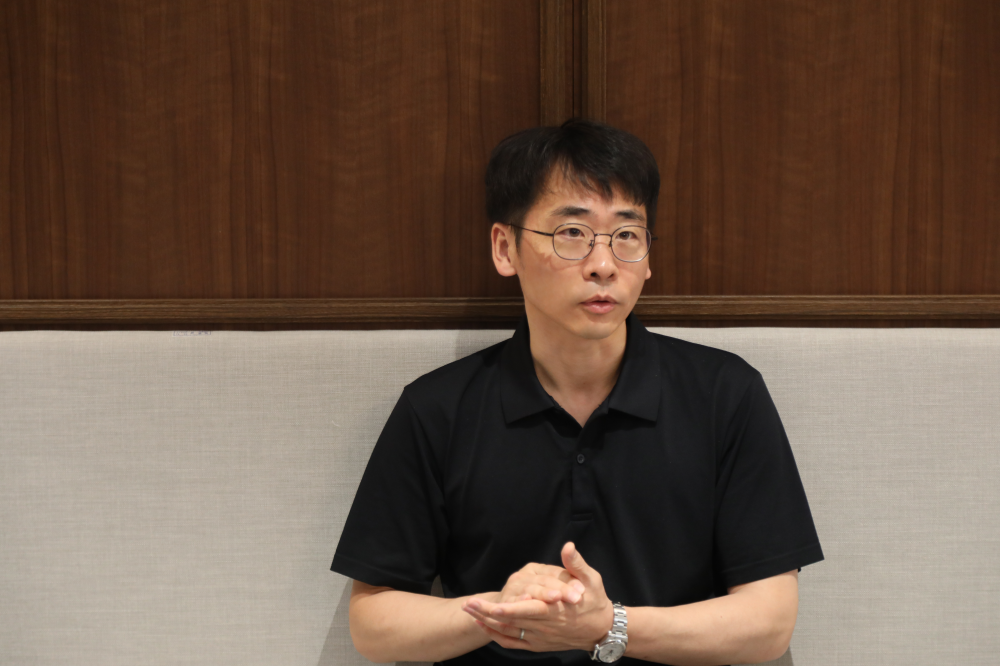
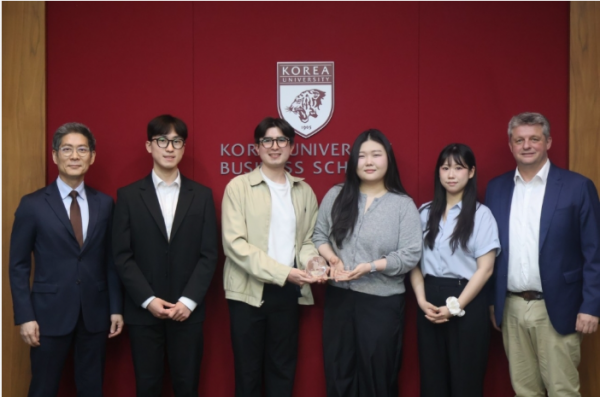
[Interview with Professor Woochan Kim, Recipient of the Hongjo Order of Service Merit] Leading Corporate Governance Reform with Unwavering Conviction     On April 1, Professor Woochan Kim received the Hongjo Order of Service Merit at the 25th Fair Trade Day ceremony, hosted by the Korea Fair Trade Commission, in recognition of his contributions to establishing a fair and competitive market order. Having long been at the forefront of corporate governance reform, Professor Kim has consistently raised critical questions about Korea’s corporate governance system. More recently, he has expanded his work into the policymaking arena by serving on a number of national advisory bodies and committees. In this interview, Professor Kim reflects on the path he has taken, shares his views on corporate governance reform and economic growth, and offers advice to students. Below is an edited transcript of the interview.   Q1. Congratulations on receiving the Hongjo Order of Service Merit. Could you share your thoughts on receiving the honor? First, I would like to express my gratitude to everyone who has supported me. The achievements for which I received this honor were the result of a collective effort by my colleagues and me. I could never have received this honor without the support of the full-time research fellows at the Solidarity for Economic Reform and the Economic Reform Research Institute. I would like to extend my sincere thanks to all of them.   Q2. You were recognized for your efforts to curb self-dealing and improve related regulations through your work as Director of the Economic Reform Research Institute and in other roles. What does this honor mean to you personally? The path of corporate governance and chaebol reform that I have pursued has never been an easy one. Because the issues we address are deeply connected to structural interests within our society, bringing about change requires considerable time and patience. At times, I found myself wondering, “Why am I doing this?” or “Could I be doing something wrong?” Receiving this honor validated the path I have taken and reassured me that I have been moving in the right direction.     Q3. Was there a defining moment that first sparked your interest in corporate governance and led you to make it your lifelong work? I gradually found myself drawn to the field. I first learned about corporate governance while studying abroad. During my doctoral studies, I attended a guest lecture by Professor Andrei Shleifer of Harvard University’s Department of Economics. Hearing him explain corporate ownership structures was what first drew my attention to the field.Then the Asian financial crisis occurred. At the root of the crisis was the chaebol problem. Korean banks borrowed funds in foreign currencies, converted them into Korean won, and lent the money to chaebol groups. The chaebol groups failed to use those funds effectively and were unable to repay their debts, which contributed to the financial crisis. That was when I realized that the chaebol issue was a problem of national importance. After becoming a professor, I joined the People’s Solidarity for Participatory Democracy and participated in the minority shareholder movement with Professor Hasung Jang. I found it rewarding to take direct action, such as attending shareholders’ meetings and filing shareholder derivative suits. I later joined the Solidarity for Economic Reform when it was established and have remained involved ever since.   Q4. On March 31, you stepped down as the founding Director of the Economic Reform Research Institute, which you had led since its establishment. What led you to step down after such a long tenure? We would also like to know the most valuable takeaway from your time as Director. Our work began with the Economic Democratization Committee of the People’s Solidarity for Participatory Democracy. In 2006, several of us who had worked together left the organization and founded the Solidarity for Economic Reform. Soon afterward, we concluded that its activities needed to be supported by empirical policy research, and we launched the Economic Reform Research Institute in 2009. I served as its founding Director for 17 years. I had been considering stepping down for several years, and as my external responsibilities suddenly increased this year, I decided that it was time to leave the position. One of the most important lessons I learned while leading the institute was that capable members are more important than anything else if an organization is to function effectively. The members of our organization are exceptionally capable experts who work largely behind the scenes. No matter what I ask them—even about subjects I know little about—they can provide an answer within minutes. I also learned how important it is for capable individuals to share common values. Everyone at the institute shares the same mission and sense of purpose: improving corporate governance. Because of this shared commitment, we have been able to resolve differences of opinion without much difficulty. I believe I was able to achieve many meaningful results over the past 17 years because I had the opportunity to work with such talented and committed people.   Q5. In March, you were appointed as a member of the Growth Economy Subcouncil of the National Economic Advisory Council. How do you believe corporate governance is connected to the country’s medium- and long-term economic growth strategy? The central challenge in achieving sustainable economic growth is determining how efficiently we can use the capital and labor available to us. Corporate governance reform is therefore essential to improving the efficiency of capital.Shareholders provide capital to a company with the expectation that its managers will use it efficiently. In many cases, however, managers invest in non-core businesses or hold real estate unrelated to the company’s operations. In many cases, returning such funds to shareholders through dividends would represent a more efficient allocation of capital. If shareholders then invest those dividends in more productive companies, the efficiency of capital allocation across the economy as a whole will improve.     Q6. You were also appointed vice chair of the Financial Consumer Protection Advisory Committee at the Financial Supervisory Service. In your role as a champion for financial consumers, is there a particularly urgent issue that you would like to address? It would be difficult to single out just one urgent issue. Financial consumer protection can be broadly divided into four areas. First, there is the problem of mis-selling in the design and sale of financial products. Second, there is financial crime. As technology continues to advance, the number of victims of phishing scams has been increasing. Third, the threat of cyberattacks is also growing. Finally, there is the need to promote inclusive finance and shared growth initiatives. Financial support and protection for vulnerable groups are equally important. All of these issues are important, so it is difficult to say that any one of them is more urgent than the others. The Financial Consumer Protection Advisory Committee is the highest-level advisory committee within the Financial Supervisory Service, demonstrating how seriously the agency regards financial consumer protection.   Q7. You also lead research at Korea University as Director of the Asian Institute of Corporate Governance. What unique contribution can a university research institute make to society that national advisory bodies or civic organizations cannot? The Asian Institute of Corporate Governance is Korea’s first and virtually only university-affiliated research institute dedicated to corporate governance. Taking advantage of its position within a university, the institute contributes through academic research rather than policy research. In addition to traditional corporate governance issues, we have broadened the scope of our work by supporting research projects related to environmental, social, and governance issues. We also feature internationally renowned professors at our annual online symposium.   Q8. Last November, the second National Corporate Governance Competition for Students was held by the Korea Corporate Governance Forum and the Asian Institute of Corporate Governance. Was there a particular reason or concern that led you to organize the competition? Were there any student proposals from the competition that particularly stood out to you? The first competition was open only to students at Seoul National University School of Law. However, the number of participants fell short of our expectations. For the second competition, we therefore opened it to undergraduate students in order to encourage broader participation. The fundamental purpose of the competition is to encourage university students to take a greater interest in corporate governance issues and understand their importance. Many students participated in the second competition, so I believe we accomplished that objective. All of the participants presented outstanding ideas, but the Gold Prize-winning team was the most memorable. What distinguished the team was that it proposed an idea that controlling shareholders could also accept. Most of the other teams made proposals that were unlikely to be accepted in practice, but the Gold Prize-winning team presented an approach that could also provide economic benefits to controlling shareholders. I found that particularly impressive.   Q9. What issues do you hope Korea University Business School students who aspire to enter the field of corporate governance research will consider during their university years? After graduation, many business school students enter fields that provide professional services to companies. In many cases, however, their work ultimately serves the interests of controlling shareholders or individual executives. I hope students recognize that there is also a third path. They can choose to stand with shareholders and pursue work that contributes to corporate governance reform. This field remains very small at present, but it may grow considerably in the future. I hope students will also consider careers in this direction.   Q10. While concluding some of your previous responsibilities, you have also taken on many new positions. Do you see this period as a turning point in your life? Finally, what is your next goal or challenge? I do not think of it as a particularly significant turning point. I have continued to do the same kind of work, and I intend to keep doing it in the future. As for my next challenge, I am considering a new form of publication that is neither a conventional printed book nor a standard e-book. I am thinking about creating a book using Notion, which would allow me to incorporate multimedia content, include a variety of links, and continually revise and update the material. Corporate governance reform involves a complex web of interests and can therefore become a lonely struggle. Nevertheless, Professor Kim has continued this work steadily, regarding it both as a mission and as something he genuinely enjoys.The path he has followed with unwavering conviction is far from over. He continues to move forward, taking on the challenges that remain unresolved.   KUBS Student Press | Reporting by Jinyoung Kim

2026.07.24 Views 19

Debut Stage for Rookie Entrepreneurs – 2025 Spring CHOO CHOO Day Successfully Held 

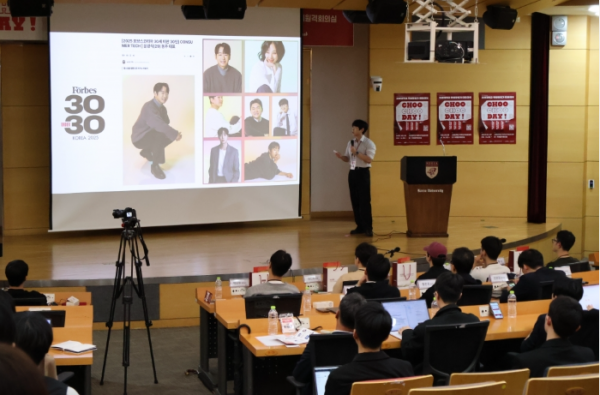
Debut Stage for Rookie Entrepreneurs – 2025 Spring CHOO CHOO Day Successfully Held      The 2025 Spring CHOO CHOO Day, a student startup demo day hosted by the Korea University Business School Startup Station, was held on Friday, May 9, in the Global Conference Hall on B1 of the Centennial Memorial Samsung Hall.  The event took the form of a demo day, where five rookie startup teams currently participating in the Startup Institute’s incubation program presented their progress, and shared the vision and potential of their ventures. Each team introduced their business ideas, go-to-market strategies, and future plans, gaining valuable, hands-on feedback from the audience.      The following five teams participated in Choo Choo Day , each showcasing their innovative startup idea: △ MARKWORKS: An AI-powered patent filing solution designed for patent attorneys, offering product similarity assessment and proactive search capabilities. △ NAWA: ‘CUPGGIRI’, a smart cup solution that automatically washes, dries, compresses, and collects cups, △ ATLO: ‘Ditto’, a personalized AI companion you can talk to anytime, anywhere, △ Live-Lively: ‘NoriCare’, a healthcare solution for managing chronic conditions in seniors, △ PEEKABOOLABS: ‘Carve’, an on-device AI solution that automatically optimizes system performance.    The event began with opening remarks by Youngkyung Kim, Director of the Iljin Center for Startup Incubation, who noted, “Today marks the moment when these well-prepared graduating startups declare their readiness to take off like rockets,” emphasizing the significance of CHOO CHOO Day.    Dae Il Nam, Vice Dean of Korea University Business School, delivered a welcome address, stating, “Today is not merely a presentation, but a stage to demonstrate your potential for the future.” He went on to encourage the participants, saying, “The journey of challenge, failure, and rising again will make each of you stronger.”      During the Open Mic session, Kwangsik Yoon, CEO of DONGJOO., that operates ‘SPINNOFF’—an AI-based team-building solution for creating novel comics—shared advice, saying, “If you have the reason why you started, a good grasp of market trends, and trustworthy teammates, your startup’s direction will naturally form.”    The event continued with five-minute pitches and eight-minute Q&A sessions for each team. The panelists included Eunwoo Park (Partner, MASHUP VENTURES), Ino Jung (Team Lead, POSTECH HOLDINGS), Hakyeong Kim (CEO, ZDVC), Ukjin Kwon (Principal, PRIMER SAZZE), and Minhong Jang (Advisor, BASS VENTURES), who offered sharp questions and practical advice while carefully evaluating the teams' potential.      The event concluded with closing remarks by Joon Ho Hwang, Director of the Startup Station, who said, “I could truly feel the spirit of youth, innovation, and challenge today,” adding, “I hope CHOO CHOO Day continues to support the growth of innovative startups and serves as a catalyst for revitalizing the economy.”    Korea University Business School’s Startup Station organizes CHOO CHOO Day each semester to provide young entrepreneurs with real startup experience and opportunities for network building. The institute plans to continue expanding various programs to support the growth of startups with innovative ideas and execution capabilities. 

2025.05.26 Views 3104

Walking the Campus, Envisioning the Future: 2025 KUBS Regular Campus Tour and Youth Day

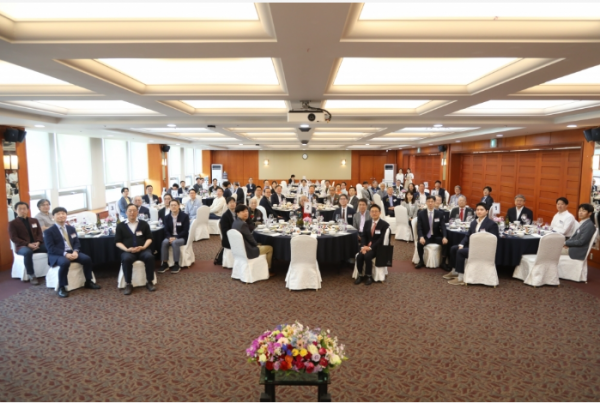
Walking the Campus, Envisioning the Future: 2025 KUBS Regular Campus Tour and Youth Day      On Saturday, May 17, Korea University Business School (KUBS) hosted the “2025 KUBS Regular Campus Tour and Youth Day” on its campus. The event welcomed approximately 100 high school students from across the country, offering them a glimpse into real college life and in-depth insights into business studies. The program was organized and led by KUBE, the official student ambassadors of KUBS, who shared their personal university experiences and perspectives.  The program consisted of △an opening ceremony, △About KUBS (an introduction to the business school and its majors), △a group photo session, △a student transition period and break, △a campus tour, △a mentoring session with enrolled students, and △a closing ceremony.      During the opening ceremony, Associate Dean Hyun Seung Na warmly welcomed the students, saying, “I sincerely thank you for taking the time and effort to be here today. I hope this experience helps you understand why business studies are essential to society and inspires greater motivation.” He especially acknowledged participants who traveled long distances from cities such as Changwon and Busan, adding, “As a small token of appreciation, we will gift Korea University tiger plushies to those who came from the farthest regions.”  The remark was met with enthusiastic applause and cheers from the audience.      The event was emceed by KUBE President Ujin Shin and Vice President Minji Kang. During the About KUBS session, ambassadors Junseok Hong and Chaewoo Lee introduced the business school, followed by Sihoon Moon and Dajin Kim, who presented an engaging overview of the school’s nine academic concentrations.  They highlighted KUBS’s reputation as the top producer of certified public accountants (CPAs) in Korea and its global learning environment, supported by 90 full-time professors and over 61.2% of classes conducted in English. To make the content more relatable, the ambassadors used the example of ramen — covering its production, distribution, and marketing — to explain business specializations in a fun and accessible way. A final quiz session added to the excitement, with small prizes awarded to students who answered correctly.      Following the group photo, students were divided into teams and gathered in lecture rooms at Hyundai Motor Hall. Each group, guided by KUBE ambassadors, embarked on a campus tour that included key business facilities — LG-POSCO Hall, Hyundai Motor Hall, and the Main Building — as well as notable locations on the Humanities and Social Sciences Campus such as the Centennial Memorial Samsung Hall, SK Future Hall, and the underground facilities beneath Central Plaza. Students took commemorative group photos at each stop, creating lasting memories.      The mentoring session that followed provided an open space for questions on admissions, academics, and university life. When asked about study strategies, ambassador Chaewoo Lee shared, “Understanding the test maker’s intent is key to performing well on school exams. I used vacation periods to prepare for the Korean SAT and focused on school grades during the semester to maintain balance.”  The ambassadors also introduced diverse career paths including CPA preparation, the Public Officer Qualification Exam, and launching a startup, offering practical insights and motivation to participants as they explore their future academic and career goals.      One student shared, “I was unsure about my future, but today sparked my interest in business. Now I’m dreaming of entering Korea University and becoming a member of KUBE.”      The KUBS Regular Campus Tour and Youth Day has evolved into more than just a campus visit — it offers meaningful, hands-on experiences that help students envision their academic journey and future careers. Held twice annually in May and November, the next Youth Mentoring Day, providing deeper insights into business education, is scheduled for July. Applications will open in June via the official KUBE website. 

2025.05.26 Views 3451

CEMS (KUBS Member School) Corporate Partner Survey Results Released 

CEMS (KUBS Member School) Corporate Partner Survey Results Released  "Professionalism and business acumen alone will not be enough for leadership success after 2030"      The Global Alliance in Management Education, CEMS, of which Korea University Business School (KUBS) is a member, has released research findings conducted in collaboration with 20 multinational corporate partners, revealing a fundamental shift in the core competencies required for successful leadership beyond 2030.  The study was based on interviews with HR and leadership professionals from the 20 CEMS partner companies. While technical expertise and business acumen remain important, there was broad consensus that future leaders must be more human-centric, culturally agile, and entrepreneurial.  CEMS corporate partners have identified five core competencies that will be essential for next-generation leaders in the post-2030 era:  1. Fusion of Analytical Skills and Creativity  Future leaders must go beyond simply interpreting data—they must be able to synthesize complex information, derive strategic decisions, and combine analytical rigor with creative thinking that cannot be replicated by automation or AI.  2. Entrepreneurial Mindset  An entrepreneurial mindset involves the ability to challenge conventional business models, embrace change, and drive purpose-driven innovation. This adaptive and proactive approach is increasingly seen as critical for leadership in a rapidly evolving environment.  3. Cultural Intelligence (CQ)  The ability to effectively communicate and collaborate with teams from diverse cultural backgrounds is emerging as a key determinant of global leadership success. Cultural agility is essential in navigating multicultural teams and global business contexts.  4. Combination of Subject-Matter Expertise and Strategic Business Insight  Future leaders must go beyond general management knowledge. A deep understanding of specific industries—combined with the ability to integrate that expertise into strategic perspectives—will be a key differentiator in driving business success.  5. Digital Agility  While future leaders are not expected to be digital specialists, they must possess a keen awareness of major digital trends and data analytics. Equally important is the ability to bridge communication between technical and business teams to guide effective decision-making.  These competencies underscore the growing importance of human-centered qualities in future leadership. Essential attributes for next-generation leaders now include resilience, adaptability, humility, emotional intelligence, value-driven decision-making, and a strong commitment to physical and mental well-being—as well as to sustainability  Jonathan von Gutzeit, Head of Talent Experience at Lufthansa Group—one of the companies that participated in the research—remarked that “the next generation of leaders must be more than just capable.” He identified ambition, responsibility, and empathy as essential qualities, and added that future leaders should be able to “pioneer new markets through strategic thinking, innovation, and customer-centricity, while cultivating inclusive and empowering organizational cultures.”  Nicolas Barbier of BNP Paribas Portugal also underscored the importance of flexibility, global awareness, and a collaborative mindset. He noted that “those who can think flexibly in rapidly changing environments, adapt well to global organizations encompassing diverse nationalities and cultures, and co-create within teams are the ones who will grow into effective leaders.”      CEMS is a global alliance in international management education, active across six continents and comprising 33 leading business schools, more than 70 multinational companies, and 8 NGOs. Together, they jointly operate the CEMS Master in International Management (MIM) program, which produces over 1,300 graduates each year. Notably, the CEMS MIM was ranked 10th out of 206 programs worldwide in the 2025 QS Master’s in Management Rankings, reaffirming its position among the world’s top programs.  Korea University Business School, the only CEMS member school in South Korea, operates the CEMS Global MIM program and is dedicated to cultivating the next generation of global leaders through a practice-oriented international curriculum that includes overseas study, internships, and corporate projects.  The five core competencies identified by CEMS—△the fusion of analytical skills and creativity, △an entrepreneurial mindset, △cultural intelligence, △the combination of expertise and strategic business insight, and △digital agility—are closely aligned with the educational philosophy of Korea University Business School (KUBS).  Looking ahead, KUBS will further strengthen its integrated leadership education, encompassing interdisciplinary themes such as AI, ESG, multicultural management, and human-centered design. Through robust support across education, research, and industry-academia collaboration, the school is committed to fostering authentic and sustainable global leaders capable of creating meaningful value on the international stage.   

2025.05.26 Views 3206

“A Business Major Embraces Art” — The Startup Journey of Open Gallery CEO Park Eui-gyu 

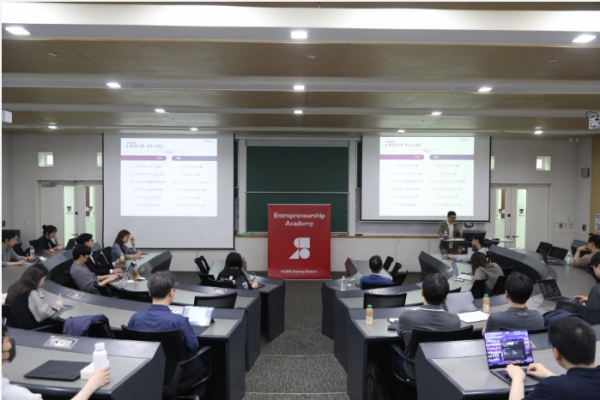
“A Business Major Embraces Art” — The Startup Journey of Open Gallery CEO Park Eui-gyu      A special lecture, part of the Entrepreneurship Academy, was held on Tuesday, April 29 in Room B307 (Kolon Lecture Hall) of the Hyundai Motor Hall. The event was hosted by the Startup Research Institute at Korea University Business School. The lecture, titled "Starting a Business in Arts & Culture: Pioneering a Non-Existent Market," was delivered by Park Eui-gyu, CEO of the art rental platform Open Gallery. He offered a candid and insightful account of the challenges and realities of launching a business in the cultural and arts sector, as well as his entrepreneurial journey in building a startup from the ground up.  A graduate of Korea University Business School, CEO Park founded Open Gallery with the vision of making art more accessible in everyday life. He shared candid insights into the process of turning an initial idea into a functioning service, the trials and errors encountered in the market, the strategies he used for growth, and how he continues to pursue his mission of “democratizing art.”      The lecture began with an introduction to Open Gallery. The company offers a service that allows users to rent and install artworks by popular Korean artists at affordable prices. It also provides personalized recommendations from professional curators, along with a QR code service that gives users detailed information about each piece. “By bringing art into everyday spaces, we act as a bridge between the public and artists,” Park said. “Our mission is to help talented artists gain the exposure they deserve.” Currently, more than 2,500 artists have registered approximately 67,000 artworks on the platform.      Park also shared how he drew on his background in strategy consulting to identify inefficiencies in the arts sector and develop an innovative model to solve them.  “There were virtually no international cases to benchmark,” he recalled. “So I conducted interviews with over a hundred people to understand consumer needs in detail, one by one.” His method of uncovering the intersection between art and business offered valuable insights to the audience.  He also shared practical advice for students preparing to launch their own ventures. “Starting a business is a highly unconventional path,” he said. “Once you make the decision, you must treat it as your top priority for the next ten years.”  Park emphasized the unique appeal of entrepreneurship, calling it “the most effective way to solve real-world problems.”  He also spoke about the mindset and leadership qualities essential for entrepreneurship.  “You need the resilience to endure failure and the ability to turn setbacks into assets,” he said, emphasizing the importance of self-reflection and feedback. “Leadership is about earning people's trust,” he continued. “You have to find balance in your business by harmonizing with people from diverse backgrounds.”       The lecture concluded with a Q&A session, during which Park offered heartfelt encouragement to aspiring student entrepreneurs. “Entrepreneurship is ultimately an expression of individuality,” he remarked. “Above all, it’s important to meet people from various walks of life and broaden your engagement with the world.” By addressing the real concerns of student entrepreneurs, he offered both a realistic view of the startup ecosystem and warm encouragement—adding depth and energy to the event’s conclusion.  This lecture was part of the Entrepreneurship Academy series organized by the Startup Station. The program invites seasoned entrepreneurs and industry experts to deliver practical insights and support for aspiring and early-stage founders. Korea University Business School will continue to support student entrepreneurs by offering a range of lecture series and practice-oriented programs designed to foster their growth and encourage new challenges. 

2025.05.16 Views 4090

Korea University Business School Opens Applications for Fall 2025 G-MBA and CEMS Global MIM Programs

Korea University Business School Opens Applications for Fall 2025 G-MBA and CEMS Global MIM Programs      Korea University Business School is now accepting applications for the Fall 2025 intake of its Global MBA (G-MBA) and CEMS Global MIM (G-MIM) programs. As in previous years, the programs continue to attract outstanding applicants aspiring to become global business leaders, reaffirming their strong reputation and popularity.  Currently, both G-MBA and G-MIM programs are in the third round of admissions. The G-MBA interviews will take place on Saturday, May 10, and the G-MIM interviews are scheduled for Friday, May 9. Final admissions results for both programs will be announced on Friday, May 23 at 3:00 PM.      The G-MBA is a one-year, full-time MBA program focused on practical business training, designed to nurture future global CEOs. It offers students the opportunity to grow into management professionals who can excel across diverse industries and cultural environments. The entire program is conducted in English, and students can choose either an exchange track with one of 29 partner universities or a dual-degree track with ESCP Business School in France or EBS Business School in Germany.  Open to working professionals and aspiring managers from all academic backgrounds—including those without a business degree—the G-MBA provides a practice-oriented curriculum that cultivates integrated and strategic thinking. Upon successful completion of the program, graduates are awarded a Master of Business Administration (MBA) degree, a highly valued credential recognized by global companies.      The G-MIM is a one-year, intensive full-time program designed for recent graduates with undergraduate degrees in business or economics who aspire to become global business professionals.  The program offers a distinctive curriculum in which students spend one semester at Korea University and another at a partner school within the prestigious CEMS Global Alliance in Management Education, gaining firsthand experience in diverse countries and cultural environments.  Korea University became the first and only CEMS member school in Korea in 2015 and has since maintained a world-class partnership in global business education. Upon successful completion of the program, students earn both a Master in Management (MiM) degree and the internationally recognized CEMS MIM Certificate.  Looking ahead, Korea University Business School will continue to nurture the next generation of global business leaders through world-class education and a robust international network. 

2025.05.13 Views 3535

Stories Over Textbooks, Laughter Over Presentations: Global MIM Hosts End-of-Term Dinner

Stories Over Textbooks, Laughter Over Presentations: Global MIM Hosts End-of-Term Dinner     On Friday, April 25, Korea University Business School’s Global MIM (G-MIM) program held a celebratory rooftop dinner on the 6th floor of Hyundai Motor Hall to mark the completion of Module 4 of the 2025 academic year. The event was attended by 22 G-MIM exchange students, Academic Director Tony C. Garrett, Professor Martin Hemmert, and G-MIM program manager.    The dinner was organized to celebrate the successful end of the academic term and to promote stronger connections among students. Held on the rooftop on a warm spring evening, the event provided a relaxed and cheerful setting where students and faculty casually mingled and enjoyed open conversations. Students shared their personal experiences and reflections on their transition into the program, building a sense of connection and mutual understanding. Engaging with peers from diverse cultural backgrounds also deepened their appreciation of the program and enriched their intercultural experience.     Participating students shared their thoughts, saying that “it was nice to have a chance to comfortably talk and share our experiences,” and that “it was impressive to see how the program cares not only about academics but also about building connections among its members.” G-MIM plans to continue supporting students’ adjustment and growth through a variety of non-academic activities in the future.      Meanwhile, G-MIM is a one-year intensive full-time program designed for undergraduate students with a background in business or economics. It offers a global curriculum, with students spending one semester at Korea University and another at one of the prestigious CEMS partner schools around the world. Upon successful completion of the program, students earn a Master in Management (MiM) degree as well as the internationally recognized CEMS MIM Certificate. 

2025.05.09 Views 2838

  • 첫페이지로
  • 31
  • 32
  • 33
  • 34
  • 35
  • 마지막페이지로