TOP

KUBS News

Total 1427

Turning Financial Data into Research - Special Lecture on Exploring Bloomberg Data for Academic Rese

"Turning Financial Data into Research" Special Lecture on Exploring Bloomberg Data for Academic Research     The Bloomberg Terminal contains one of the world's most comprehensive collections of financial market data. However, transforming that information into meaningful research variables requires multiple steps, from exploring available data and verifying variable definitions to extracting data and constructing research datasets. To help students navigate this process, Korea University Business School (KUBS) held a special lecture titled "Financial Data Exploration and Research Applications Using Bloomberg" on Friday, May 15, at the LG-POSCO Building. The session was led by Dr. Ha-yeon Park of the Korea University Business Administration Education and Research Group for BK21 FOUR and was attended by KUBS graduate students. The Bloomberg Terminal is a widely used financial data platform that provides access to real-time market information, company data, and financial analytics. During the lecture, students learned how to search for and extract financial data using both the Bloomberg Terminal and its Excel Add-in, while also exploring how Bloomberg data can be effectively applied to academic research. Dr. Park introduced the basic structure of the Bloomberg Terminal and demonstrated practical methods for exploring financial data. She guided students through the process of identifying research variables and verifying their definitions, emphasizing that carefully confirming variable names, definitions, and available options before downloading data is essential for ensuring research accuracy. She then explained how to extract data using the Excel Add-in and organize Bloomberg data into structured datasets suitable for empirical research. In the latter part of the lecture, Dr. Park demonstrated how Bloomberg data can support academic research by drawing on several case studies, including examples from her own work. She explained how ETF-related data can be identified, extracted, and organized according to different research objectives. She also advised students not to rely exclusively on Bloomberg, noting, "Rather than using Bloomberg as a single data source, I recommend using it for the types of data in which it has particular strengths." She emphasized the importance of cross-checking Bloomberg data with other databases whenever appropriate. The lecture provided students with a practical overview of how financial data can be translated into research—from developing research questions and selecting appropriate variables to constructing reliable datasets. By following the entire workflow, participants gained a clearer understanding of how Bloomberg data can be explored, evaluated, and incorporated into academic research. The lecture also reflects Korea University Business School's recent expansion of its Bloomberg Terminal infrastructure. As part of a financial data hub established through a KRW 1 billion donation from Eugene Investment & Securities, KUBS increased the number of Bloomberg Terminals from one to twelve—the largest Bloomberg Terminal installation among universities in Korea. Nine terminals have been installed in the Sudang CLC Lounge, while the remaining three are available through remote-access accounts.     The Bloomberg Terminal is one of the most widely used financial data platforms in investment banking, asset management, equity research, and other finance-related fields. Hands-on experience with the platform provides students with valuable practical skills that can help them transition into careers in the financial industry. Students who complete the Bloomberg Market Concepts (BMC) certification may also find it beneficial when preparing for the CFA examination or applying for internships in finance. With the expanded infrastructure significantly improving access throughout the semester, more students now have the opportunity to work directly with real-time market data in their coursework, research projects, and academic studies. KUBS Student Press Reporting by Chaewoo Lee Photography by Jinyoung Park

2026.07.22 Views 389

Best English Thesis Award Ceremony for Spring 2025  

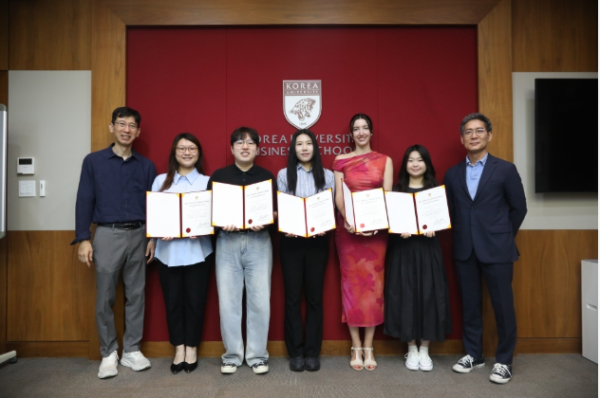
Best English Thesis Award Ceremony for Spring Semester 2025   The Best English Thesis Award Ceremony for the first semester of the 2025 academic year was held on Monday, August 11, at the KUBS Dean’s Office. The Best English Thesis Award is presented every semester to promote excellence in English-language thesis writing and to recognize the efforts of graduate students who produce outstanding work. Dean Eonsoo Kim and Associate Dean for Research Daeil Nam attended the ceremony to congratulate the awardees. A total of six graduate students were recognized. The awardees and their thesis titles are as follows:  △ ZHANG TONGTONG (MS, LSOM): Incentive Mechanisms for Government-Enterprise Joint Emergency Supplies Reservation: A Multi-Period CSR-Adjusted Model  △ Yehun Bae (MS, Management): Leaders Asking for Help: Disclosing Vulnerability or Signaling Competence? A Moderated Mediation Model of Leader Help-Seeking Style, Perceived Leader Competence, and Follower's Willingness to Help the Leader  △ CLUZEAU ANGELIQUE CHARENTE (MS, Global Business): Firm Size and Entry Mode Choice: Examining the Moderating Effect of Firm-Specific Assets  △ Dain Kim (MS, Marketing): Does the Variety of User-Generated Images Affect Review Helpfulness?: Exploring the Moderating Role of Brand Logo  △ Youngsun Park (MS, Finance): Liquidity Regulation in the Presence of an Unregulated Banking  △ Jooyeon Oh (MS, Strategy): Prior Firm Performance and Unrelated M&A: The Moderating Effect of CEO Risk Hobby 

2025.08.21 Views 3278

First Steps as a Researcher — 2025 Fall Semester Graduate Orientation Held

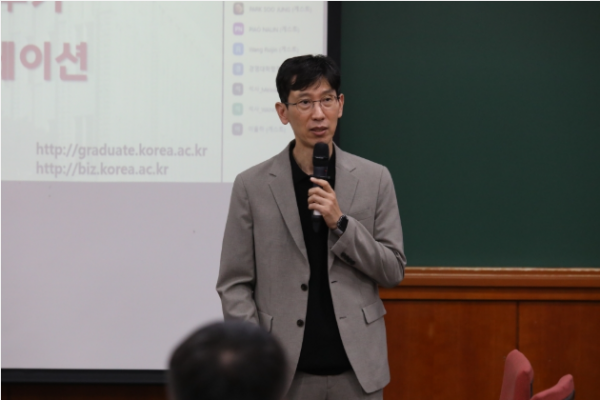
First Steps as a Researcher — 2025 Fall Semester Graduate Orientation, Department of Business Administration  Korea University’s Graduate School of Business Administration held its 2025 Fall Semester Graduate Student Orientation on Monday, July 28, at Room 432, LG-POSCO Hall. The orientation was designed to provide new graduate students with essential academic information and guidance on the research environment, supporting them in planning their future academic journey.  The event began with opening remarks by Professor Dae Il Nam, Chair of the Department of Business Administration. Professor Nam introduced himself as a researcher specializing in business strategy and startups, and said, “Our department offers one of the best research environments in the country, and I hope you take pride in conducting your research here.” He went on to say, “Since you have made the significant decision to pursue graduate studies, I hope you will find a research topic that truly excites you.”  The orientation program then officially began. The session included an overview of the department’s organizational structure, introductions of the heads of each major, as well as guidance on the curriculum, course registration, and domestic academic exchange programs.  In addition, the session provided detailed guidance on essential aspects of graduate student life, including graduation requirements such as the comprehensive examination, foreign language proficiency test, and thesis submission qualifications; academic procedures such as the application and change of academic advisors; scholarship and research funding opportunities; participation in the BK21 program; and the use of academic databases.  The session concluded with basic announcements, including Korea University Business School and Graduate School websites, the university portal and research portal, research lab and locker assignments, and student ID issuance.  After the general orientation, students were divided into their respective majors for separate orientations. Through this program, new students received detailed information on their major curriculum, key research areas, and plans for their future studies and careers.    One new student remarked, “Graduate school life used to feel vague, but today’s orientation made it much clearer,” adding, “While I feel a bit nervous as I am just starting out, I am also excited to embark on a new journey of learning and research.”  This orientation served as the first official event to guide new students on their journey as researchers in business administration and to share essential information for their graduate studies.  Participants celebrated the start of their graduate journey by sharing their expectations for future research and academic endeavors. 

2025.08.21 Views 3325

Stronger Together: 2025 Korea University E-MBA Alumni Festival Wraps Up in Success 

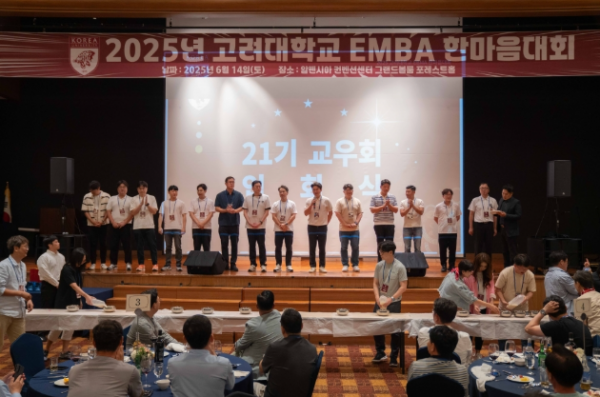
Stronger Together: 2025 Korea University E-MBA Alumni Festival Wraps Up in Success      Korea University Business School (KUBS) hosted the 2025 Executive MBA (E-MBA) Alumni Festival from Saturday, June 14, to Sunday, June 15, at the Alpensia Resort in Pyeongchang. Held under the slogan “All Together, Go Go Go!”, the event featured a variety of programs—including an induction ceremony, commemorative performances, an awards presentation, and a development fund pledge ceremony—that celebrated the spirit of unity and generosity, strengthening the bonds within the E-MBA community..  The festival began with welcoming remarks from the E-MBA Alumni Association President and congratulatory remarks from the Associate Dean of MBA Programs. This was followed by the 21st class’s induction ceremony and a traditional Korean sabal ritual, a bowl-sharing ceremony symbolizing unity and friendship.     A highlight of the evening was the graduation class’s development fund pledge ceremony, part of an E-MBA tradition in which each graduating class contributes KRW 30 million to support the school.  At the pledge ceremony, a representative from the 21st class presented the donation letter, and the Graduate School of Business expressed its gratitude by presenting a donation certificate and a plaque of appreciation. The funds will be used meaningfully to improve the school’s educational environment and support its continued development. This act is regarded not merely as financial support, but as a symbolic practice of the E-MBA alumni network, rooted in responsibility, mutual respect, and a strong sense of community among graduates.      Following the commemorative group photo for the induction, the celebration segment featured the E-MBA Chorus, which delivered a moving performance of four songs, including “Life”. The atmosphere reached its peak when special guest singer Nam-jung Park took the stage, performing his hit song “Thinking of You” along with other popular numbers.  The event continued with a toast from the KU Alumni Association President, introductions of participants by class year, and award ceremonies for the golf and travel activities, all filled with a warm spirit of camaraderie among alumni. It concluded on a high note with a closing toast from Associate Dean Gangseog Ryu of the MBA Programs. 

2025.08.12 Views 3314

Shaping the Future of Business with Doosan – CEMS Skill Seminar Concludes Successfully 

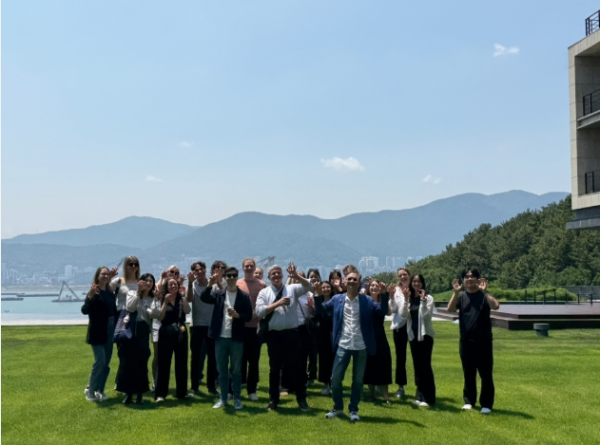
Shaping the Future of Business with Doosan – CEMS Skill Seminar Concludes Successfully      Korea University Business School (KUBS) successfully hosted the 2025 Spring CEMS Global MIM Skill Seminar, a practical, hands-on program designed to strengthen the global business competencies of 17 incoming CEMS students. The seminar focused on career development and immersive corporate visits to Korean companies, while offering participants valuable hands-on learning experiences.  The program consisted of △ a career development lecture held on Friday, May 23; △ a visit to the Doosan Heritage Museum in Bundang on Saturday, May 24; and △an overnight trip from Friday, May 30 to Saturday, May 31 to Doosan Enerbility’s headquarters and manufacturing facilities in Changwon. It was conducted as a practice-oriented program that combined various forms of learning and hands-on experiences.      The career development lecture focused on global strategy and sustainable management, exploring various case studies centered on Doosan’s history and vision. At the Doosan Heritage Museum in Bundang, Professor Tae-Won Park provided a guided tour of exhibits that visually trace the major milestones of Doosan Group from its founding to the present day. It was a meaningful opportunity to reflect on the company’s philosophy and values, as well as the changes it has undergone in response to the times—prompting participants to revisit the stories of the people embedded within its history and culture.      The visit to Changwon was carefully organized to provide participants with an in-depth understanding of Doosan Enerbility’s business strategy and manufacturing operations. On the first day, participants attended a lecture at the company’s Changwon headquarters on corporate strategy and HR practices. This was followed by a tour of the Changwon plant, where they experienced firsthand the production of world-class power generation facilities. In the evening, a dinner and Q&A session with Vice Chairman Tae-Won Park offered a valuable opportunity for direct engagement with the company’s leadership.      This seminar was particularly meaningful in that it focused on case studies from companies within the Doosan Group, including Doosan Bobcat, which recently joined as a KUBS CEMS Corporate Partner. Although Doosan Bobcat did not participate in the program directly, students were able to deepen their understanding of the Doosan Group as a whole by experiencing firsthand the history, technological capabilities, and sustainable management strategies of Doosan Enerbility, another company within the group.      Professor Tae-Won Park (Vice Chairman of Hancom Group and Board Member of Chung-Ang University), who planned and led the program, explained, “This Skill Seminar was designed to vividly illustrate to students how a company adjusts its strategies and continues to survive and grow over time by tracing Doosan’s 129-year business history in the context of changing eras and technologies. The emphasis was on enhancing students’ practical understanding by exposing them to real business environments and the language of business used in the field.”   He also emphasized, “The opportunity to witness advanced technologies—such as small modular reactors (SMRs) and gas turbines—that only a few countries in the world are capable of manufacturing was a valuable experience for students, allowing them to truly grasp the essence of global industrial competitiveness.”      Above all, he noted that “beyond plant tours and lectures, the evening gatherings and overnight stay during the two-day, one-night program fostered natural interaction and strengthened the bonds among students.” Professor Park added, “I believe that the accumulation of such experiences has ultimately served as the foundation for Korea University Business School to rank first among all 33 CEMS member schools worldwide in the Skill Seminar category.”  Lastly, he expressed his hope that “the CEMS Skill Seminar will continue to serve as a vibrant learning platform that bridges theory and practice, as well as domestic and global perspectives. Education grounded in real-world experience, I believe, will play a vital role in equipping students with practical insight and a global business mindset.”      Meanwhile, the CEMS Global MIM is a joint master’s program offered by more than 30 leading business schools worldwide, and Korea University Business School is the only CEMS member school in Korea, taking a leading role in fostering global talent.   

2025.08.08 Views 3445

[Interview] Campus CEO Startup Competition Winner ‘Ourtube’

[Interview] Campus CEO Startup Competition Winner ‘Ourtube’ – A Challenge Born from the ‘Strategic Technology Commercialization’ Course    Starting a business is an excellent way to learn how to manage failure. The journey of Team Ourtube, which began in Professor Jinyoung Kim’s entrepreneurship course Strategic Technology Commercialization, is a prime example. Their innovative idea—a recommendation platform designed to break the filter bubble effect of YouTube’s algorithm—won them first place in the Campus CEO Startup Competition. Behind this achievement was a classroom environment that embraced trial and error, along with team dynamics fueled by strong engagement. KUBS News sat down with the team to hear how their entrepreneurial idea became a powerful platform for learning and growth.        ■ Interview with Professor Jinyoung Kim (Special Lecturer)  Q1. Was there anything particularly noteworthy about the winning team’s development during the course?  A1. Entrepreneurship courses are more like juggling practice than traditional lectures. The instructor isn’t the only one tossing balls in the air—each student must learn to juggle their own. Some start the semester already holding a ball, while others don’t even know how to make one. By the end, my goal is for every team to put on its own juggling performance. Rather than simply delivering knowledge, this course placed a greater focus on cultivating the ability to manage failure.  In that sense, Team Ourtube was especially memorable. Their dedication and focus were evident right through to the end of the semester, and their passion truly stood out. I hope that this hands-on “juggling” experience will help them pursue their own ideas with confidence in the future.  Q2. What kind of support do you think is still needed for student entrepreneurship?  A2. KUBS offers a robust entrepreneurial infrastructure, including the Startup Station. Of course, not all students aim to become entrepreneurs, but an increasing number are wondering how successful founders achieve what they do. I believe we need more accessible opportunities for students to try their hand at entrepreneurship in a low-pressure setting. If on-campus programs—such as the Crimson Startup Support Group—continue to diversify and lower their entry barriers, they can serve not only as platforms for launching startups, but also as spaces where students can safely practice managing failure.  Q3. Any advice for students aspiring to start their own ventures?  A3. Failure should be experienced repeatedly on a small scale, quickly, and within a manageable scope. Just as you build muscle at the gym, the ability to manage failure can also be developed through practice. At KUBS, we offer a range of entrepreneurship courses taught by faculty members who bring both academic expertise and real-world experience. I encourage any students interested in startups to take advantage of these opportunities to strengthen their mental muscles.      ■ Interview with the Winning Team ‘Ourtube’  The participants were Hyunjoon Koh (Class of 2019), Jaewook Shim (Class of 2021), and Kiyong Choi (Class of 2021). Team member Byeongchan Kim (Class of 2021) was unable to attend the interview due to personal reasons.  Q1. What led you to participate in the startup competition?  A1. Hyunjoon Koh: Taking Professor Kim’s entrepreneurship course was the biggest reason. I remember giving an elevator pitch during midterms, and then the class voted for team leaders. In the next session, we had a casual “happy hour” with snacks, where we interviewed classmates on the spot to form our teams. That spontaneous and interactive process really strengthened our team chemistry, and we were proud of the result. When the professor recommended the competition, we naturally decided to take on the challenge.  Jaewook Shim: The team leader’s idea aligned closely with my own concerns about the “filter bubble” problem. I was intrigued and wanted to help bring the concept to life. Since we were already proud of what we had produced in class, joining the competition was a natural next step for us.  Kiyong Choi: I joined the team a bit later. I had been studying software development on my own and was interested in service design, so when Jaewook invited me to help on the technical side, I agreed—even though I didn’t feel fully confident in my skills. With the team’s encouragement, I decided to participate.  Q2. What was the core idea behind your winning startup concept?  A2. Hyunjoon Koh: Ourtube is a platform that identifies and reduces bias in YouTube’s recommendation algorithm. It promotes more balanced viewing by leveraging algorithm scores and MBTI analysis to recommend a wider variety of content, addressing the filter bubble problem. The name “OurTube” reflects our aim to shift from “YOU” to “OUR,” thereby creating a shared experience rather than an isolated one.  Q3. What was the biggest challenge during preparation process?  A3. Hyunjoon Koh: As a senior preparing for job hunting, it was challenging to juggle both the competition and job applications. Initially, our idea focused on political content, but after receiving feedback about its limited profitability, we decided to broaden the scope, which required a lot of careful consideration.  Jaewook Shim: It was my first time pitching, and conveying an idea clearly within a short time was more difficult than I expected. I studied various pitch examples on YouTube and practiced extensively. I eventually presented for our team at the Campus CEO Startup Competition, and through that experience, my presentation skills improved significantly.  Kiyong Choi: Since all of us were business majors, we were concerned about the technical feasibility of our concept. To address this, we sought technical advice from a friend in computer engineering and also researched possible legal risks.  Q4. What are your plans moving forward after winning the competition?  A4. Hyunjoon Koh: I hope to apply for other government support programs, such as the Pre-Startup Package. We are building on the feedback we received—especially regarding feasibility and profitability—as we prepare for the next stage.  Jaewook Shim: The most valuable part of the competition was receiving feedback from industry professionals. I would like to continue participating in other competitions and startup support programs whenever the opportunity comes up.  Kiyong Choi: While I don’t yet have the technical skills to immediately implement our idea, I’m refining my personal portfolio based on the team leader’s concept. Even at our post-competition team dinner, we talked about regrouping and making another serious attempt. I’m still very optimistic about collaborating again in the future. 

2025.08.08 Views 3159

KUBS Partners with Leading Global Universities to Advance on the World Stage 

KUBS Partners with Leading Global Universities to Advance on the World Stage      Korea University Business School (KUBS) is rapidly strengthening its global competitiveness by establishing a series of new exchange agreements with leading universities across the United States, Europe, and Asia. From September 2024, KUBS has signed or is in the process of negotiating a total of nine new international partnerships. Notably, many of these agreements are with universities ranked among the top 20 undergraduate business schools in the United States, drawing particular attention.  KUBS has recently forged a variety of exchange agreements with prestigious U.S. institutions. For undergraduate exchange programs, it has entered into agreements with the University of Virginia and Michigan State University. In addition, comprehensive MOUs for broader academic collaboration have been signed with Carnegie Mellon University and the University of California, San Diego (UC San Diego). At the MBA level, exchange agreements have been established with Emory University and Georgetown University. KUBS is also expanding partnerships with universities in Europe and Asia, including Université Paris Dauphine-PSL in France and the City University of Hong Kong. Negotiations with the University of Washington are also progressing smoothly.  These new agreements encompass a range of meaningful collaborations—including undergraduate, graduate, and MBA student exchanges, as well as joint research—providing students with broader opportunities for global learning experiences. A particularly notable agreement is with The Johns Hopkins University, which offers KUBS undergraduate students admitted to its graduate programs through the Global +1 Program up to 50% in scholarship support.  A representative from the KUBS International Office stated, “The fact that KUBS has signed so many agreements with leading international institutions in such a short period demonstrates the school’s growing global reputation and educational excellence. We will continue to expand top-tier partnerships worldwide.”  As of now, Korea University Business School maintains active international exchange partnerships with 114 universities in 33 countries.   

2025.08.08 Views 2984

  • 첫페이지로
  • 21
  • 22
  • 23
  • 24
  • 25
  • 마지막페이지로