TOP

KUBS News

Total 613

KUBS Faculty News (October–December 2025)

KUBS Faculty News (October–December 2025)    1. Professor Min Jung Kim     Professor Min Jung Kim received both the Corporate Strategy Best Paper Prize and the Outstanding Service Award in the Knowledge & Innovation Division at the Strategic Management Society (SMS) Annual Conference 2025, held in October 2025 in San Francisco, USA.    The research awarded the Best Paper Prize, titled “Strategic Responses to Rival Advancements: R&D Project Decisions and Resource Reallocation,” is a collaborative study with Professor Christine Choi (University of North Carolina at Chapel Hill) and Professor Sohyun Park (Stevens Institute of Technology). The study examines how firms decide which existing R&D projects to exit when new growth opportunities—such as technological advancements by competitors—emerge. In particular, it empirically identifies the impact of portfolio-level knowledge externalities on firms’ exit decisions.    In addition, Professor Kim was honored with the Outstanding Service Award in the Knowledge & Innovation Division in recognition of her contributions to fostering research exchange and collaboration within the academic community. The award acknowledges her service as a Representative-at-Large for the SMS Knowledge & Innovation Division.      2. Professor Martin Hemmert      Professor Martin Hemmert was recognized as a co-author of one of the Top 10 Articles of the Past 25 Years selected by the academic journal Asia Business & Management, in celebration of the 25th anniversary of Palgrave Macmillan. The list was curated by the journal’s editorial team based on criteria including quality, impact, and contextual insight.    The selected article is as follows:  Hemmert, M., Cross, A. R., Cheng, Y., Kim, J.-J., Kohlbacher, F., Kotosaka, M., Waldenberger, F., & Zheng, L. J. (2019). The distinctiveness and diversity of entrepreneurial ecosystems in China, Japan, and South Korea: An exploratory analysis. Asian Business & Management, 18, 211–247.    This recognition is regarded as further affirmation of the scholarly impact and sustained contribution of KUBS faculty research in the field of Asian business and management studies.      3. Professor Jaehwan Kim    The KU Bayes Colloquium, a regular seminar series designed to promote research exchange among scholars working on Bayesian inference at Korea University, was held again this semester. The colloquium is organized every semester and has traditionally taken place in the Business Building during the spring semester and in the College of Political Science and Economics Building during the fall semester. The seminar is also open to interested graduate students of Korea University Business School.    This semester’s theme was “Bayesian Inference for Econometrics and Marketing,” and the event was held as follows:    Date & Time: December 27 (Saturday), 9:25–12:30  Venue: Room 508, College of Political Science and Economics Building, Korea University  Contact: Professor Jaehwan Kim (jbayes@korea.ac.kr), Professor Kyuho Kang (kyuho@korea.ac.kr)      4. Professor Shijin Yoo      BGS, a band club composed of faculty members and staff from Korea University Business School, held a year-end performance on Monday, December 23, at 6:00 p.m. at Blueraum Anam. Approximately 60 attendees, including family members, friends, faculty, staff, and current and former graduate students, gathered to share a warm and festive year-end atmosphere.    Formed in late 2018, BGS is a faculty–staff band that continues to foster connection and exchange among its members through music. This year’s performance was organized into two thematic parts—Part 1: “The Spark & The Vibe” and Part 2: “The Hope & The Festival”—conveying messages of energy and hope as the year drew to a close.    The performance featured Professors Daeki Kim, Byung Cho Kim, Jongwon Park, Shijin Yoo,  Jongsoo Kim, and Min Jung Kim and along with staff member Minjung Yoon, as performers. The band presented a diverse setlist, including “I Am a Butterfly” (YB), “Drowning” (WOODZ), and “Running Across the Sky” (Huh Gak), engaging closely with the audience throughout the evening. 

2026.01.22 Views 1029

Learning from Korea’s Digital Innovation: KUBS EEC and BMI Brussels in Global Educational Exchange

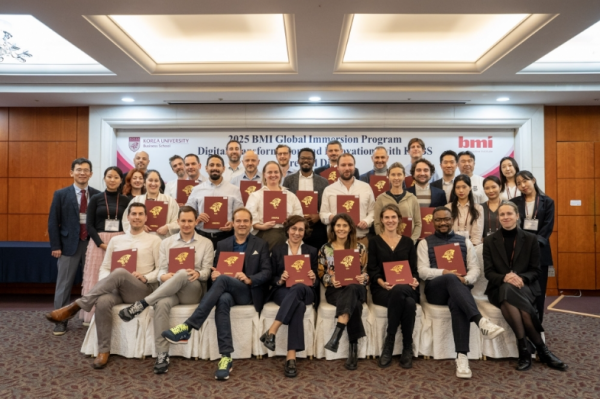
Learning from Korea’s Digital Innovation: Korea University EEC and BMI Brussels in Global Educational Exchange      Korea University Business School’s Executive Education Center (EEC) successfully concluded the “BMI Brussels ASBL International Study Tour” program, held over four days from Monday, October 20 to Thursday, October 23, in collaboration with the BMI Executive Institute (BMI), a leading European institution for executive education.  Founded in 1999 in Vilnius, Lithuania, BMI was established as a European management education consortium with initial funding support from the European Union (EU). The institute was created with the goal of cultivating senior business leaders in Europe, offering courses taught by an international faculty and educational content developed in partnership with HEC Paris, UCLouvain, and other prominent European business schools. Since then, BMI has expanded its partnership network to the United States, Germany, Poland, Finland, Italy, France, Morocco, Canada, and Singapore. In 2020, it opened its second campus in Brussels, Belgium, and since 2021, it has operated the UCLouvain–BMI International Executive MBA program in cooperation with the Louvain School of Management.        Approximately 30 Executive MBA (EMBA) students from BMI participated in the program, held under the theme “Digital Transformation and Innovation: The South Korean Perspective.”  Over the four-day program at Korea University, participants attended a series of lectures, including:   ▲“A Process-Centered Approach to Innovation” by Professor Chang Jin Wook  ▲“Innovation and Strategy in the Era of Digital Transformation” by Professor Kim Min Jung   ▲“Digital Transformation: Theory and Practice” by Professor Kim Byung Cho   ▲“Algorithm Literacy: Applications of Artificial Intelligence (AI)” by Professor Lee Gunwoong   ▲“Overview and Opportunities in Seoul’s Venture Investment Ecosystem” by CEO Park Young-hoon   ▲“Entrepreneurship: Opportunity Discovery and Business Model Development” by Professor Lee Jaemin   ▲“The Power of Community through the Video Game Industry” by CEO Park YoungMok . The lectures in this program offered an in-depth exploration—through both theory and real-world case studies—of how companies and organizations can design and implement innovation amid the sweeping changes driven by digital transformation.  Each session went beyond technology-centered discussions, providing a multifaceted view of how digital innovation influences business strategy, organizational culture, leadership, and the creation of social value. Participants also examined how strategic thinking evolves as digital technologies reshape traditional industries, and they explored the growing importance of data literacy, particularly in understanding how artificial intelligence (AI) and algorithms affect efficiency and fairness in decision-making.        The students actively took notes and engaged in every lecture, freely asking questions whenever something was unclear. The lively exchange of questions and answers created an enthusiastic learning atmosphere, while the professors occasionally added humor to keep the sessions engaging and interactive. Through these dynamic interactions, the classes were conducted with great energy and focus. Despite the rapidly dropping temperatures, the participants’ passion for learning remained undiminished.  Professor Jin Wook Chang shared his impressions, saying, “It was impressive to see participants reflect on the academic concepts and corporate cases introduced during the sessions, relating them to their own experiences and using them to foster meaningful learning and exchange with one another.” He added, “They showed deep interest in the achievements of Korean companies leading in strategies utilizing online data and media, asking insightful questions and offering thoughtful suggestions. I believe this visit provided not only an opportunity for academic and cultural exchange but also meaningful insights that participants can apply in their professional fields.”        During the campus tour on October 22, students showed great enthusiasm and engagement. At the Startup Institute, they learned that the institute’s logo was inspired by a train and that its entrepreneurship competitions and related events are called “Choo Choo Day”—a story that both amused and impressed them. When introduced to the Business School’s traditional April Fool’s Day event, “Eating Jajangmyeon on the Central Plaza Lawn,” one student laughed and said, “I saw that in the movie Parasite,” creating a cheerful and friendly atmosphere. As the group toured campus landmarks such as the Central Plaza fountain and the Centennial Memorial Hall, expressions of “It’s so beautiful!” echoed throughout. One student commented, “Just walking here during exam season would be refreshing,” while another began dancing spontaneously when BTS’s Dynamite was heard playing nearby. The tour offered a vivid glimpse into the students’ curiosity and affection for Korea University’s campus and Business School—and their firsthand encounter with the spirit of the Korean Wave.  The group also visited leading Korean companies such as Hyundai Motor Group ZER01NE, Samyang Foods, and Amorepacific to see firsthand how digital transformation is being implemented across different industries. Students shared that “through an educational experience combining theory and practice, we were able to gain a deeper understanding of Korea’s digital innovation capabilities.”  Through the program, participants gained broad insights into   ▲ the fundamental concepts of digital transformation and innovation processes,  ▲the impact of digital transformation on business strategy, marketing, and innovation, and  ▲the roles of startup ecosystems and emerging technologies within global digital transformation trends.        After the completion of the program, a certificate presentation ceremony and farewell dinner were held, where students looked back on their four-day journey.  Before the ceremony, Vice Dean Ryu Gangseog delivered his closing remarks, humorously noting, “Today feels like both your first and last day,” to ease the bittersweet feelings of parting. He went on to say, “Time has truly flown by,” as he warmly congratulated the students on completing the program and expressed his sincere appreciation to everyone who contributed to its success. Concluding his remarks, he said, “You are now part of the Korea University family,” wishing the participants a meaningful and fulfilling remainder of their stay in Korea  The certificate presentation ceremony followed, where students received their certificates along with commemorative gifts. The warm and cheerful atmosphere continued throughout the event, as Vice Dean Ryu Kang-seok personally congratulated each student and offered words of encouragement. The ceremony marked both the conclusion of their shared journey and a meaningful new beginning as members of the Korea University family.        During the closing session, students shared their final reflections. One student spoke about his memorable experiences with Korean food, such as kimchi, and his impressions of Korea’s culture and development. He jokingly remarked, “It’s Belgian fries, not French fries,” drawing laughter from the audience, and added, “Although small in size, Korea is a country with so much to learn from. It was a truly inspiring experience to explore the roots of Korea’s digital future and innovation at Korea University.”  The students also expressed their satisfaction with the lectures and corporate visits, extending heartfelt appreciation to the staff for their thoughtful organization of the program. The student humorously added, “We weren’t exactly easy students, but you led us so well until the end,” before raising a toast and saying “감사합니다 (Thank you)” in Korean. When he said, “I’d like to bring my daughter to Korea University someday,” Vice Dean Ryu replied with a smile, “Then I’ll guarantee her admission,” prompting laughter and applause from the room.  Another student shared, “The smooth execution of this program was made possible by the EEC staff, who meticulously supported us from the very first email to the very end.” He added, “Visiting leading Korean companies such as Hyundai Motor Group ZER01NE, Samyang Foods, and Amorepacific, and experiencing their management practices firsthand, was the most impressive part of the program.” The students expressed their heartfelt gratitude for the warm hospitality extended to them throughout the program, saying, “If given the opportunity, we would love to visit Korea and Korea University again.” They concluded their remarks with a hopeful message: “Next time, we hope Korea University visits Belgium so that we can share another wonderful experience together.”      Concluding with a farewell dinner, BMI successfully wrapped up its Study Tour program on a high note. A representative from Korea University’s Executive Education Center (EEC) remarked, “Through this program, we will continue to drive educational innovation so that participants can grow into future-oriented business leaders equipped with both strategic insight and innovative leadership in an era of technology-driven change.”  Meanwhile, the EEC at Korea University continues to host Study Tour programs designed for executives from global universities, corporations, and institutions to experience Korea’s latest management strategies and innovation practices firsthand. This year, ESADE, OneMBA, and Agrocentro S.A. successfully completed their programs. SKOLKOVO is scheduled to visit Korea University on October 27 and 29, followed by the Chinese University of Hong Kong (CUHK) in November. 

2025.11.11 Views 1961

AMP Holds Inauguration Ceremony Marking Its 50th Anniversary and 100th Cohort 

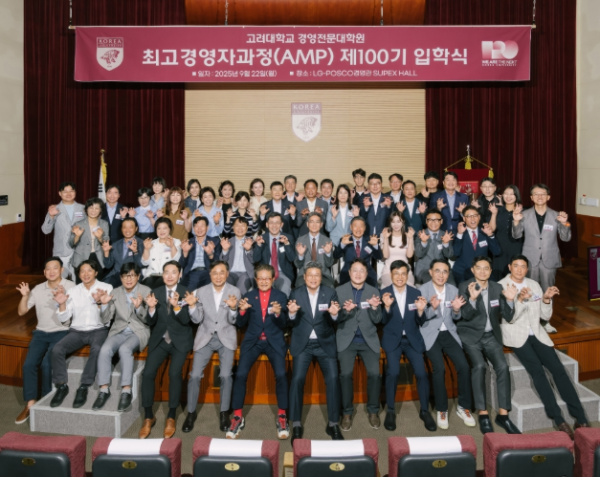
AMP Holds Inauguration Ceremony Marking Its 50th Anniversary and 100th Cohort  On Monday, September 22, Korea University Business School’s Advanced Management Program (AMP) held an inauguration ceremony for its 100th cohort at SUPEX Hall, located in the LG‑POSCO Building.    The ceremony began with the introduction of distinguished guests, followed by an opening address delivered by Dean Eonsoo Kim of Korea University Business School. Dean Kim remarked, “I sincerely welcome all members of the 100th cohort,” emphasizing that “the number 100 carries special significance, and the fact that the AMP has continued without interruption for 50 years since its establishment in 1975 is a remarkable achievement.” He added, “I hope this program will provide opportunities to ask new questions, foster meaningful exchange, and gain broad insights.”    Afterwards, Jaehwan Park, Chair of the Business Administration Awards Committee, delivered congratulatory remarks on behalf of the President of the AMP Alumni Association. He stated, “Over the past half-century, the AMP has nurtured countless leaders who have demonstrated leadership across all sectors of society. I sincerely congratulate you on becoming part of this proud tradition.”  Following the singing of the university anthem and a group photo session, the KUBE student ambassadors of the Business School guided participants on a campus tour. Through the tour, new members experienced Korea University’s history and campus environment firsthand, deepening their appreciation and understanding of the university.  In the lecture room dedicated to the AMP program at the Hyundai Motor Business Hall, Professor Jaiho Chung delivered a keynote lecture titled “Three Keywords for Understanding the Global Economy in 2025.” Focusing on Trumpnomics 2.0, central bank independence, and yen carry trade, Professor Chung offered an in-depth analysis of the future trajectory of the global economy, capturing the keen interest of the participants. During the Q&A session that followed, numerous questions were raised, reflecting the cohorts’ strong intellectual curiosity and academic enthusiasm.    At the evening banquet, cohort members exchanged business cards and continued networking, sharing their professional backgrounds and aspirations during the self‑introduction session, and bonding over shared toasts. Accompanied by a generous dinner and a makgeolli (traditional Korean liquor) ceremony, the event concluded in a warm and convivial atmosphere filled with fellowship and celebration.    Now celebrating its 100th cohort, Korea University’s AMP has established itself as one of Korea’s premier executive education programs, helping to shape the history of leadership education in the country. This milestone cohort represents both a new beginning and a symbolic turning point—marking the start of the next fifty years beyond a proud half-century of tradition, and opening a new chapter in the future of Korea University’s AMP. 

2025.10.14 Views 1651

[Interview with Newly Appointed Faculty for Fall 2025] Professor Dae hoon Noh

[Interview with Newly Appointed Faculty for Fall 2025] Professor Dae hoon Noh — Decoding Innovative Business Models Through Game Theory  In September 2025, Korea University Business School appointed five new faculty members, each bringing expertise in diverse areas of research: Professor Dae hoon Noh (LSOM), Professor Juyoung Lee (Business Administration), Professor Seunghoo Chung (Business Administration), Professor Jae Young Cho (Strategy), and Professor Angela Aerry Choi (Information Systems).  To mark the occasion, KUBS News sat down with the newly appointed professors to introduce their research interests and educational philosophies to our readers.    Q1. Please introduce yourself.  Hello, my name is Dae hoon Noh, and I’m an Assistant Professor in the LSOM (Logistics, Service & Operations Management) area at Korea University Business School. Prior to joining KUBS in the Fall 2025 semester, I was an Assistant Professor at the University of San Diego (USD) in the United States. My research focuses on the game-theoretic analysis of innovative business models, particularly those based on platform businesses. I study how firms make decisions simultaneously and how those decisions impact society as a whole.    Q2. What led you to join Korea University Business School, and how do you feel about it?  I have always considered returning to Korea, and I’m deeply honored to join Korea University. I’m particularly impressed by the outstanding research capabilities of the faculty at KUBS and look forward to meaningful collaborations. It’s also deeply fulfilling to teach KUBS students. I will do my utmost to support them as they grow into future leaders of society after graduation.    Q3. What is the research area or topic you are currently focusing on?  As mentioned, my research focuses on the game-theoretic analysis of innovative business models. To illustrate this further, one of my studies examines the competition between global ride-hailing services like Uber and traditional taxi operators—exploring when each model has a competitive advantage and what the broader societal implications of such competition are. In addition to this, I conduct game-theoretic analyses of innovative business models across various industries.    Q4. What is your philosophy when teaching or guiding students?  I aim to help students grasp the essence of the material rather than relying on rote memorization. No matter what content is covered over the course of a semester, knowledge gained through memorization alone tends to fade quickly.  However, if students can understand the lecture material as a coherent and structured narrative, then even if they forget some of the details over time, they will be able to recover that knowledge much more quickly when they revisit it. I strive to design my lectures with that kind of lasting understanding in mind.    Q5. Beyond academic knowledge, what do you think students must learn during their college years?  I believe communication skills are essential. It’s important to be able to communicate your ideas clearly and in an organized manner, tailored to the audience. Even if you excel academically or analytically, your capabilities may still be undervalued if your delivery is weak. I hope students get plenty of practice articulating what they’ve learned to others effectively.    Q6. As a new faculty member at the Business School, what are your goals or visions for the future?  I hope to see the Business School recognized as a world-class institution. The President, Dean, and many dedicated faculty members are already working tirelessly toward this goal, and I hope to contribute in my capacity by producing high-quality research.    Q7. Lastly, could you offer some words of advice and encouragement to Korea University students heading out into the world?  University life is a time filled with both joy and idealism, as well as uncertainty and anxiety about the future. The path most commonly taken may appear to be the only right one, and straying from it can feel unsettling — but in reality, there are many different paths forward.  Don’t be afraid to be different. Use your time in college to explore a variety of experiences and work hard to discover the path that truly suits you — for the sake of the person you’ll be 10 or 20 years from now. I encourage you to seek support from your professors and alumni along the way. Make the most of Korea University’s exceptional community — it will serve as a great source of strength throughout your life. 

2025.10.13 Views 1924

[SK Paper Award Interview] Professor Juhyun Pyun on “A New Interpretation of Global Imbalances” 

[SK Paper Award Interview] Professor Juhyun Pyun on “A New Interpretation of Global Imbalances”  In 2025, Professor Ju Hyun Pyun of Korea University Business School, as a co-corresponding author, co-authored a paper titled “Fear of Appreciation and Current Account Adjustment” with Paul R. Bergin and Kyunghun Kim. The paper has been accepted for publication in the international journal Journal of International Economics and has been honored with the Paper Award at the SK Awards.  To celebrate the achievement, Professor Pyun shared insights into the research journey and the philosophy that guided his work.    Q1. First of all, congratulations on receiving the Paper Award. Could you briefly introduce yourself and your paper?  My paper analyzes, both empirically and theoretically, how the “fear of appreciation” — the tendency of some countries to resist currency appreciation — affects the process of current account adjustment, which represents the balance between a country’s exports and imports.  In the empirical analysis, we find that in countries that suppress currency appreciation through exchange rate policies, current account imbalances adjust faster when in deficit than when in surplus.  Using a multi-country monetary model, we then theoretically show how such policy constraints can explain this asymmetry in adjustment speed.  The paper offers a new approach to testing a long-standing hypothesis first proposed by Nobel Laureate Milton Friedman, while also illustrating how exchange rate and foreign exchange policy environments can have structural implications for global firms’ investment and supply chain strategies.    Q2. What motivated you to begin this research, and what was the core problem you aimed to address?  Global imbalances—particularly the persistent asymmetry in adjustment speeds between current account surplus and deficit countries—have long been a central topic in both academic and policy debates.  While previous discussions often emphasized Milton Friedman’s intuition that exchange rate flexibility facilitates adjustment, in practice, many emerging economies have resisted currency appreciation and accumulated substantial foreign reserves.  My research began with this question: Why does surplus adjustment tend to be slower, while deficit adjustment occurs more rapidly?  This question also holds practical significance for global firms, as a country’s exchange rate policy directly influences export competitiveness, the profitability of overseas investments, and the flow of global capital.    Q3. What is the most important message this paper conveys to academia or the industry?  The central message of the paper is that the asymmetry in current account adjustment speeds is not simply a market-driven outcome, but rather an institutional result of policymakers’ “fear of appreciation” stance.  From an academic perspective, the study points to a new direction for international macro-financial modeling—one that endogenizes policy constraints within theoretical frameworks. From a policy standpoint, it cautions that persistent foreign exchange market interventions may contribute to the prolonged nature of global imbalances.  For global firms, the findings imply that countries with larger current account surpluses tend to face greater uncertainty arising from exchange rate stabilization policies. In this sense, understanding a country’s policy stance—beyond merely forecasting exchange rate movements—becomes a crucial element of risk management in foreign investment, pricing, and supply chain decisions.    Q4. Do you have any personal methods for overcoming slumps that often occur in academic or research life?  When I experience slumps in my research life, they usually don’t stem from the research process itself, but rather from moments when journal reviewers fail to recognize the value of my work—which can be quite discouraging.  I don’t have a particular method for overcoming such moments, but I think the belief that research is my calling allows those slumps to pass rather quickly.    Q5. Are there any new research topics or directions you would like to explore in the future?  Looking ahead, I plan to examine how the recently revived debates over Trump-era tariff policies may be reshaping the mechanisms of global imbalance adjustment.  One of the key objectives of these U.S.-imposed tariffs is to address the country’s current account deficit, and I am particularly interested in how this policy shift is influencing global firms’ foreign investment patterns and localization strategies.  From the corporate perspective, this signals the emergence of a new era in which capital flows and exchange rate stability are being managed in fundamentally different ways.    Q6. Do you have any words of advice for students who wish to pursue a career as a researcher?  In social science research, I believe that what matters most is how we define our fundamental values in understanding the world and the people we study.  The perseverance to continue research, even when the results are not as expected, comes from that very conviction.    A summary of Professor Ju Hyun Pyun’s paper is introduced below.  This paper finds that one-sided nominal exchange rate interventions in the form of a “fear of appreciation” slow the adjustment of current account surpluses, providing new evidence in support of Friedman’s hypothesis that adjustment occurs more rapidly under flexible exchange rates. The analysis shows that countries with more flexible exchange rate regimes exhibit faster convergence than peggers in correcting current account deficits, but not in the case of surpluses. This asymmetry is linked to the one-sided suppression of currency appreciations observed in certain economies.  To capture this mechanism, we develop a multi-country monetary model that incorporates a “fear of appreciation” policy rule governing foreign exchange intervention, solved as an occasionally binding constraint. The model illustrates how government capital flows that sustain exchange rate regimes can influence international financial adjustment, and it successfully explains the pronounced asymmetry in current account adjustment speeds across different exchange rate regimes and current account positions. 

2025.10.13 Views 1707

[SK Paper Award Interview] Professor Injun Noh: “Moving Forward with Curiosity and Patience” 

[SK Paper Award Interview] Professor Injun Noh: “Moving Forward with Curiosity and Patience”  In 2025, Professor Injun Noh of Korea University Business School co-authored the paper “Are All Generic Drugs Created Equal? An Empirical Analysis of Generic Drug Manufacturing Location and Serious Drug Adverse Events” (with John Gray, George Ball, Zachary Wright, and Hyunwoo Park), which was accepted for publication in the international journal Production & Operations Management and received the Paper Award at the SK Awards. Building on the good news of having also won a Paper Award earlier in the year, Professor Noh shared deeper reflections on the philosophy behind this latest research    Q1. First of all, congratulations on receiving the Paper Award. Could you briefly introduce yourself and your paper?  This study examines the quality issues of generic drugs, which are taken daily by millions of people worldwide. Because of intense price competition and declining profitability, the manufacturing of generics has steadily shifted from advanced economies such as the United States to emerging markets like India. However, information on supply chains—such as where a drug is manufactured—is not clearly disclosed to healthcare providers or consumers, making it difficult to empirically assess how these shifts affect patient safety and product quality.  In our research, we identified a novel data source that enabled us to trace the manufacturing locations of generic drugs and to compare quality outcomes by production site. Using the FDA’s equivalence criteria (same active ingredient, same formulation, and same route of administration), we found that generics manufactured in India showed a significantly higher incidence of serious adverse events compared with identical drugs manufactured in the United States.  This pattern was especially pronounced among older generic drugs facing greater market competition. These findings suggest that in less regulated environments typical of some emerging markets, drug quality—though less immediately visible—may deteriorate in the course of cost-cutting or supply chain optimization.    Q2. What is the most important message this study conveys to academia and industry?  This study is the first to provide large-scale empirical evidence on the quality issues of generic drugs manufactured in emerging markets—particularly India—an area that had previously been discussed only on the basis of anecdotal evidence.  The findings attracted extensive coverage in major global media outlets, especially in the United States. Notably, the core results of the study were cited in discussions by the U.S. House Committee on Energy and Commerce, underscoring its significance and impact.  At a time when healthcare systems worldwide are increasingly dependent on generic drugs as affordable treatment options, this research underscores the urgent need for greater transparency in drug supply chain information, differentiated regulatory approaches that account for manufacturing location and the intensity of price competition, and the establishment of more robust quality monitoring systems.    Q3. Do you have any personal methods for overcoming slumps that are common in academic life or research?  There are times when the numerous responsibilities of being a professor—managing projects, teaching, reviewing papers, and advising students—can feel both physically and mentally overwhelming. At such times, taking a short break to exercise helps me clear my mind and regain focus.    Q4. Are there any new research topics or directions you hope to explore in the future?  While my current research focuses primarily on the U.S. pharmaceutical industry, I hope to broaden its scope to encompass the Korean pharmaceutical sector and, more broadly, the healthcare industry as a whole.    Q5. Do you have any words of advice for students who wish to pursue a career as researchers?  I believe it is essential to observe the world with keen attention and to cultivate a habit of identifying meaningful and intriguing questions. At the same time, achieving lasting research outcomes requires going beyond momentary curiosity and dedicating oneself to sustained effort with patience and perseverance.    A summary of Professor Injun Noh’s paper is introduced below.  Generic drugs provide lifesaving, affordable treatments to millions of people each day. Over the past several decades, the manufacturing of generic drugs has been steadily shifting from advanced economies, such as the United States, to emerging economies, such as India. However, due to the opacity of global drug supply chains, the quality risks associated with manufacturing in emerging economies have not been systematically and empirically examined.  This study aims to fill this gap. To do so, we construct a novel dataset containing information on drug manufacturing locations, which enables us to compare the frequency of serious adverse events among generic drugs produced in different regions. Using exact matching analyses based on the equivalency criteria established by the U.S. Food and Drug Administration (FDA), we find that generic drugs manufactured in India—where most emerging-economy generics are produced—are associated with significantly higher rates of serious adverse events than their equivalents produced in the United States, where most advanced-economy generics are made.  We further find that this key result is driven by mature generic drugs, which are particularly susceptible to operational and supply chain cost-cutting efforts—efforts that may, unfortunately, compromise drug quality. Our findings offer important implications for regulatory policies, particularly regarding the FDA’s oversight of generic drugs. 

2025.10.13 Views 1566

KUBS Exchange Day Fosters Interaction Between Local and International Students 

KUBS Exchange Day Fosters Interaction Between Local and International Students     The International Office of Korea University Business School (KUBS) hosted KUBS Exchange Day on September 9 at Ahn Young-Il Hall, LG-POSCO Building. About 60 participants, including KUBS students set to go on exchange in Spring 2026 and exchange students from around the world, came together to interact and network.  The event opened with welcoming remarks from Dean Eonsoo Kim of KUBS. Dean Kim encouraged the participants, saying, “I hope you take pride in being part of Korea University Business School and create lasting memories.” He added warmth to the atmosphere by expressing his gratitude in several languages.  Following the dean’s remarks, Min Ki Cho, president of KUBS Buddy, a student organization supporting exchange students, took the stage and said, “It is an honor to be here today.” He added, “I hope all students build fond memories through this event.”      Participants broke the ice with self-introductions during group activities and over shared meals, discussing their expectations for their exchange experience and their choice of destination countries. A questionnaire covering topics such as travel, lifestyle, and campus life also helped spark conversations and encourage interaction among students.  This year’s KUBS Exchange Day went beyond academic exchange, serving as a platform for cultural exchange and friendship. For students preparing to study abroad, it provided a valuable pre-departure experience. 

2025.09.25 Views 2489

  • 1
  • 2
  • 3
  • 4
  • 5
  • 마지막페이지로