TOP

KUBS News

Total 1415

‘KUBS 120 MARCH’ Campaign Nears 40% of Goal … Total Pledges Reach Approx. KRW 4.6 Billion

‘KUBS 120 MARCH’ Campaign Nears 40% of Goal … Total Pledges Reach Approx. KRW 4.6 Billion Three major large-scale pledges secured within four months of launch … Campaign continues through May 31     Korea University Business School’s KRW 12 billion fundraising campaign, “KUBS 120 MARCH,” has secured approximately KRW 4.6 billion in pledged donations within just four months of its launch, nearing 40% of its goal.   Since the campaign’s launch in January, when pledged donations stood at around KRW 2 billion, the total has more than doubled in just three months. From December 1, 2025, to March 29, 2026, total pledges reached KRW 4,652,317,231, with 324 participants, including corporations, alumni, faculty, staff, and students.       | Three major pledges secured … Alumni and corporations join forces    One of the most notable achievements is the securing of three major pledges. An anonymous donor pledged support for the research fund, Eugene Investment & Securities Co., Ltd. for the development fund, and Samyang Tongsang for scholarships. Alumni account for approximately 62% of total pledges, while corporations represent about 35%, jointly driving the campaign forward.   Group donations have also continued. Following the participation of the Class of ’81 alumni association, the Business School Class of ’79 Scholarship Committee (28 members), the KUBS Class of ’98 Alumni Night (126 participants), as well as faculty and staff, have also joined the campaign.     | Expanding participation across classes, generations, and professions    The donor base is highly diverse. Participation spans from alumni who entered in the 1970s to current students from the Class of ’26, as well as members of EMBA, DBA, and AMP programs, undergraduate alumni, and even alumni from the College of Medicine. From individual research labs and faculty bands to student councils, all corners of the Business School are actively engaging with the campaign, further broadening its base of participation.   This campaign is particularly meaningful in that it places value not only on the total amount raised but also on participation itself. From small contributions starting at KRW 10,000 to major gifts reaching KRW 1 billion, every act of giving becomes part of the shared legacy of KUBS’s 120-year history.    | Investing in the future campus… Advancing the 3C Trading Zone and 4Tech strategy    The funds raised are being used to realize the Business School’s future vision. Alongside the advancement of the “4Tech Strategy,” centered on AI, semiconductors, energy, and robotics, spatial innovation projects are also taking shape.   The Business School is already operating AI-focused tracks and 4Tech micro-degree programs, and continues to expand its educational and research capabilities with its largest-ever full-time faculty body of 95 members.   On the basement level of Hyundai Motor Hall, the “3C Trading Zone (tentative name)” is currently under development, with a trading demo day scheduled for early May. The space will also include an Art & Culture Room. Artist Uhm Jung-soon’s installation piece, K, the Noseless Elephant, has already been installed in the building.   Construction has also begun on an LED display in the lobby of LG-POSCO Hall, which will serve as a large-scale digital donor wall. An opening ceremony is scheduled following the conclusion of the campaign in May.   Dean Eonsoo Kim stated, “We have come this far thanks to the collective support of each and every member,” adding, “We hope more people will join us on this journey as we prepare for the next 120 years of the Business School.”   The “KUBS 120 MARCH” campaign will continue through May 31, 2026. Donations can be made via the official sponsorship page (box.donus.org/box/koreauniversity/KUBS120march).   As of December 1, 2025 – March 29, 2026 | Total pledged amount: KRW 4,652,317,231

2026.04.09 Views 319

“I want to make an environment where a young graduate’s donation is considered natural” – Han Jeongs

“I want to make an environment where a young graduate’s donation is considered natural” – Han Jeongsoo (Business ’11) Alumnus Interview   Alumnus Han Jeongsoo (Business ‘11) donated ten million won as the KUBS scholarship. We listened to his story through a written interview which was done after the donation ceremony held on August 3rd (Tue) at the Dean’s office.     (From the left) Associate Dean for Academic Affairs Dr. Chun, Jae Uk, Associate Dean for Planning and Budget Dr. Hwang, Joon Ho, Alumni Han Jeongsoo(Business ‘11), Dean of KUBS Dr. Bae, Johngseok   Q. Please introduce yourself.   Hello, my name is Han Jeongsoo.   I entered Korea University Business School in 2011 and participated in the 44th KUBS Student Council. After graduation, I worked in the financial business industry. Currently, I set up a company which makes corporate investments and operates scholarship business etc.   As a hobby, I am sharing my thoughts and stories about investment through my Youtube channel ‘세상학개론’.   Q. As a student who entered KUBS in 2011, such a young alumnus’ donation is very impressive. It must have been a big decision for yourself, what made you decide on giving this donation?   To be honest, it is quite shameful to have an interview since there are many alumni who gave donations with bigger amounts.   Rather than having a special motive, I always wanted to become a cool senior who can give scholarship fees after graduating since I was able to persistently see the donating culture of my KUBS seniors.   As in my case, I thought that KUBS was more meaningful than any other donation charities since my donation could lead to donations from juniors in the future. In fact, even before this donation, I have been regularly donating 10,000 won per month since graduation. I couldn't afford to donate as much as I wanted when I just came out to the society, and instead wanted to donate continuously even if the amount was small.   I think I was able to make a donation that does not make myself ashamed after having some leisure in my life, although I still want to make more donations, and that is why I am inconvenienced.   My goal is to not give a one-time donation, but rather to steadily increase my donation for 27 years just like alumnus Kim Jeongho of 'Bear.Better.'   Q. Do you have any memorable episodes during your university life?   Since I double-majored computer engineering, I remember making myself have a hard time going back and forth the liberal arts and science campus to attend classes before graduation (laughter).   To pick one specific episode, I had a chance to participate at the ‘KUBS Night of Alumni’ event as a part-time worker. When I saw numerous admirable alumni during the event, I thought “When I grow up, I want to become a cool senior just like them”. It was a novel excitement looking at seniors who are actively devoting themselves in a bigger world than fellow students.   Afterwards, the nametags posted at places such classrooms, chairs, stairs etc. started to jump into my eyes. Starting from chairs, desks, and classrooms to a building named after one’s name, I wondered how successful I should be in order to make such donations and motivated myself.   Q. Lastly, do you have any words to say for your KUBS juniors?   I want to make an environment where a young graduate’s donation is considered very natural, rather than something novel.   I would like to become a cool senior who can help juniors dream of giving donations in the future

2021.08.18 Views 4057

International Scholar Invitation Forum held with Professor Alex Edmans of London Business School

International Scholar Invitation Forum held with Professor Alex Edmans of London Business School From the left, KUBS professors Dr. Kim Joonghyuk, Dr. Jungbien Moon, Dr. Kim Woochan, Dr. Na Hyun Seung, Dr. Kyung Suh Park   The forum was held both offline and online while abiding to guidelines to prevent the spread of COVID-19.   On July 6th(Tue), the ‘ESG International Scholar Invitation Forum,’ hosted by KUBS Asian Institute of Corporate Governance (AICG) and sponsored by ‘KUBS-SK business for Society project,’ was held both online(Zoom) and filmed in studio. The event began with the welcoming words of Professor Kyung Suh Park, head of KUBS Asian Institute of Corporate Governance (AICG), followed by a presentation from Professor Alex Edmans of London Business School and a panel discussion between KUBS professors Kim Joonghyuk(host), Kim Woochan, Jungbien Moon, and Na Hyun Seung.   Professor Alex Edmans, a globally renowned expert in ESG management, mentioned he was aware that ESG became an important topic in Korea. He emphasized the importance of financial elements in ESG management. He explained that financial elements are ‘profit’ for investors and ‘fair prices’ for society and individuals, and ESG management is ‘dividing the whole pie even more effectively.’   How can companies implement ESG management? Professor Edmans asked ‘How a purposeful business makes decisions’ and said, “it is unrealistic to serve customers, employees, suppliers, the environment and the community while providing profit to investors at the same time.” Since it is difficult to satisfy everyone, a company’s goal for ESG management should be determined by ‘Comparative Advantages’ and ‘Principle of Materiality.’ He cited “Corporate Sustainability: First Evidence on Materiality” by Khan, Serafeim, Yoon(2016) and explained that firms should contemplate what value they can deliver by utilizing their current capabilities and focus on specific issues that can be tackled rather than try to solve every problem of their ESG.     Professor Edmans introduced his book, 「Grow The Pie: How Great Companies Deliver Both Purpose and Profit」 and emphasized that ESG is ultimately a helpful value to firms and highlighted the role of shareholders for the responsibility of ESG management. He concluded the session by giving his thanks to KUBS Asian Institute of Corporate Governance for the opportunity to participate in this forum and the participants for their keen attention.   Editor | Yoon Seon Woo (Media & Communication ’18) Photography | Shin Se Rim (College of Political Science and Economics, Economics ‘18)  

2021.07.20 Views 4055

CDTB Colloquium, "The digital therapeutics market is expanding – we should take interest in mana

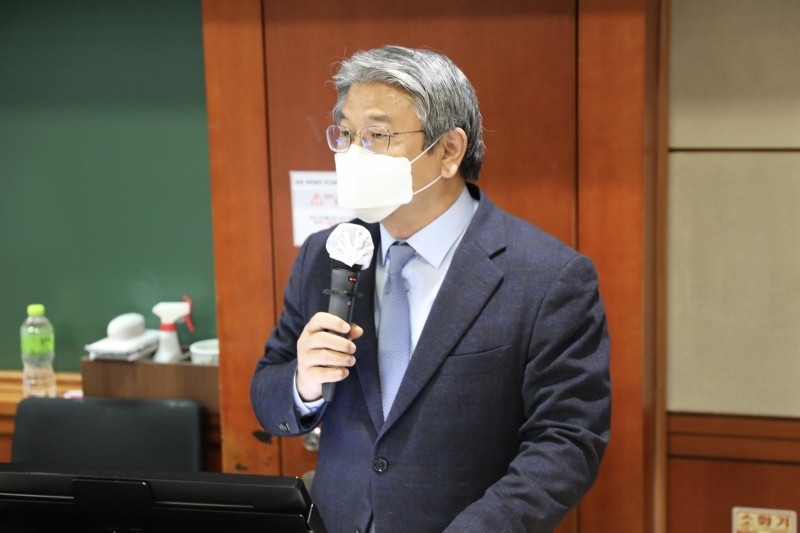
CDTB Colloquium, "The digital therapeutics market is expanding – we should take interest in managing big data" Dae-sung Kyung, the Executive Director of Hanmi Pharmaceutical   “CDTB Colloquium – Hamni Pharmaceutical,” hosted by KUBS (Dean=Bae, Johngseok) Center for Digital Transformation & Business (CDTB; Head=Dr. Baeho Kim and Dr. Byungcho Kim) was held on Friday, July 25, in SUPEX Hall. On this day, Executive Director Dae-sung Kyung of Hanmi Pharmaceutical was invited as the keynote speaker and gave a lecture on the topic “Digital Transformation in the Healthcare Industry.” The event was held both online and offline, strictly following COVID-10 guidelines.   Before starting the lecture, Executive Director Kyung explained the pharmaceutical industry in general. The size of the pharmaceutical industry in South Korea is about 21 trillion won, accounting for about 1.2% to 1.3% of the world pharmaceutical market. In the global pharmaceutical market, United States leads the industry by taking up to 40% of market shares, followed by Europe, China, and Japan. While analyzing the hiring trends in the South Korean pharmaceutical industry, Director Kyung mentioned that although he is a business major, the pharmaceutical sector is open to people from different academic backgrounds. In addition, he showed a positive outlook on the development of the pharmaceutical industry, stating that “Despite the fact that national R&D spending in this area is quite small (1.7 trillion won), its growth potential is increasing as we entered into the digital era.”   “The 4th Industrial Revolution in the field of healthcare is actively taking place; pharmaceutical companies are going through digital transformation by merging with big data, mobile, IoT, and cloud,” Executive Director Kyung stated, “It is highly likely that the pharmaceutical industry will develop into a high value-added industry.” Unlike traditional therapeutics where patients are prescript with drugs, digital therapeutics utilize software such as applications and devices to treat patients. In fact, university hospitals use digital therapeutics to stimulate brain activities and learning processes. He further explained that traditional and digital therapeutics will develop to complement each other and that the implementation of AI technology will reduce the time it takes to develop pharmaceuticals by 70% and the cost it takes by half.   In the second part of the lecture, “Global Trends and Implications,” Executive Director Kyung dealt with the concept of medical data. He emphasized the importance of medical data in establishing welfare policies, stating that “data” is the key to digital transformation. He mentioned that South Korea has advantages in collecting medical data due to national health insurance, and that such data can be used to analyze prescription patterns and social costs. Since this process requires the ability to effectively utilize different kinds of data, he encouraged the students to enter the pharmaceutical industry, stating that “You have the skill to combine data sets.”   The last part of the lecture consisted of a Q&A session, where students asked questions such as “How to utilize data in the field of Korean Medicine” and “How to identify variables when government data from Health Insurance Review & Assessment Services is combined with private data.”   Meanwhile, KUBS has established CDTB in 2019 to act as a platform that connects education, research, and industry, while leading digital transformation in the field of education and research. CDTB has been hosting many special lectures since then.   Article | Seonwoo Yoon (School of Media & Communication ’18) Photo | Serim Shin (College of Political Science & Economics, Department of Economics ’18)

2021.07.19 Views 2875

[2021 Summer FMBA Special Lecture] ‘Understanding ESG Management and Implementation Strategy’ – Sam-

[2021 Summer FMBA Special Lecture] ‘Understanding ESG Management and Implementation Strategy’ – Sam-il PWC Partner Yun Young Chang Sam-il PWC partner Yun Young-Chang   At Korea University Business School (Dean= Johngseok Bae) Finance MBA summer semester’s ‘Special lecture’ - Practices in Finance,’ Sam-il PWC partner Yun Young-Chang was invited as a lecturer and covered the topic of ‘Understanding ESG management and implementation strategy’. The lecture was held both online and offline, strictly following COVID-19 guidelines to prevent infections.   Partner Yun Young Chang defined what ESG management is before dealing with the details of establishing an ESG strategy. While CSR focuses on the relationship between corporate-society by ‘firms voluntarily assuming various social responsibilities’, ESG is focused on ‘the evaluation of a company’s nonfinancial capabilities(environmental, social, governance) for the purpose of the stakeholders’ investment decision’.   Partner Yun introduced the current situation where ESG regulations are being reinforced, citing examples such as the movement to expand various environmental regulations led by the US president Biden, BMW’s demand for eco-friendly energy use from its business contractors, etc. He then emphasized that when implementing an ESG strategy companies should keep in mind ‘how to build∙implement an ESG strategy in accordance with the companies features while minimizing impairment in one’s business competitiveness’. Intel’s ‘RISE Strategy’, Hyundai Motor’s ‘Promotion of Eco-friendly vehicle vision alignment throughout its affiliates’, SK group’s ‘Social value measurement’ were particularly introduced as systematically well formed ESG strategies and implementation plans.   Among the three agendas of ESG management, ‘Environmental’, ‘Social’, ‘Governance’, confrontation toward carbon-neutrality was mainly dealt for the ‘Environmental’ factor during the lecture. Partner Yun introduced carbon neutral goal plans of global firms such as the use of renewable energy, technological development and achievement in economic feasibility through R&D, etc. Then emphasized the need for domestic companies’ strategic responses on carbon neutrality. In addition, human rights management, BoD composition, etc. were the focuses of ‘Social’ and ‘Governance’ factors. Partner Yun stated that it is necessary to prepare evaluation criteria suitable for the situation of Korea rather than to apply global ESG governance evaluation indicators directly.   Korea University Business School FMBA hosts ‘Practices in Finance-Special Lectures’, during the summer semester, invites practical experts from various fields in the financial sector to give special lectures on their field’s current status, prospects, major issues, and cases. It is to provide practical knowledge and convey experience in the financial field. It will be held in the form of a special lecture on individual topics such as ESG, Private Equity, IB, Venture Capital, and FinTech etc.     Article·Photo | Management Support Team

2021.07.19 Views 3246

CDTB Colloquium, “Digital transformation is the key to the future of finance”

CDTB Colloquium, “Digital transformation is the key to the future of finance”      CDTB Colloquium, hosted by KUBS (Dean=Dr. Bae, Jongseok) Center for Digital Transformation & Business (CDTB; Head=Dr. Baeho Kim and Dr. Byung Cho Kim), was held on Friday, Jun 4th, in LG-POSCO Building SUPEX Hall. CDTB Colloquium is a program that mainly investigates firms’ digital transformation strategies. The center also works to build consensus among KUBS members and to secure active support from related external organizations. In this event, CEO Gwang-yeol Ryu of SGI Seoul Guarantee Insurance was invited as the keynote speaker and gave a lecture on the topic “Changing Environment of Financial Industry and Digital Transformation.” The event was held both online and offline, strictly following COVID-19 guidelines to prevent infections.   Before the start of the lecture, the Dean of Korea University Business School, Jongseok Bae, gave a congratulatory speech. He stated, “Since there is numerous research on the topic of digital transformation, it is important to be aware of what kinds of trials and experiments are taking place in different industries.” He showed his anticipation by saying that “I hope we can expand our understanding through today’s lecture on the financial field.”   CEO Gwang-yeol Ryu began his lecture by explaining the recent performance and the risk factors in the financial industry. “Due to the 2008 Financial Crisis and COVID-19, expansionary monetary policy continued, causing liquidity, household debt, and corporate bonds to increase. Consequently, the number of risk factors increased as well,” he said, pointing out the reality of an unfavorable financial environment. He thereby emphasized that the development of digital technology will change the game in the future.   CEO Ryu continued, “MZ Generation, who put importance on customer experience and prefer online communication, is the new customer base for firms.” “Many BigTech firms – such as Kakao, Toss, and Naver in Korea and Google, Apple, and Facebook in the world – are providing financial services as well. They are starting to take over the market as comprehensive platforms,” he said. As BigTech firms are taking control of FinTech and financial institutions, the financial environment is being centered on BigTech. Furthermore, CEO Ryu introduced the concept of a fast-changing financial environment centered on mobile technology, where AI or blockchain technologies are added to create services such as customer data-based product development. “Legislations in Korea are also starting to reflect the changes in the financial environment by implementing policies such as Financial Regulatory Sandbox and Data Bills,” he added.   Moreover, he explained how digital transformation will take place in the financial industry during the post-COVID-19 era. He further introduced the Marketplace and Open Banking Model based on platform and data sharing technology. “To fully achieve digital transformation, we need to change both the business model and the business organization, based on data-based and demand-oriented hyper-personalization strategy,” he said.   CEO Ryu ended the lecture by briefly explaining his company, SGI Seoul Guarantee Insurance, and its major tasks. He also introduced the company’s digital transformation plans by saying, “SGI Seoul Guarantee Insurance is planning to broaden its business area by utilizing AI and big data in various fields such as household purchase and compensatory damages. Moreover, it will expand its strategic partnership with FinTech and BigTech companies.”   Article | Sangbong Chung (College of Political Science & Economics, Department of PSIR ’17) Photo | Serim Shin (College of Political Science & Economics, Department of Economics ’18)

2021.06.28 Views 3954

  • 첫페이지로
  • 86
  • 87
  • 88
  • 89
  • 90
  • 마지막페이지로