TOP

KUBS News

Total 1417

[Entrepreneurship Academy Lecture On-Demand] “Coding Now Done by ‘Vibe’”

“Coding Now Done by ‘Vibe’”... Special Lecture on AX-Based Startup Insights   On March 17, the Entrepreneurship Academy Lecture On-Demand was held, hosted by Korea University Startup Institute. The session featured Malacca, an AX strategist and AX builder, who delivered a hands-on lecture titled “Vibe Coding Practice: From Planning to MVP Deployment (Gemini & Firebase),” combining AI-based development methods with real-world startup experience.    The lecture drew strong interest from students and was held across two classrooms in the Hyundai Motor Hall. Approximately 170 participants attended, reaching maximum capacity. Although each classroom accommodates around 100 people, attendance exceeded seating capacity, with even stair areas being utilized. To accommodate all participants, a live Zoom broadcast was conducted simultaneously, allowing students to join from both classrooms.      Participants were highly engaged in the hands-on session, following along with coding exercises during the lecture. Students had the opportunity to build simple programs in real time, gaining practical experience with AI-based development processes.    During the lecture, AI-based processes were introduced, emphasizing that AI is not merely a tool but a key driver of AX (AI Transformation), transforming corporate workflows and organizational culture. While highlighting the high productivity of AI “vibe coding,” Malacca also noted the need for safeguards such as “context engineering” and “harness” to address the challenges of maintaining complex systems. He further emphasized that the essence of entrepreneurship lies not in technology-driven thinking, but in validating hypotheses through customer interviews. He advised that “starting quickly, failing, and learning fosters a virtuous cycle of growth driven by execution.”      During the session, Malacca utilized “Jjap Slack,” a tool he personally developed using vibe coding, to facilitate real-time interaction through live comments, enabling participants to ask questions and receive feedback instantly. The session was particularly meaningful in that it was conducted using the same harness template provided to students, allowing them to work with programs at a level applicable to real-world practice.    This “Entrepreneurship Academy Lecture On-Demand 1” highlighted both the evolving role of developers in the AX era and the practical capabilities required for entrepreneurship, offering students integrated insights that bridge technology and business perspectives. The Korea University Startup Institute plans to continue expanding hands-on, practice-oriented startup education programs. 

2026.04.14 Views 54

A Day Spent with Passionate Future Business Leaders... The 15th KUBS Youth Mentoring Day

A Day Spent with Passionate Future Business Leaders... The 15th KUBS Youth Mentoring Day     The 15th KUBS Youth Mentoring Day (hereinafter referred to as Youth Mentoring Day) was held on July 29th at Korea University Business School (Dean=Sang Yong Kim). Organized and conducted by 'KUBS Student Ambassadors KUBE (hereinafter KUBE)' and 10 student mentors, this year's Youth Mentoring Day saw the participation of over 100 high school students from across the nation who aspire to pursue studies in business administration. Despite the scorching weather due to a heatwave warning, the enthusiasm of the young participants aspiring for business studies at KUBS remained undiminished.        Firstly, KUBE introduced 'Korea University Business School' and the '7 Majors and 3 Tracks in Business Administration,' explaining the field of business administration to high school students who might be unfamiliar with it. KUBE also mentioned the LG-POSCO Business Hall and the Hyundai Motor Business Hall, which are exclusively used by Korea University Business School. KUBE highlighted that classes are held in these two buildings, which were donated entirely by alumni contributions.        During the introduction to KUBS and business administration majors, a 'quiz' was conducted after each presentation. Students who answered the quiz correctly were awarded a Korea University character 'Hoi' keychain. The high school students enthusiastically participated in the quiz by raising their hands or stating the answers with their group names.        Next, Professor Jungbien Moon conducted a special lecture (hereinafter referred to as lecture) on the topic of 'International Management.' Professor Moon introduced the subtopic 'East Asia and International Management in the 21st Century Global Order' and posed an interesting question: "Among China, the United States, North Korea, and Japan, which country is closest to South Korea?" One student mentioned distance and answered North Korea, while another student considered international relations and responded with 'the United States.'      Based on the students' answers, Professor Jungbien Moon emphasized, "We need to question the definition of 'closeness' within the question." He introduced criteria such as geographical distance, cultural distance, and institutional distance to determine the country closest to South Korea. The lecture was tailored for high school students new to the field of business administration. Professor Moon continued the lecture by discussing △South Korea's position and East Asia △The current world order and East Asia △Future world order: Liberalism, Realism, Isolationism? △Global order and global strategy: The case of electronic - semiconductors △Summary and suggestions.        After lunch, a campus tour was conducted, allowing the high school students to experience Korea University's campus and the infrastructure of the Business School. Against the backdrop of the beautiful Business School campus, the students took photos to capture memories. Subsequently, they engaged in group activities focusing on 'Business Administration Practicum.' This practicum was based on the special lecture on 'International Management' and provided an experiential understanding of the processes of business negotiation and global strategic planning.            Following the practicum, group mentoring sessions were held. The participants had the opportunity to ask and receive precious information from mentors and KUBE about various aspects of university admissions, study methods, campus activities, and the overall university experience.        On a separate note, Korea University Business School's Youth Mentoring Day targets 1st and 2nd year high school students during both summer and winter breaks. Application for participation can be made through the Korea University Business School Student Ambassador KUBE website (biz.korea.ac.kr/kube) during the designated application period. 

2023.08.16 Views 3185

KUBS Faculty awarded 2022-2 Seoktap Lecture · Research Award

KUBS Faculty awarded 2022-2 Seoktap Lecture · Research Award     5 Korea University Business School (Dean=Sangyong Kim) professors won the 2022-2 Seoktap Lecture Award and the winners are △Byungwan Koh △Jaeyoung Kim △Joonghyuk Kim △Kyung Sam Park △Dongseop Lee (in Korean alphabetical order).         The awarded lectures are △ ‘BUSINESS ANALYTICS II (ENG)’ by Byungwan Koh, △ ‘PRINCIPLES OF ACCOUNTING’ (ENG) by Jaeyoung Kim, △ ‘FINANCIAL MANAGEMENT’ (ENG) by Joonghyuk Kim, △ ‘BUSINESS STATISTICS’ by Kyung Sam Park, △ ’BUSINESS ETHICS’ (ENG) by Dongseop Lee.      Seoktap Lecture Award has been operating as part of the ‘Lecture Evaluation Incentive System’ since the first semester of 2004 to improve the quality of lectures and improve the educational environment. At the end of each semester, the winners will be selected with the average score of the Course Survey taken by the students who were enrolled in the course. Major classes are awarded to full-time faculty in the top 5% of the number of courses opened by each college, liberal arts courses in the top 5% of the total number of courses opened, and English lectures in the top 5% of the number of courses opened by each category.      In addition, 2 KUBS faculty members won the 2022-2 Seoktap Research Award and the winners are △ Kwanho Suk and △ Martin Hemmert.        Seoktap Research Award has been awarded since 2016 to faculty members who contributed to the improvement of the research ability of this school with excellent research results. The Seoktap Research Award comprehensively judges academic papers, academic books, and research expenses announced for one year, and follows four criteria: faculty within the top 3% of each category, faculty who are main authors of renowned academic research papers, faculty with excellent international research cooperation papers, and faculty with excellent research expenses.

2023.08.03 Views 2794

2023 May~July Korea University Business School News

1.  Professor Dongwon Lee        KrAIS (President: Professor Dongwon Lee (MIS) / Professor Geonsu Han of McGill University) held the ‘2023 KrAIS Summer Workshop’ with the theme “The Future of Human-AI Collaboration: Opportunities, Challenges and Best Practices” for three days from July 4th to 6th, at the Hyundai Business Building, with the sponsorship of the Korea University Business School (Dean= Sang Yong Kim) BK21 Project. The event commenced with a congratulatory speech from Korea University’s president Dongwon Kim, a keynote addressed by the editor-in-chief of Information Systems Research, Suprateek Sarker, and an opening speech by Professor Dongwon Lee. The 2023 KrAIS Summer Workshop had a lot of academic and industry cooperation programs such as the Doctoral Consortium in which 36 domestic and international doctoral students, 16 domestic and international junior professors participated in. It was a successful event with around 160 experts and researchers in the field of MIS attending.       KrAIS is a scholarly organization under the Association for Information Systems (AIS), researching the theory and application of Management Information Systems and digital business. Since its establishment in 2004, it has served as a platform for research and networking among distinguished Business School professors and doctoral researchers. It also plays the role of applying global cutting-edge research to assist domestic businesses and institutions in their digital business innovation.     2.  Professor Kihoon Kim        Professor Kihoon Kim (LSOM)’s paper, was awarded as the best presentation award, which was co-authored by researched Eunsol Yu, at the ‘Impact of Government Subsidy Scheme on EV Market Expansion and Competition’ at the 2023 Korean Production and Operations Management Society Spring Academic Conference held on May 12th. On one hand, the Korean Production and Operations Management Society is an academic organization that was established in 1988 and holds academic conferences every spring and autumn, and joints symposiums with industry professions and private sectors.    

2023.08.02 Views 3043

Korea University Business School 55th Student Council Film … Capturing the Brilliant Moments of Univ

Korea University Business School 55th Student Council Film … Capturing the Brilliant Moments of University Life     Last march, the 55th KUBS student council Film was elected with great support from their fellow students (95.3% approval). Throughout the semester, the 55th student council Film has been working around the clock. Starting in April, they had a project ‘A moment of Memories’ for April Fool’s day and in May, they had the KUBS Festival. Looking ahead, they are planning Re-orientation camp, field day and the KUBS MT. The KUBS Newspaper had the opportunity to ask the leaders of the 55th student council Film – President Jungwon Lee and Vice-president Eung Je Kim – about their achievements in the first semester and their future plans.        Q. Please Introduce the KUBS 55th Student Council, Film.    A. Student Council President Jungwon Lee (hereinafter Jungwon Lee): Hello, I am the KUBS Student council president Jungwon Lee. Our slogan is “Capture your Brightest Moment” and we are making all-round efforts to make the university life of the youth shine.     Student Council Vice-president Eung Je Kim (hereinafter Eung Je Kim): Hello, I am the vice-president Eung Je Kim. I would like to describe our identity with the word ‘youth’. Due to the unique situation of Covid-19, it seems that our students have lost their youth. We decided to run for the student council to help KUBS students reclaim their lost youth and we chose the name ‘Film’ for our campaign team, to signify recording it.        Q. What is the goal of KUBS student council Film?     A. Jungwon Lee: Before we were elected, it was to break away from the previous emergency response committee system and independently carry out student activities. We aimed to address issues such as lack of people to work and budget execution of the emergency response committee and to implement cultural and welfare projects for our students.     Eung je Kim: After being elected, our goal was to leave a lot of references for future student councils. There is a conservative atmosphere when it comes to implementing new projects that have not been done before by the student council, so we wanted to allow future students councils to have a bit more freedom in planning various events.       Q. How was the response from the students regarding the KUBS Festival, and do you have any self-reviews or feedback?      A. Jungwon Lee: The goal of this year’s festival was ‘to create a festival with extensive participation of KUBS students.’ Although we expanded the scale of booths, stages, and pubs significantly, we were able to cover the budget due to the support of the alumni and various companies, despite the limited student council budget. Through this event, we realized that we can organized high-quality events with a small budget if we work hard, so we plan to work even harder in the future.     Q. What are your plans for the 2nd semester in terms of projects and events?     A. Eung Je Kim: We are planning the Re-orientation camp, a field day, KUBS MT. ‘Re-orientation camp’ will be for the class of 19~21, who were not able to attend the ‘Freshmen Orientation cam’ due to Covid-19, and the field day and KUBS MT will be designed to allow all students, regardless of academic year and age to come together and enjoy.     Jungwon Lee: Apart from this, we have already finalized dates for events like career fair and club fair with the Career Development Center. We are also preparing mentoring programs where alumni will meet students once or twice a month. We will continue the events that were held in the first semester, such as snack events, night snack events, military bus service and locker allocations, and we are planning a joint opening party with the five classes of KUBS. We are also in charge of monitoring and managing the escalators that were suspended due to Covid-19 but have been restarted.      Q. What kind of student council does ‘Film’ want to be remembered as by the students?    A. Eung Je Kim: People often say, “That’s how it used to be”. During our term, students will attend various events and we hope that they can look back and say “Thanks to them this aspect was fun, it was good. They brought these changes”. We want to be remembered as a student council that have lived up to our slogan, “Capture your Brightest Moment,” and we hope that students can look back at photos we took and the records we left behind and bring back fond memories.          Q. Do you have anything to say to the students?     A. Eung Je Kim: First, we would like to express our gratitude for trusting us and electing us. If there are any shortcoming, please criticize us constructively and if there are areas we did well in, please offer your compliment. We hope that you enjoy the projects we have prepared, and we look forward for the remaining term.     Jungwon Lee: Since the student council was retained last year, many events have come back. We will continue to work hard, so we hope this year can be the most brilliant moment of your university life. Thank you. 

2023.08.02 Views 2622

[A Word from the Head of ESG Research Institution] ESG Research Institution, the platform of knowled

[A Word from the Head of ESG Research Institution] ESG Research Institution, the platform of knowledge... Aspires to be an institution leading the ESG direction, increasing social influence      ESG, which stands for Environmental Social Governance, represents the non-financial factors of a company and embodies the philosophy that companies practicing transparent management in areas such as eco-friendly operations, socially responsible management, and governance improvement can achieve sustainable growth. Interest in ESG is growing not only in private companies but also in public institutions.      In October 2021, the Korea University Business School established the ESG Research Center (Center Director: Jae Hyuk Rhee), the first of its kind in Korean universities, which was later formally promoted to the ESG Research Institute in March. As an officially recognized research institute, the ESG Research Institute gained momentum to conduct extensive ESG-related research, develop educational content, and address research demands from public institutions and industries. In light of this, the Business News Agency conducted an in-depth interview with Jae Hyuk Rhee, who has been leading the ESG Research Institute since its establishment.      Q. Who is Jae Hyuk Rhee, the Head of the ESG Research Institute?    A. Jae Hyuk Rhee is a professor at Korea University Business School, responsible for teaching ESG management, international management, and business strategy. He is also actively involved as the chairman of various ESG committees for companies and organizations, including LG Group and academic pension funds.    Q. Is there a reason for your interest in ESG?    A. In 2008, during my first year of research, I visited Ohio State University in the United States, where the term ESG did not even exist in Korea at that time. In the US, various research and projects related to sustainability were already thriving. Interacting with various researchers there, I became convinced that ESG would become a new source of determining a company's competitive advantage. Especially from a global strategic perspective, I thought ESG would hold significant implications for Korean companies. That's when I started studying ESG in earnest.    Q. What led you to take on the position as the Head of the ESG Research Center?    A. I was appointed to contribute to the activation of ESG research and the cultivation of ESG experts at Korea University Business School. Professor Johngseok Bae, the former dean of the Business School, asked me many questions about the necessity of university-level ESG research and education. Through these discussions, he eventually proposed that I become the director of the ESG Research Center, the predecessor of the ESG Research Institute. Those questions were a crucial turning point for me.    Q. What role does the ESG Research Institute play at KUBS?    A. The primary goal and purpose of the ESG Research Institute is to build consensus on ESG and share related knowledge. Therefore, the main target audience for the ESG Research Institute is the students studying at KUBS. We offer various programs that can help students pursue careers in the field of ESG. For example, the ESG Research Institute organizes global ESG forums, joint research between industry, academia, and research institutes on ESG, and research competitions for undergraduate students. We want to support students in becoming ESG experts and making a difference in society.    Q. ESG management in public institutions is becoming more active. Why is ESG important for public institutions?    A. ESG is a set of indicators used by various stakeholders, including investors, to assess the sustainability of a particular company. As a result, private companies were the first to show interest and actively respond to ESG. However, interest in ESG is also increasing within educational institutions, such as universities, and this trend is spreading to small and medium-sized enterprises, venture companies, and even foreign companies that have entered Korea. Public institutions are no exception. As evident in the case of the Korea Land & Housing Corporation (LH), which highlighted the lack of ethics among its employees, ESG and sustainability are critical management issues for public institutions as well.    However, the methods of assessing sustainability and the corresponding results for public institutions vary significantly depending on the government's policies. Based on the K-ESG guidelines developed with support from the Ministry of Trade, Industry, and Energy in 2021, I am currently working on a project to develop sustainability assessment indicators for public institutions. The impact of public institutions on Korean society cannot be ignored, and many students aspire to work in public institutions. Hence, ESG management in public institutions is crucial.    Q. How would you describe the ESG Research Institute in one word?    A. I would like to say, "The ESG Research Institute is a knowledge platform." Our ESG Research Institute offers various programs, including special lectures and research competitions, as well as inviting foreign scholars and conducting lecture series. Given the wealth of ESG-related knowledge accumulated in the ESG Research Institute, I hope students can visit anytime to gain insights into ESG-related matters. I also encourage them to actively participate in the ESG Research Institute's programs and contribute their knowledge to its development. I expect the ESG Research Institute to become a knowledge platform for students interested in ESG and contribute to KUBS in nurturing the next generation of societal leaders.    Q. What are the plans and aspirations for the ESG Research Institute in the future?    A. Going forward, discussions on ESG will continue to expand among various stakeholders involved in "management," not only in companies and universities but also in small and medium-sized enterprises, venture companies, and foreign companies operating in Korea. The evaluation methods for each stakeholder will also become more sophisticated. For example, while most Korean companies are currently considering carbon neutrality, many foreign evaluation agencies are already emphasizing the importance of carbon negativity. Thus, the evaluation of a company's sustainability is constantly evolving, and it is crucial for various economic entities in Korea to keep up with this trend.    However, with the wealth of knowledge, expertise, and network possessed by the ESG Research Institute, I want to proactively propose what diverse economic entities in Korea should pursue in the future. My personal hope is that through this process, the ESG Research Institute can lay the groundwork to become a representative research institution in the field of ESG. 

2023.08.02 Views 4525

[Finance MBA Overseas Field Trip - Japan] "Exploring the Flow of International Financial Markets

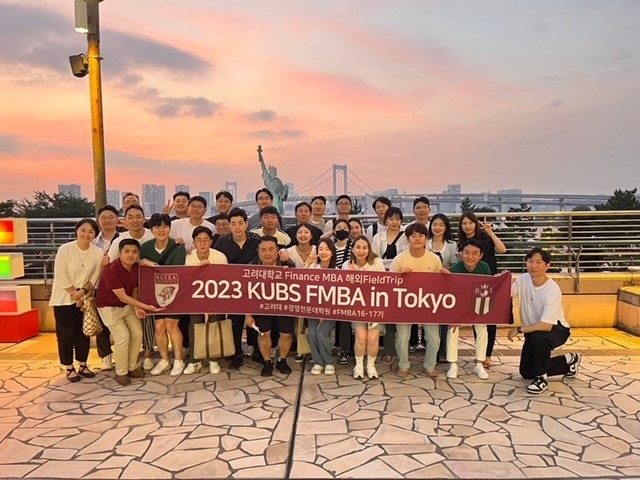
[Finance MBA Overseas Field Trip - Japan] "Exploring the Flow of International Financial Markets in Tokyo, the Financial Hub of East Asia"      Korea University's Graduate School of Business (Dean: Sang Yong Kim) operates an overseas field trip program for Part-time MBA students to enhance their global management acumen. The field trip, which was unable to take place due to COVID-19, resumed in 2022, allowing students to explore prestigious international locations and contribute to their development as global business leaders.        The Finance MBA (F-MBA) students embarked on their overseas field trip to Tokyo, Japan, from June 24th to 27th, during the first semester of the 2023 academic year. Tokyo serves as the hub of East Asian economies and a core of Japan's economy, making it an ideal destination for this field trip. The program included the participation of 36 F-MBA students and Professor Son Beom-jin.        During the three-night, four-day trip, F-MBA students engaged in △corporate visits, △economic and financial seminars, and △cultural exploration. They visited the Tokyo Stock Exchange, Mitsubishi UFJ Trust and Banking Corporation, and the Industrial Bank of Tokyo to gain insights into Japan's economic status and financial system. Notably, the Tokyo Stock Exchange plays a crucial role in shaping Japan's stock prices as the oldest securities exchange in the country.        Additionally, a seminar was held with MBA graduates from Hitotsubashi University. As the successor to Tokyo College of Commerce, which was one of Japan's top business schools, Hitotsubashi University boasts the highest prestige and authority in the business and economics field. It is also a part of the Tokyo Big Six Universities, alongside the University of Tokyo, Kyoto University, and Tokyo Institute of Technology. Through the seminar, the participating F-MBA students gained a deeper understanding of the local financial industry, and they also had the opportunity to experience culture through a visit to the Mori Art Museum.   

2023.08.02 Views 2803

  • 첫페이지로
  • 61
  • 62
  • 63
  • 64
  • 65
  • 마지막페이지로