TOP

KUBS News

Total 1428

Interview with Professor Woochan Kim, Recipient of the Hongjo Order of Service Merit - Leading Corp

[Interview with Professor Woochan Kim, Recipient of the Hongjo Order of Service Merit] Leading Corporate Governance Reform with Unwavering Conviction     On April 1, Professor Woochan Kim received the Hongjo Order of Service Merit at the 25th Fair Trade Day ceremony, hosted by the Korea Fair Trade Commission, in recognition of his contributions to establishing a fair and competitive market order. Having long been at the forefront of corporate governance reform, Professor Kim has consistently raised critical questions about Korea’s corporate governance system. More recently, he has expanded his work into the policymaking arena by serving on a number of national advisory bodies and committees. In this interview, Professor Kim reflects on the path he has taken, shares his views on corporate governance reform and economic growth, and offers advice to students. Below is an edited transcript of the interview.   Q1. Congratulations on receiving the Hongjo Order of Service Merit. Could you share your thoughts on receiving the honor? First, I would like to express my gratitude to everyone who has supported me. The achievements for which I received this honor were the result of a collective effort by my colleagues and me. I could never have received this honor without the support of the full-time research fellows at the Solidarity for Economic Reform and the Economic Reform Research Institute. I would like to extend my sincere thanks to all of them.   Q2. You were recognized for your efforts to curb self-dealing and improve related regulations through your work as Director of the Economic Reform Research Institute and in other roles. What does this honor mean to you personally? The path of corporate governance and chaebol reform that I have pursued has never been an easy one. Because the issues we address are deeply connected to structural interests within our society, bringing about change requires considerable time and patience. At times, I found myself wondering, “Why am I doing this?” or “Could I be doing something wrong?” Receiving this honor validated the path I have taken and reassured me that I have been moving in the right direction.     Q3. Was there a defining moment that first sparked your interest in corporate governance and led you to make it your lifelong work? I gradually found myself drawn to the field. I first learned about corporate governance while studying abroad. During my doctoral studies, I attended a guest lecture by Professor Andrei Shleifer of Harvard University’s Department of Economics. Hearing him explain corporate ownership structures was what first drew my attention to the field.Then the Asian financial crisis occurred. At the root of the crisis was the chaebol problem. Korean banks borrowed funds in foreign currencies, converted them into Korean won, and lent the money to chaebol groups. The chaebol groups failed to use those funds effectively and were unable to repay their debts, which contributed to the financial crisis. That was when I realized that the chaebol issue was a problem of national importance. After becoming a professor, I joined the People’s Solidarity for Participatory Democracy and participated in the minority shareholder movement with Professor Hasung Jang. I found it rewarding to take direct action, such as attending shareholders’ meetings and filing shareholder derivative suits. I later joined the Solidarity for Economic Reform when it was established and have remained involved ever since.   Q4. On March 31, you stepped down as the founding Director of the Economic Reform Research Institute, which you had led since its establishment. What led you to step down after such a long tenure? We would also like to know the most valuable takeaway from your time as Director. Our work began with the Economic Democratization Committee of the People’s Solidarity for Participatory Democracy. In 2006, several of us who had worked together left the organization and founded the Solidarity for Economic Reform. Soon afterward, we concluded that its activities needed to be supported by empirical policy research, and we launched the Economic Reform Research Institute in 2009. I served as its founding Director for 17 years. I had been considering stepping down for several years, and as my external responsibilities suddenly increased this year, I decided that it was time to leave the position. One of the most important lessons I learned while leading the institute was that capable members are more important than anything else if an organization is to function effectively. The members of our organization are exceptionally capable experts who work largely behind the scenes. No matter what I ask them—even about subjects I know little about—they can provide an answer within minutes. I also learned how important it is for capable individuals to share common values. Everyone at the institute shares the same mission and sense of purpose: improving corporate governance. Because of this shared commitment, we have been able to resolve differences of opinion without much difficulty. I believe I was able to achieve many meaningful results over the past 17 years because I had the opportunity to work with such talented and committed people.   Q5. In March, you were appointed as a member of the Growth Economy Subcouncil of the National Economic Advisory Council. How do you believe corporate governance is connected to the country’s medium- and long-term economic growth strategy? The central challenge in achieving sustainable economic growth is determining how efficiently we can use the capital and labor available to us. Corporate governance reform is therefore essential to improving the efficiency of capital.Shareholders provide capital to a company with the expectation that its managers will use it efficiently. In many cases, however, managers invest in non-core businesses or hold real estate unrelated to the company’s operations. In many cases, returning such funds to shareholders through dividends would represent a more efficient allocation of capital. If shareholders then invest those dividends in more productive companies, the efficiency of capital allocation across the economy as a whole will improve.     Q6. You were also appointed vice chair of the Financial Consumer Protection Advisory Committee at the Financial Supervisory Service. In your role as a champion for financial consumers, is there a particularly urgent issue that you would like to address? It would be difficult to single out just one urgent issue. Financial consumer protection can be broadly divided into four areas. First, there is the problem of mis-selling in the design and sale of financial products. Second, there is financial crime. As technology continues to advance, the number of victims of phishing scams has been increasing. Third, the threat of cyberattacks is also growing. Finally, there is the need to promote inclusive finance and shared growth initiatives. Financial support and protection for vulnerable groups are equally important. All of these issues are important, so it is difficult to say that any one of them is more urgent than the others. The Financial Consumer Protection Advisory Committee is the highest-level advisory committee within the Financial Supervisory Service, demonstrating how seriously the agency regards financial consumer protection.   Q7. You also lead research at Korea University as Director of the Asian Institute of Corporate Governance. What unique contribution can a university research institute make to society that national advisory bodies or civic organizations cannot? The Asian Institute of Corporate Governance is Korea’s first and virtually only university-affiliated research institute dedicated to corporate governance. Taking advantage of its position within a university, the institute contributes through academic research rather than policy research. In addition to traditional corporate governance issues, we have broadened the scope of our work by supporting research projects related to environmental, social, and governance issues. We also feature internationally renowned professors at our annual online symposium.   Q8. Last November, the second National Corporate Governance Competition for Students was held by the Korea Corporate Governance Forum and the Asian Institute of Corporate Governance. Was there a particular reason or concern that led you to organize the competition? Were there any student proposals from the competition that particularly stood out to you? The first competition was open only to students at Seoul National University School of Law. However, the number of participants fell short of our expectations. For the second competition, we therefore opened it to undergraduate students in order to encourage broader participation. The fundamental purpose of the competition is to encourage university students to take a greater interest in corporate governance issues and understand their importance. Many students participated in the second competition, so I believe we accomplished that objective. All of the participants presented outstanding ideas, but the Gold Prize-winning team was the most memorable. What distinguished the team was that it proposed an idea that controlling shareholders could also accept. Most of the other teams made proposals that were unlikely to be accepted in practice, but the Gold Prize-winning team presented an approach that could also provide economic benefits to controlling shareholders. I found that particularly impressive.   Q9. What issues do you hope Korea University Business School students who aspire to enter the field of corporate governance research will consider during their university years? After graduation, many business school students enter fields that provide professional services to companies. In many cases, however, their work ultimately serves the interests of controlling shareholders or individual executives. I hope students recognize that there is also a third path. They can choose to stand with shareholders and pursue work that contributes to corporate governance reform. This field remains very small at present, but it may grow considerably in the future. I hope students will also consider careers in this direction.   Q10. While concluding some of your previous responsibilities, you have also taken on many new positions. Do you see this period as a turning point in your life? Finally, what is your next goal or challenge? I do not think of it as a particularly significant turning point. I have continued to do the same kind of work, and I intend to keep doing it in the future. As for my next challenge, I am considering a new form of publication that is neither a conventional printed book nor a standard e-book. I am thinking about creating a book using Notion, which would allow me to incorporate multimedia content, include a variety of links, and continually revise and update the material. Corporate governance reform involves a complex web of interests and can therefore become a lonely struggle. Nevertheless, Professor Kim has continued this work steadily, regarding it both as a mission and as something he genuinely enjoys.The path he has followed with unwavering conviction is far from over. He continues to move forward, taking on the challenges that remain unresolved.   KUBS Student Press | Reporting by Jinyoung Kim

2026.07.24 Views 59

A New Chapter in Business Education… Launch of the Doctor of Business Administration (DBA) Program i

A New Chapter in Business Education… Launch of the Doctor of Business Administration (DBA) Program in Spring 2025 Korea University Business School (Dean: Eonsoo Kim), the first in Korea to introduce commercial education, has proudly upheld over 60 years of history since establishing its Graduate School of Business Administration in 1963. Today, under the leadership of Dean Eonsoo Kim, the Graduate School is recognized as a leader in delivering Korean-style MBA programs with a focus on practical, industry-centered education. Beginning in Spring 2025, the school will take a bold step forward with the launch of its Doctor of Business Administration (DBA) program, aiming to pioneer practical, industry-driven Korean management theories and usher in a new chapter in business education.    The KUBS-DBA program aims to develop management scholars who excel in both practical skills and academic excellence, shaping future leaders in management innovation. The three-year program offers a part-time format with classes held on Fridays and Saturdays. Students will be awarded a doctoral degree upon completing 36 credits and successfully passing the dissertation reviews.    Why choose the KUBS-DBA program? The KUBS-DBA program is optimal for professionals who want to balance work and study while pursuing career development, practical and scientific research, and knowledge creation and sharing. The program integrates professional experience with theoretical knowledge, enabling students to contribute to the development of Korean-style management theories and models. Research outcomes are realized in various forms, such as dissertations, management case studies, management manuals, and monographs, promoting both knowledge creation and sharing.    To achieve these goals, the KUBS-DBA program offers a curriculum supported by the largest faculty in the country, consiting of 88 full-time faculty member. The program focuses on developing core research competencies, reinterpreting and systematizing practical experience through theoretical learning and conducting in-depth studies on the latest research and management trends. Additionally, students receive personalized education and one-on-one guidance tailored to their individual interests and needs.    In addition, the KUBS-DBA program is open to applicants who hold a master’s degree and have at least 10 years of practical experience. The admission quota is limited to 12 students, with applications opening on October 14. For more information, please contact the administration office at 02-3290-1309. 

2024.09.25 Views 6385

"What If You Dream of Career Development?"—2025 Korea MBA Admission Information Session Held

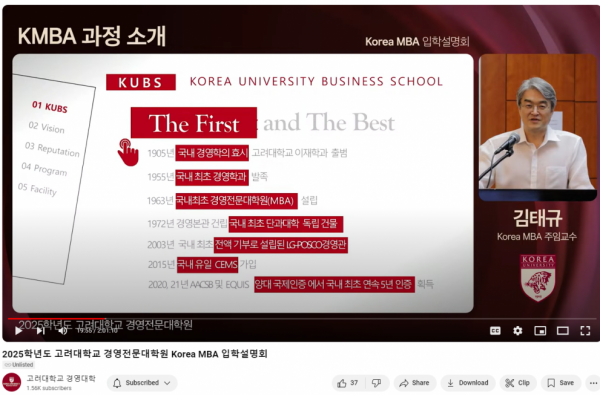
"What If You Dream of Career Development?"—2025 Korea MBA Admission Information Session Held On September 11, 2024, Korea University's Graduate School of Business (Dean: Eonsoo Kim) hosted an admission information session for the 2025 Korea MBA program at LG-POSCO Hall. Unlike the in-person session for the Finance MBA and the hybrid session for the Executive MBA, the Korea MBA information session was conducted entirely online. The agenda included a welcome speech by Dean Eonsoo Kim, an introduction to Korea University Business School, an overview of the Korea MBA program, admission guidelines, and presentations from student clubs.  The Korea MBA program is designed for working professionals aspiring to continuous career development, rooted in the rich history of Korea University's Graduate School of Business Administration. The program employs various teaching methods, including discussions, presentations, and group projects, allowing students to choose one of eight specialized tracks: Global Business, Marketing, Human Resources, Strategy, Finance, Accounting, Logistics, Service & Operations Management (LSOM), and Management Information Systems (MIS).  Professor Tai Gyu Kim, the academic director who introduced the Korea MBA program during the session, highlighted its distinctive courses. He explained that the Introduction to General Management (Orientation) course offers students an opportunity to deepen their understanding of the curriculum while learning the university's anthem and cheers, fostering camaraderie with peers and alumni. Additionally, the Special Topics on Management course provides insights into contemporary business trends and innovative concepts.  The session also featured information about an overseas Field Trip, where Korea MBA students visit prominent countries to attend lectures by local scholars and experts, participate in corporate visits, and engage in industry tours, enhancing their global business perspective.  To showcase vibrant student life, club activities were highlighted through creative videos made by each club, followed by a Q&A session with the Korea MBA Student Council, who shared insights into MBA life. For those interested, the application period for the 2025 Korea MBA program runs from September 13 to October 11. For further inquiries, prospective students can contact the admissions office at 02-3290-1303 or 2705. 

2024.09.25 Views 3340

The Best Choice for Future CEOs: 2025 Executive MBA Admission Information Session Held

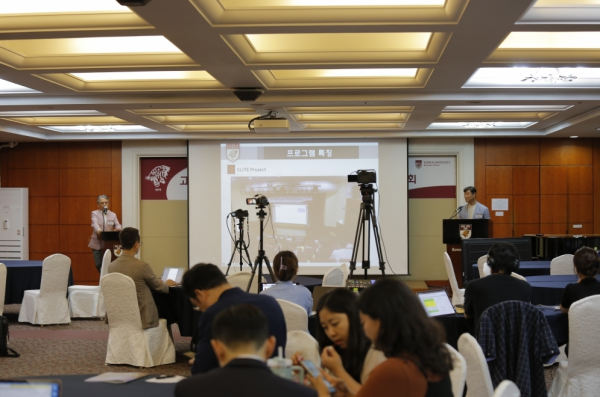
The Best Choice for Future CEOs: 2025 Executive MBA Admission Information Session Held On September 6th, Korea University's Graduate School of Business Administration (Dean: Eonsoo Kim) hosted an admission information session for the 2025 Executive MBA program at LG-POSCO Hall, with both in-person and online attendance. The in-person event took place in Young-Il Ahn Hall, while an online livestream was available via KUBS’s YouTube channel.  The session covered several key topics: an introduction to Korea University Business School, an overview of the Executive MBA program and curriculum, a showcase of the program’s distinctive features, admission guidelines, a Q&A session, and introductions to the alumni association and student clubs.  The event began with a welcome video from Dean Eonsoo Kim, followed by a presentation from Associate Dean Gangseog Ryu. Associate Dean Ryu emphasized that “Korea University's Graduate School of Business Administration is a pioneer in the field and consistently holds the title of the top business school in the country.” He also highlighted that the school is the only domestic institution listed in the Financial Times 2023 Global Executive MBA Rankings, adding that “the Executive MBA program has consistently ranked among the top 100 worldwide as a standalone offering.”  The session continued with an introduction to the Executive MBA program and its curriculum, delivered by two academic directors, Professors Shijin Yoo and Daeki Kim. They explained that the Executive MBA employs a modular format, featuring intensive two-week courses followed by a one-week break, allowing for 5 to 7 modules per semester. Additionally, they introduced the ELITE Project, a unique initiative where participants take on the role of CEO to present innovative business strategies and entrepreneurial ideas.  After the Q&A session regarding the curriculum, alumni and student clubs gave presentations, highlighting the strong network among graduates. Participants learned about a variety of clubs, including the Business Club “Bisty” and the Wine Club “Warak.”  The application period for the 2025 Executive MBA program runs from September 13 to October 11. For further inquiries, prospective students can contact the admissions office at 02-3290-1309. 

2024.09.25 Views 3486

“The Future of Marketing Transformed by AI”: Entrepreneurship Academy Lecture on Demand by Joo-hye S

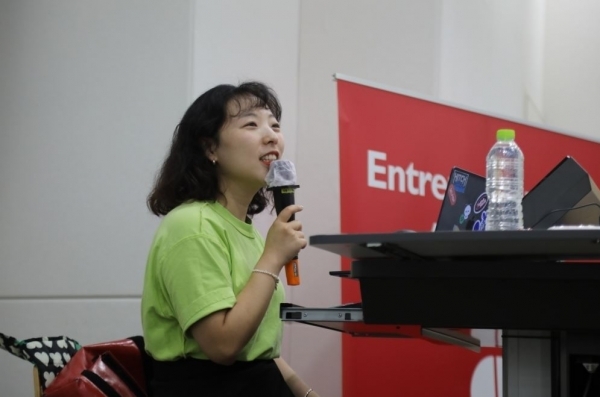
“The Future of Marketing Transformed by AI”: Entrepreneurship Academy Lecture on Demand by Joo-hye Shin of SELFISH CLUB   On September 10, 2023, Korea University's Business School (Dean: Eonsoo Kim) hosted a lecture on demand for the Entrepreneurship Academy at the Startup Research Center (Director: Jungbien Moon) in Room B308 of the Hyundai Motor Hall. The lecture was delivered by Joo-hye Shin, master of SELFISH CLUB.    Joo-hye Shin is the founder of SELFISH CLUB and serves as a leading speaker for AI marketing education at various institutions, including the Gyeonggi Knowledge and Busan Economic Promotion Agency, Fast Campus, and Class101. During her lecture, she presented on the topic of “Building a Full-Stack Marketing Team with AI.”      Shin began by sharing her career journey, which spans over a decade in the marketing field across numerous startups, including the healthcare platform GoodDoc, P2P finance, Wingbling, and Class101. She revealed that her venture into artificial intelligence (AI) stemmed unexpectedly from her experience as a victim of a Ponzi scheme.    While working at a real estate investment platform and in P2P finance, she was left broke due to the scheme. "I had to take up marketing as a laborer," she explained. Teaming up with a friend as a "marketing duo," she worked at five different companies, which transformed her perspective on marketing. “In marketing, being ‘number one’ is meaningless; the goal is to achieve a strong positioning in a specific area and become a ‘promotion expert,’” she reflected. This experience ultimately led her to create a full-stack marketing team at Class101, which brings together a team to achieve shared objectives.      After using ChatGPT, Shin concluded that AI can be most effectively utilized by those with prior experience. She noted that while AI makes it challenging to recruit specialists like designers and engineers, it presents a golden opportunity for marketers and planners. She emphasized that we are in an era where it is possible to generate prompts based on images, marking the end of watermarking images purchased for use. Shin concluded her lecture by posing the question of whether AI could enable marketers to accomplish tasks previously deemed impossible. 

2024.09.24 Views 2715

"Training Financial Experts" 2025 Finance MBA Admission Information Session Held

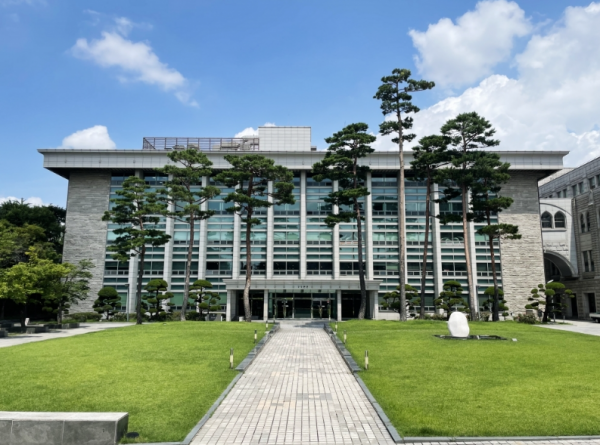
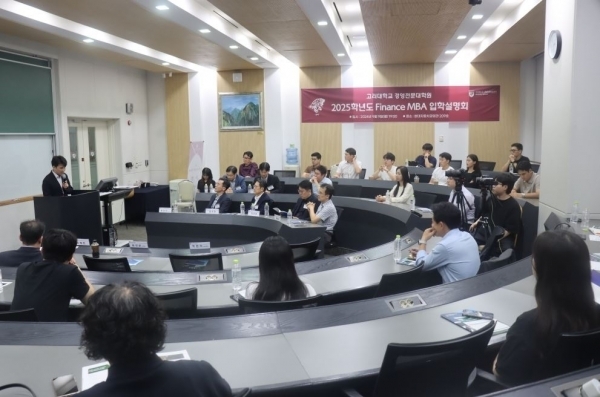
"Training Financial Experts" 2025 Finance MBA Admission Information Session Held      On September 9th, Korea University Business School (Dean: Eonsoo Kim) held the 2025 Finance MBA Admission Information Session in Room 209 of Hyundai Motor Hall. The session followed the order of △Welcome speech by Dean Eonsoo Kim △Introduction to Korea University Business School △Overview of the Finance MBA program △Introduction of finance faculty △Introduction to the Student Council △Campus tour.      Dean Eonsoo Kim opened with a welcome speech, stating, "Our business school offers an innovative curriculum that is tailored to the rapidly changing industrial environment and is supported by top-tier faculty. I hope you will experience our outstanding infrastructure firsthand." Following this, Associate Dean Gangseog Ryu provided an overview of Korea University Business School, and Professor Bumjean Sohn, head of the Finance MBA program, introduced the Finance MBA. Professor Sohn remarked, "The Finance MBA aims to nurture financial experts with both competence and vision. The program incorporates the latest trends in the financial sector and offers a comprehensive curriculum that spans all areas of finance." He also highlighted key aspects of the program, including △Overseas Field Trips △Finance Practical Lectures △CFA Program Partnership △Exchange/Double Degree/Renaissance Programs.      Finance professors, including Baeho Kim, Woochan Kim, Taejin Kim, James L. Park, and Joon Ho Hwang, also attended and greeted the participants. Professor Woochan Kim commented, "Work must already be demanding, yet your commitment to furthering your education by being here is truly commendable. Your dedication motivates me to deliver lectures that match your passion."      Seon-Gyun Song, president of the Finance MBA student council, then introduced aspects of campus life, such as school events, clubs, and student groups. The session concluded with a tour of the business school campus. Applications for the 2025 Spring Finance MBA program will be accepted from September 13th to October 11th, and inquiries can be directed to the admissions office (02-3290-1308). 

2024.09.24 Views 3051

  • 첫페이지로
  • 41
  • 42
  • 43
  • 44
  • 45
  • 마지막페이지로