TOP

KUBS News

Total 1428

Interview with Professor Woochan Kim, Recipient of the Hongjo Order of Service Merit - Leading Corp

[Interview with Professor Woochan Kim, Recipient of the Hongjo Order of Service Merit] Leading Corporate Governance Reform with Unwavering Conviction     On April 1, Professor Woochan Kim received the Hongjo Order of Service Merit at the 25th Fair Trade Day ceremony, hosted by the Korea Fair Trade Commission, in recognition of his contributions to establishing a fair and competitive market order. Having long been at the forefront of corporate governance reform, Professor Kim has consistently raised critical questions about Korea’s corporate governance system. More recently, he has expanded his work into the policymaking arena by serving on a number of national advisory bodies and committees. In this interview, Professor Kim reflects on the path he has taken, shares his views on corporate governance reform and economic growth, and offers advice to students. Below is an edited transcript of the interview.   Q1. Congratulations on receiving the Hongjo Order of Service Merit. Could you share your thoughts on receiving the honor? First, I would like to express my gratitude to everyone who has supported me. The achievements for which I received this honor were the result of a collective effort by my colleagues and me. I could never have received this honor without the support of the full-time research fellows at the Solidarity for Economic Reform and the Economic Reform Research Institute. I would like to extend my sincere thanks to all of them.   Q2. You were recognized for your efforts to curb self-dealing and improve related regulations through your work as Director of the Economic Reform Research Institute and in other roles. What does this honor mean to you personally? The path of corporate governance and chaebol reform that I have pursued has never been an easy one. Because the issues we address are deeply connected to structural interests within our society, bringing about change requires considerable time and patience. At times, I found myself wondering, “Why am I doing this?” or “Could I be doing something wrong?” Receiving this honor validated the path I have taken and reassured me that I have been moving in the right direction.     Q3. Was there a defining moment that first sparked your interest in corporate governance and led you to make it your lifelong work? I gradually found myself drawn to the field. I first learned about corporate governance while studying abroad. During my doctoral studies, I attended a guest lecture by Professor Andrei Shleifer of Harvard University’s Department of Economics. Hearing him explain corporate ownership structures was what first drew my attention to the field.Then the Asian financial crisis occurred. At the root of the crisis was the chaebol problem. Korean banks borrowed funds in foreign currencies, converted them into Korean won, and lent the money to chaebol groups. The chaebol groups failed to use those funds effectively and were unable to repay their debts, which contributed to the financial crisis. That was when I realized that the chaebol issue was a problem of national importance. After becoming a professor, I joined the People’s Solidarity for Participatory Democracy and participated in the minority shareholder movement with Professor Hasung Jang. I found it rewarding to take direct action, such as attending shareholders’ meetings and filing shareholder derivative suits. I later joined the Solidarity for Economic Reform when it was established and have remained involved ever since.   Q4. On March 31, you stepped down as the founding Director of the Economic Reform Research Institute, which you had led since its establishment. What led you to step down after such a long tenure? We would also like to know the most valuable takeaway from your time as Director. Our work began with the Economic Democratization Committee of the People’s Solidarity for Participatory Democracy. In 2006, several of us who had worked together left the organization and founded the Solidarity for Economic Reform. Soon afterward, we concluded that its activities needed to be supported by empirical policy research, and we launched the Economic Reform Research Institute in 2009. I served as its founding Director for 17 years. I had been considering stepping down for several years, and as my external responsibilities suddenly increased this year, I decided that it was time to leave the position. One of the most important lessons I learned while leading the institute was that capable members are more important than anything else if an organization is to function effectively. The members of our organization are exceptionally capable experts who work largely behind the scenes. No matter what I ask them—even about subjects I know little about—they can provide an answer within minutes. I also learned how important it is for capable individuals to share common values. Everyone at the institute shares the same mission and sense of purpose: improving corporate governance. Because of this shared commitment, we have been able to resolve differences of opinion without much difficulty. I believe I was able to achieve many meaningful results over the past 17 years because I had the opportunity to work with such talented and committed people.   Q5. In March, you were appointed as a member of the Growth Economy Subcouncil of the National Economic Advisory Council. How do you believe corporate governance is connected to the country’s medium- and long-term economic growth strategy? The central challenge in achieving sustainable economic growth is determining how efficiently we can use the capital and labor available to us. Corporate governance reform is therefore essential to improving the efficiency of capital.Shareholders provide capital to a company with the expectation that its managers will use it efficiently. In many cases, however, managers invest in non-core businesses or hold real estate unrelated to the company’s operations. In many cases, returning such funds to shareholders through dividends would represent a more efficient allocation of capital. If shareholders then invest those dividends in more productive companies, the efficiency of capital allocation across the economy as a whole will improve.     Q6. You were also appointed vice chair of the Financial Consumer Protection Advisory Committee at the Financial Supervisory Service. In your role as a champion for financial consumers, is there a particularly urgent issue that you would like to address? It would be difficult to single out just one urgent issue. Financial consumer protection can be broadly divided into four areas. First, there is the problem of mis-selling in the design and sale of financial products. Second, there is financial crime. As technology continues to advance, the number of victims of phishing scams has been increasing. Third, the threat of cyberattacks is also growing. Finally, there is the need to promote inclusive finance and shared growth initiatives. Financial support and protection for vulnerable groups are equally important. All of these issues are important, so it is difficult to say that any one of them is more urgent than the others. The Financial Consumer Protection Advisory Committee is the highest-level advisory committee within the Financial Supervisory Service, demonstrating how seriously the agency regards financial consumer protection.   Q7. You also lead research at Korea University as Director of the Asian Institute of Corporate Governance. What unique contribution can a university research institute make to society that national advisory bodies or civic organizations cannot? The Asian Institute of Corporate Governance is Korea’s first and virtually only university-affiliated research institute dedicated to corporate governance. Taking advantage of its position within a university, the institute contributes through academic research rather than policy research. In addition to traditional corporate governance issues, we have broadened the scope of our work by supporting research projects related to environmental, social, and governance issues. We also feature internationally renowned professors at our annual online symposium.   Q8. Last November, the second National Corporate Governance Competition for Students was held by the Korea Corporate Governance Forum and the Asian Institute of Corporate Governance. Was there a particular reason or concern that led you to organize the competition? Were there any student proposals from the competition that particularly stood out to you? The first competition was open only to students at Seoul National University School of Law. However, the number of participants fell short of our expectations. For the second competition, we therefore opened it to undergraduate students in order to encourage broader participation. The fundamental purpose of the competition is to encourage university students to take a greater interest in corporate governance issues and understand their importance. Many students participated in the second competition, so I believe we accomplished that objective. All of the participants presented outstanding ideas, but the Gold Prize-winning team was the most memorable. What distinguished the team was that it proposed an idea that controlling shareholders could also accept. Most of the other teams made proposals that were unlikely to be accepted in practice, but the Gold Prize-winning team presented an approach that could also provide economic benefits to controlling shareholders. I found that particularly impressive.   Q9. What issues do you hope Korea University Business School students who aspire to enter the field of corporate governance research will consider during their university years? After graduation, many business school students enter fields that provide professional services to companies. In many cases, however, their work ultimately serves the interests of controlling shareholders or individual executives. I hope students recognize that there is also a third path. They can choose to stand with shareholders and pursue work that contributes to corporate governance reform. This field remains very small at present, but it may grow considerably in the future. I hope students will also consider careers in this direction.   Q10. While concluding some of your previous responsibilities, you have also taken on many new positions. Do you see this period as a turning point in your life? Finally, what is your next goal or challenge? I do not think of it as a particularly significant turning point. I have continued to do the same kind of work, and I intend to keep doing it in the future. As for my next challenge, I am considering a new form of publication that is neither a conventional printed book nor a standard e-book. I am thinking about creating a book using Notion, which would allow me to incorporate multimedia content, include a variety of links, and continually revise and update the material. Corporate governance reform involves a complex web of interests and can therefore become a lonely struggle. Nevertheless, Professor Kim has continued this work steadily, regarding it both as a mission and as something he genuinely enjoys.The path he has followed with unwavering conviction is far from over. He continues to move forward, taking on the challenges that remain unresolved.   KUBS Student Press | Reporting by Jinyoung Kim

2026.07.24 Views 59

"A Day of Unity and Passion for the E-MBA Family" — KUBS E-MBA Hold Joint Sports Day

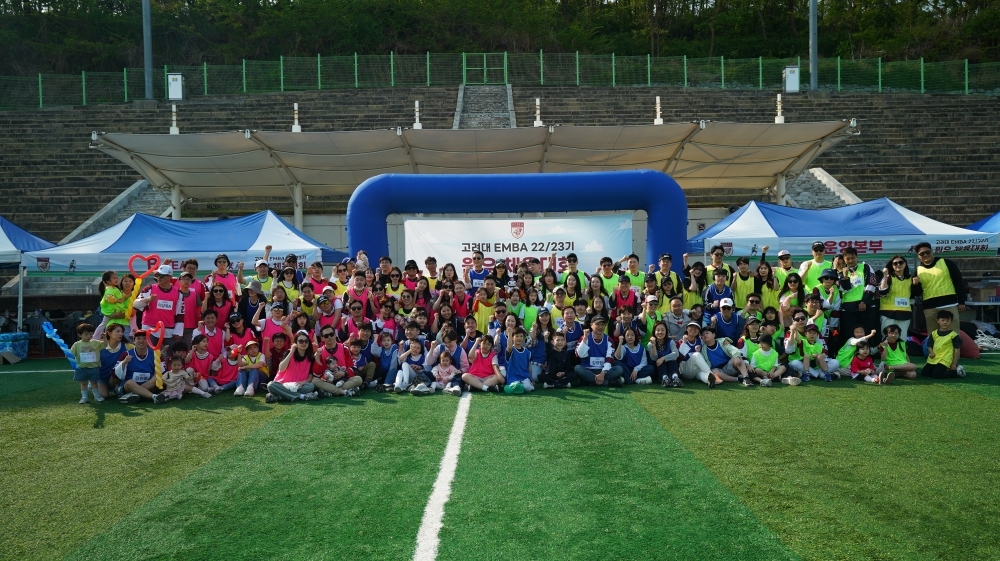
"A Day of Unity and Passion for the E-MBA Family" — Korea University Business School E-MBA Cohorts 22 and 23 Hold Joint Sports Day     On Saturday, April 26, students from the 22nd and 23rd cohorts of Korea University Business School's Executive MBA (E-MBA) program successfully held a joint Sports Day at Nokji Stadium on the Korea University Campus.    Renowned as one of Korea’s top Executive MBA programs, Korea University's E-MBA is known for its rigorous academic curriculum and strong alumni network. The event was designed to foster camaraderie among students and create meaningful memories with their families.    More than 100 students and their family members participated in the event, filling the day with passionate cheers and enthusiastic energy as they took part in a variety of games. The event fostered a spirit of unity and created a truly vibrant atmosphere.    Highlighted activities included a curtain-style tug-of-war, a cooperative ball bouncing game, an O.X. quiz, and a leg wrestling match between the 22nd and 23rd cohorts. Special programs were also arranged for children, making the event a warm and inclusive celebration for all generations.    Jeon Eun-ae, head of athletics for the 22nd cohort, remarked, "It was a meaningful opportunity to step away from our busy academic and professional routines, share laughter, cheer each other on, and develop a deeper understanding of one another. I hope this event strengthens the bond between the 22nd and 23rd cohorts moving forward."    The event successfully reaffirmed the strong spirit of unity and collaboration among Korea University Business School E-MBA students.   

2025.05.09 Views 3459

Riding the Spring Breeze: 2025 Spring CHOO CHOO DAY to Be Held

Riding the Spring Breeze: 2025 Spring CHOO CHOO DAY to Be Held      The Startup Station of Korea University Business School will host the 2025 Spring CHOO CHOO DAY on Friday, May 9 at 2:30 PM. The event will be held in person at the International Remote Conference Room, located on B1 of the Centennial Memorial Samsung Hall.    A total of five startups will participate in CHOO CHOO DAY, each showcasing their unique products and services. The participating companies are:  NAWA: Cup끼리, a smart trash bin that washes, dries, compresses, and collects used cups.  Markworks: Markworks, an AI-powered trademark similarity judgment and proactive search solution designed for patent attorneys.  ReB.Lively: NoriCare, a healthcare solution specializing in chronic disease management for seniors.  Peekaboo Labs: CARVE, a solution that enables users to build dedicated on-device AI systems with just one line of code.  Atlo: DITTO, an empathetic, personalized chatbot that responds to and resonates with human emotions.    The event is open to anyone interested in startups. Registration can be completed through the link below:    ▶ [Register Here]    CHOO CHOO DAY is a startup demo day where young entrepreneurs, nurtured through the Startup Research Institute’s incubation program, present and demonstrate their products and services. Held twice a year in the spring and fall, the event serves as a valuable platform for participating startups to attract early-stage investment and advance to the next stage of growth. 

2025.05.09 Views 3413

KUBS Holds Entrance Ceremony for the 106th Class of the MSP Cohort

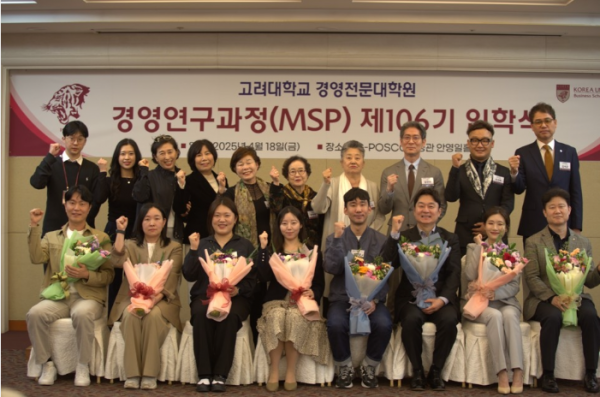
“Doing Better by Being Different” – KUBS Holds Entrance Ceremony for the 106th Class of the MSP Cohort      On Friday, April 18, the Korea University Business School held the entrance ceremony and orientation for the 106th cohort of the Management Studies Program (MSP) at Ahn Young-Il Hall, located on the 6th floor of the LG-POSCO Hall. A total of eight new students joined the 106th cohort, embarking on a new journey of learning and growth together. MSP is a Mini MBA program tailored for young leaders, aiming to strengthen their strategic thinking and practical capabilities.      In his welcome address, Dean Eonsoo Kim of Korea University Business School emphasized, “At Korea University Business School, under the philosophy of ‘Doing Better by Being Different,’ we aim to nurture leaders who contribute to society through a differentiated approach to education.” He added, “You will cultivate the insight to navigate today’s rapidly changing business environment through the framework of 3C — Curiosity, Collaboration, and Contribution — and 4Tech —  AI, Semiconductors, Robotics, and Energy.”      Professor Seokkyun Kim, Academic Director of MSP, introduced the curriculum, faculty, and student activities, highlighting MSP’s unique strengths not only in academic excellence but also in fostering a broad and influential professional network. In his congratulatory remarks, Alumni Association President Hwan-gi Son said, “The passion and effort you dedicate over the next six months will surely become invaluable assets for your future,” and added, “It is a great honor to learn from top-tier faculty, and I look forward to the lasting connections that will be formed under the name of ‘alumni.’”      Following the speeches, the President and Vice President of the Alumni Association presented flower bouquets to the new students. The ceremony concluded with a rendition of the Korea University school song and a commemorative group photo.      Launched in 1963, the Management Studies Program (MSP) is Korea’s leading executive education program, boasting a tradition of over 60 years. It attracts mid- to senior-level executives, public sector leaders, and professionals from a wide range of industries. Korea University Business School remains committed to delivering relevant and impactful business education that responds to the evolving demands of society. 

2025.04.25 Views 3351

KUBS Signs MoU with Carnegie Mellon University’s Tepper School of Business

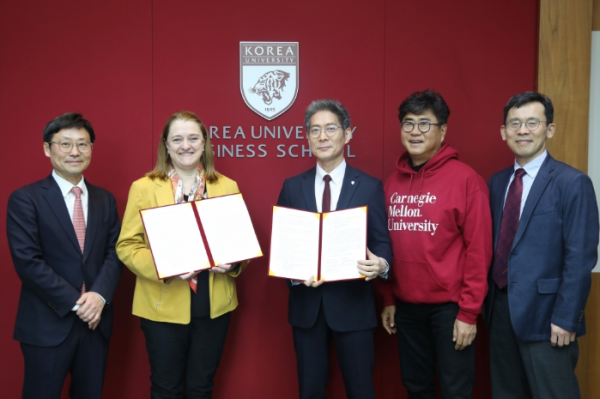
Korea University Business School Signs MoU with Carnegie Mellon University’s Tepper School of Business for International Collaboration      On Friday, April 4, Korea University Business School (KUBS) signed a Memorandum of Understanding (MoU) with the Tepper School of Business at Carnegie Mellon University (CMU) to strengthen international collaboration. The signing ceremony took place at the Dean’s Office, located on the first floor of the KUBS main building.  This in-person ceremony was made possible by the visit of Professor Isabelle Bajeux-Besnainou, Dean of the Tepper School of Business, to Korea University. Representing KUBS were Dean Eonsoo Kim, Associate Dean Gangseog Ryu, and Associate Dean Byung Cho Kim. The two institutions shared their vision and explored potential areas of cooperation.  Under the MoU, the two schools agreed to collaborate in the following areas:  ▲ faculty exchange for research and educational activities,  ▲ student exchange programs,  ▲ joint development and operation of courses within degree programs, and  ▲ cooperation on the development of new degree programs and curricula.      Following the signing, Dean Kim and Dean Bajeux-Besnainou participated in a commemorative photo session and exchanged gifts symbolizing their respective institutions.  Dean Eonsoo Kim stated, “Partnering with the Tepper School of Business—one of the world’s leading business schools—will be a meaningful step toward expanding KUBS’s global network. We will actively work to ensure this partnership leads to tangible exchanges and outcomes.”  Through this agreement, KUBS aims to further enhance its global competitiveness in education and research, and to solidify its position as a leading business school dedicated to nurturing global leaders.      The Tepper School of Business at Carnegie Mellon University is widely recognized for its data-driven approach to business education. Most recently, it ranked 6th in the 2025 U.S. News & World Report for undergraduate business programs in the United States, reaffirming its excellence and reputation. 

2025.04.18 Views 3674

Entrepreneurship Academy Lecture by Jung Dohwan, Co-CEO of CRYCHEESEBURGER 

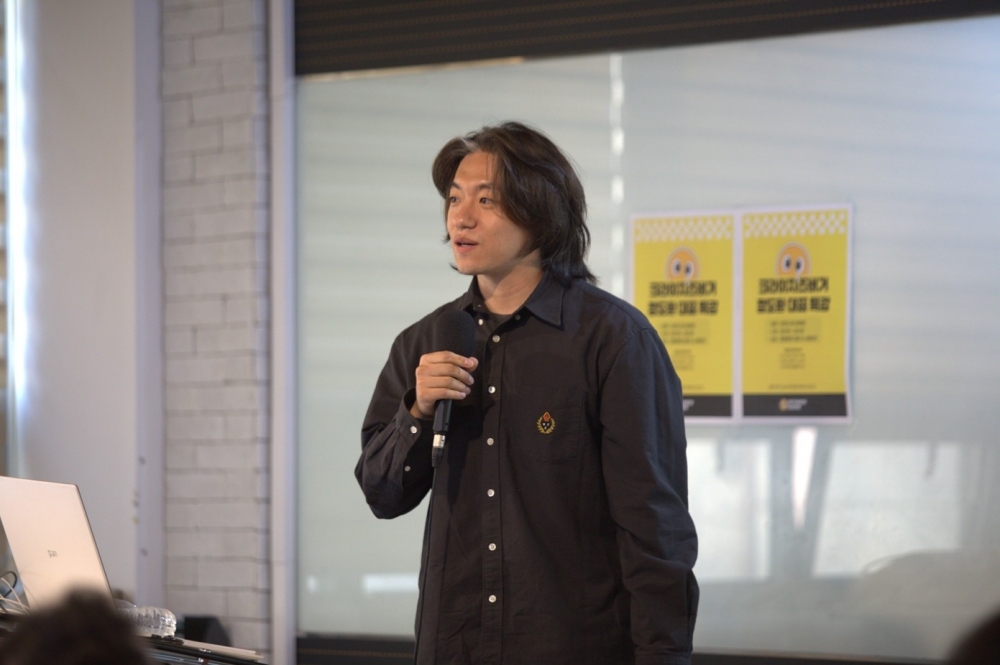
“Brands Are Ultimately Built by People” – Entrepreneurship Academy Lecture by Jung Dohwan, Co-CEO of CRYCHEESEBURGER      A special lecture organized by the Startup Station at Korea University Business School took place on Tuesday, April 8, at The STAGE on the second floor of the Main Building. Under the theme “Launching and Operating an F&B Brand,” the lecture was delivered by Jung Dohwan, Co-CEO of CRYCHEESEBURGER, a handcrafted burger brand, who shared practical insights into entrepreneurship and brand management.      Jung opened the lecture by explaining what led him to enter the F&B industry, emphasizing its systems-oriented nature and the appeal of offline business. “F&B is a field where you can gain hands-on experience in every aspect of business, from logistics and product development to marketing and customer experience,” he said. “Its biggest advantage is the ability to rapidly test and implement hypotheses in real time.”    He then shared the brand philosophy behind CRYCHEESEBURGER. As a casual dining brand, CRYCHEESEBURGER centers its core value on “delivering a satisfying dining experience at a reasonable price.” Jung emphasized, “What sets a brand apart is offering products and experiences that match its positioning,” and added, “Above all, the most important thing is to be honest with your customers.”    He also shared practical lessons from his journey as a founder and operator. “While having an efficient business strategy is important, the essence of any business ultimately lies in people,” he said. “What matters most is having teammates you can trust—those who are willing to climb the mountain with you.” On leadership, he noted, “The most effective way to motivate your team is by leading through example,” adding, “Never forget that, in the end, every leader is judged by their results.”      Toward the end of the lecture, a Q&A session was held with Korea University students preparing to launch their own startups. Jung encouraged them, saying, “Don’t trap yourself in a narrow mold—take charge of your life and career, and carve out your own path.” He reiterated the importance of maintaining a broad and open perspective.    CRYCHEESEBURGER is a Korea-based handcrafted burger brand that launched its first store in Bucheon in 2013 and currently operates seven company-owned locations throughout the Seoul metropolitan area. Jung Dohwan, who formerly served as an investment professional at Fast Ventures, supported the growth of numerous startups. He now leads the company as an F&B executive, putting into practice a distinctive branding strategy. 

2025.04.17 Views 3284

KUBS KULSOM Advances to Global Student Challenge Final with 5th Place Worldwide in Preliminary Round

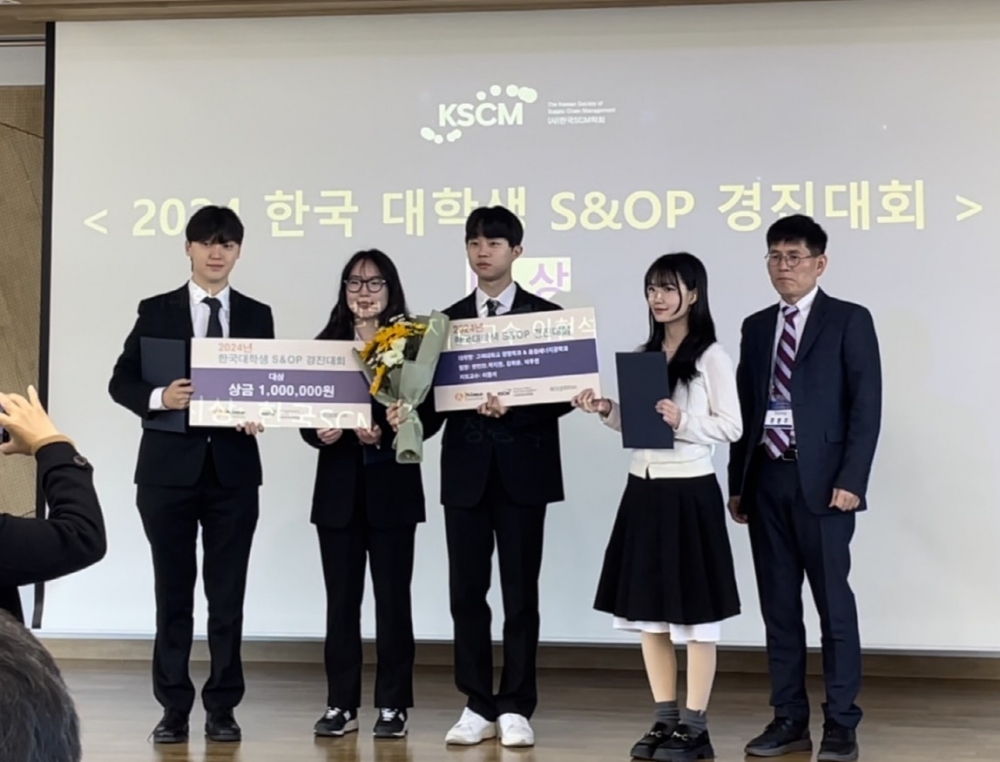
Korea University Business School’s KULSOM Advances to Global Student Challenge Final with 5th Place Worldwide in Preliminary Round      KULSOM (Korea University Logistics, Service and Operations Management), a student academic society at Korea University Business School, has advanced to the Final Round of the Global Student Challenge (GSC), a prestigious international supply chain management competition. Representing South Korea after winning the national S&OP (Sales and Operations Planning) competition, KULSOM placed 5th among 143 teams worldwide in the preliminary round.    KULSOM is composed of students interested in LSOM (Logistics, Service and Operations Management), a discipline within business administration. KULSOM has actively participated in both domestic and international competitions based on its academic and practical understanding of supply chain and operations strategy. In this event, the team competed under the name “KULSOM” along with Korea University’s official logo, further enhancing the university’s presence on the global stage.    Professor Hyun Seok Lee, academic director and LSOM professor, remarked, “This outstanding achievement reflects the students’ passion and hard work. It is a source of great pride to see Korea University Business School’s strengths once again recognized on the global stage.”      The GSC is an international competition hosted by Inchainge, a supply chain education institution based in the Netherlands. It brings together university students from around the world who specialize in supply chain and operations management to compete through strategic simulations modeled after real-world business scenarios.    KULSOM is now making thorough preparations for the Final Round, aiming to deliver another strong performance and take another leap forward on the global stage. 

2025.04.16 Views 3652

  • 첫페이지로
  • 31
  • 32
  • 33
  • 34
  • 35
  • 마지막페이지로