TOP

KUBS News

Total 1417

‘KUBS 120 MARCH’ Campaign Nears 40% of Goal … Total Pledges Reach Approx. KRW 4.6 Billion

‘KUBS 120 MARCH’ Campaign Nears 40% of Goal … Total Pledges Reach Approx. KRW 4.6 Billion Three major large-scale pledges secured within four months of launch … Campaign continues through November 30     Korea University Business School’s KRW 12 billion fundraising campaign, “KUBS 120 MARCH,” has secured approximately KRW 4.6 billion in pledged donations within just four months of its launch, nearing 40% of its goal.   Since the campaign’s launch in January, when pledged donations stood at around KRW 2 billion, the total has more than doubled in just three months. From December 1, 2025, to November 30, 2026, total pledges reached KRW 4,652,317,231, with 324 participants, including corporations, alumni, faculty, staff, and students.       | Three major pledges secured … Alumni and corporations join forces    One of the most notable achievements is the securing of three major pledges. An anonymous donor pledged support for the research fund, Eugene Investment & Securities Co., Ltd. for the development fund, and Samyang Tongsang for scholarships. Alumni account for approximately 62% of total pledges, while corporations represent about 35%, jointly driving the campaign forward.   Group donations have also continued. Following the participation of the Class of ’81 alumni association, the Business School Class of ’79 Scholarship Committee (28 members), the KUBS Class of ’98 Alumni Night (126 participants), as well as faculty and staff, have also joined the campaign.      | Expanding participation across classes, generations, and professions    The donor base is highly diverse. Participation spans from alumni who entered in the 1970s to current students from the Class of ’26, as well as members of EMBA, DBA, and AMP programs, undergraduate alumni, and even alumni from the College of Medicine. From individual research labs and faculty bands to student councils, all corners of the Business School are actively engaging with the campaign, further broadening its base of participation.   This campaign is particularly meaningful in that it places value not only on the total amount raised but also on participation itself. From small contributions starting at KRW 10,000 to major gifts reaching KRW 1 billion, every act of giving becomes part of the shared legacy of KUBS’s 120-year history.    | Investing in the future campus… Advancing the 3C Trading Zone and 4Tech strategy    The funds raised are being used to realize the Business School’s future vision. Alongside the advancement of the “4Tech Strategy,” centered on AI, semiconductors, energy, and robotics, spatial innovation projects are also taking shape.   The Business School is already operating AI-focused tracks and 4Tech micro-degree programs, and continues to expand its educational and research capabilities with its largest-ever full-time faculty body of 95 members.   On the basement level of Hyundai Motor Hall, the “3C Trading Zone (tentative name)” is currently under development, with a trading demo day scheduled for early May. The space will also include an Art & Culture Room. Artist Uhm Jung-soon’s installation piece, K, the Noseless Elephant, has already been installed in the building.   Construction has also begun on an LED display in the lobby of LG-POSCO Hall, which will serve as a large-scale digital donor wall. An opening ceremony is scheduled following the conclusion of the campaign in May.   Dean Eonsoo Kim stated, “We have come this far thanks to the collective support of each and every member,” adding, “We hope more people will join us on this journey as we prepare for the next 120 years of the Business School.”   The “KUBS 120 MARCH” campaign will continue through November 30, 2026. Donations can be made via the official sponsorship page (box.donus.org/box/koreauniversity/KUBS120march).   As of December 1, 2025 – November 30, 2026 | Total pledged amount: KRW 4,652,317,231

2026.04.17 Views 2011

One-Year Intensive Program Nurturing Business and Data Integration Professionals

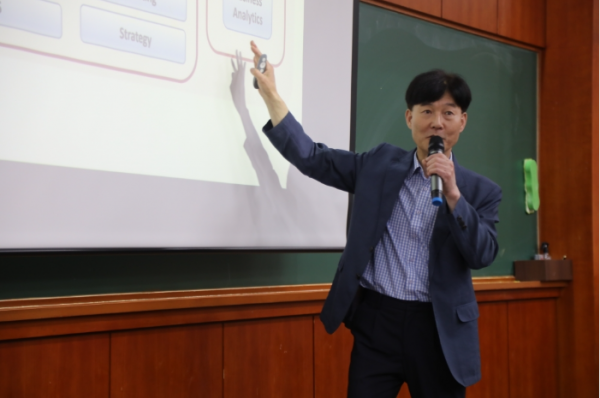
One-Year Intensive Program Nurturing Business and Data Integration Professionals: 2026 Spring BA Program Information Session  The admission briefing session for the Master’s Program in Business Analytics (hereinafter BA) under the Department of Business Administration at Korea University Graduate School for the 2026 academic year was held on Wednesday, September 17, in Room 433 of the LG-POSCO Building at Korea University.     The session was led by Professor Kyung Sam Park, who began by providing an overview of the BA program. The BA program is a practical and field-oriented master’s program designed to cultivate business professionals with interdisciplinary expertise, equipping students with both the theoretical foundations and analytical skills necessary for data analysis and information extraction.  This is a one-year program open to applicants from all undergraduate backgrounds. To graduate, students must complete a total of 32 credits, consisting of 24 course credits (15 required and 9 elective) and 8 credits from a capstone project. Students who lack foundational knowledge in relevant areas may be required to take prerequisite courses designated by their academic advisor. Instead of a traditional thesis, the program features a practical, project-based capstone. Since 2023, the program has also operated the “Renaissance Program,” which allows graduates to re-enroll in designated courses within five years of graduation through a formal application process.    The curriculum is organized into six modules, running from March to January of the following year. Beginning in Module 2, students initiate their capstone projects, forming teams to address real-world business challenges proposed by corporate partners under the supervision of faculty advisors. Mid-term presentations take place in October, followed by final presentations in January of the following year. In addition, bootcamps are held in February and August to help students strengthen essential skills—such as coding—before entering the main program.  Students take courses such as Principles of Business Analytics, Business Analytics Programming, Business Analytics for Healthcare, and Business Analytics and Artificial Intelligence. They also conduct data analysis projects using real corporate datasets. Professor Park highlighted, “What differentiates the BA program is that it teaches not only data analysis but also business operation systems. Students can gain a business perspective here that is difficult to acquire in other fields, such as statistics.”    He went on to introduce examples of past capstone project topics and partner organizations. To date, the BA program has established partnerships with leading companies such as LG Household & Health Care, LG CNS, Hyundai Motor Company, Lotte Members, GS Retail, Woori Card, and PwC. Students have collaborated with these partners on projects such as Keyword Extraction and Scenario Strategy Development through Review Analysis and Developing a Real-Time Business Management Data Analysis Framework Using Large Language Models (LLMs). Professor Park noted, “One of the key strengths of Korea University Business School is its ability to continuously conduct capstone projects in collaboration with large-scale partner organizations.”    The session concluded successfully with a Q&A segment featuring current 6th-cohort students and program staff, who addressed participants’ questions and provided detailed responses to their inquiries. 

2025.10.21 Views 2200

2026 Korea University K-MBA Admission Briefing: Nurturing Next-Generation Leaders through Tradition

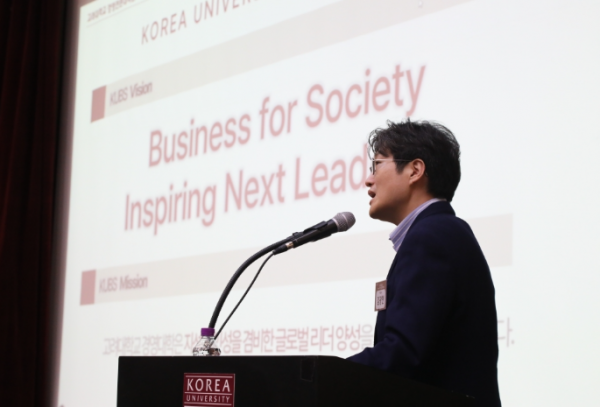
2026 Korea University K-MBA Admission Briefing: Nurturing Next-Generation Leaders through Tradition and Distinctive Excellence  On Friday, September 19, Korea University Business School held the 2026 Korea MBA (hereinafter K-MBA) Admission Briefing at the SUPEX Hall in the LG-POSCO Building. In his welcome address, Dean Eonsoo Kim remarked, “If you decide to join Korea University’s MBA program, we promise to be a steadfast partner on your journey. I hope today’s briefing session provides you with new vision and inspiration.”    Professor Kwanghyun Kim then presented the vision of the K-MBA: “Business for Society, Inspiring Next Leaders.” He emphasized that the goal of the K-MBA program is not merely the pursuit of profit, but to explore business practices that contribute to society while nurturing the next generation of leaders in the process. He also highlighted the program’s key differentiating features, which include: ▲ The First and The Best MBA ▲ Cultivation of Competence and Insight▲ A Diverse Range of Programs ▲ An Exceptional Professional Network ▲ World-Class Faculty and Learning Environment  Representing the student body, K-MBA Student Council President Mansung Park shared his reasons for choosing the K-MBA, confidently stating, “When it comes to an MBA, Korea University is the clear choice.” He introduced not only the academic rigor of the program but also the valuable learning opportunities gained through peer interaction. He also outlined the structure of the student council, which operates through four divisions, and described the vibrant networking environment fostered by career groups, club rooms, and various small-group activities.    In the latter part of the session, a one-hour Q&A took place, during which participants actively raised questions on a wide range of topics—including networking, maximum course credits, class sizes, and independent research opportunities—covering all aspects of admissions, coursework, and campus life.    The well-attended session offered participants in-depth insights into the K-MBA’s vision, distinctive program features, dynamic networking environment, and the diverse opportunities it provides for developing as future leaders. It marked a meaningful start for those embarking on a new challenge.  Meanwhile, the K-MBA holds the distinction of being the first MBA program ever established in Korea. As the earliest MBA program introduced by Korea University, it embodies both tradition and leadership in the field. In addition to essential courses required for managers, the K-MBA offers a wide selection of elective courses that encompass various subfields of business administration, allowing students to freely choose classes that align with their interests and career goals. Furthermore, the K-MBA prides itself on its strong alumni network and sense of unity. This tradition begins with the orientation—where new and senior students come together to learn about Korea University’s history and cheering culture—and reaches its peak during the annual Korea-Yonsei Games. The alumni network currently numbers around 10,000, with graduates active across diverse industries serving as a reliable support system for their juniors.    Applications for the K-MBA program are currently open from Monday, September 8, 2025, to Wednesday, October 15, 2025, at 3:00 p.m. Final candidates will be selected through a document review and interviews, with the final results announced on Friday, December 12, 2025. For further inquiries, please contact the Admissions Office by phone (+82-2-3290-1360) or email (mba_admissions@korea.ac.kr). 

2025.10.21 Views 3134

2026 Finance MBA Admission Briefing: Nurturing Future Financial Leaders 

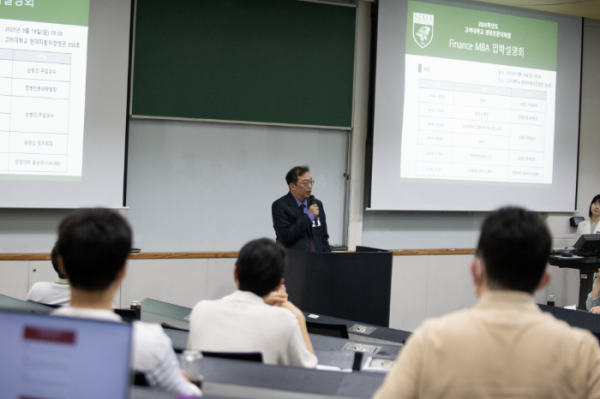
2026 Finance MBA Admission Briefing: Nurturing Future Financial Leaders  The admission briefing for the 2026 academic year Finance MBA (hereinafter F-MBA) program was held on Friday, September 19, in Room 202 of the Hyundai Motor Hall at Korea University. The session was led by Professor Bumjean Sohn, the program’s academic director.  The F-MBA is an MBA program designed to cultivate specialists in finance and financial management, distinguishing itself from the K-MBA and E-MBA tracks. While the K-MBA is primarily geared toward middle managers and the E-MBA targets senior executives, the F-MBA focuses on developing professionals for the finance industry.  Professor Son emphasized, “An MBA program is not like medical school or law school, where a professional qualification is automatically granted upon graduation. The value of the program lies in the opportunities it provides for both personal and professional growth—and whether you choose to seize those opportunities depends on you.” He also advised, “Since two years can pass more quickly than expected, it is important to enter the program with clear goals in mind.”    The core strengths of the F-MBA program can be summarized in two key aspects: academics and networking. Professor Son explained, “Professionals who have worked in the field for nearly a decade may question the need for further academic study. However, as artificial intelligence continues to advance at a rapid pace, academic learning becomes an essential tool for adapting to changes in both life and the workplace.” In terms of networking, the program’s strength lies in its strong community of finance professionals. With a small cohort of 45 students—most of whom are employed in financial institutions or corporate finance departments—the program fosters a close-knit and collaborative network.    To graduate, students must complete a total of 45 credits, including at least 36 credits in core finance courses, with a minimum GPA of 3.0. Classes are held on weekday evenings and Saturdays. Course offerings include subjects such as Principles of Finance, Corporate Finance, and Python Programming for Finance.  The F-MBA curriculum includes courses in artificial intelligence and big data analysis, enabling students to learn statistical analysis techniques and R/Python programming for financial market analysis from the ground up. Professor Son noted, “Because most students in the program come from liberal arts backgrounds, we start from the fundamentals—but they should be prepared for a rigorous academic workload.”    A key component of the curriculum is the Independent Research course, which allows students to apply the theories and methodologies learned throughout the program to real-world challenges and develop practical solutions. Students work in teams under the close supervision of faculty advisors, gaining hands-on experience in scientifically analyzing and solving actual business problems. Professor Son noted, “You may end up learning even more through the Independent Research course than from the regular classes themselves.” Past cohorts have explored topics such as Bond Investment Strategies for Busy Professionals and The Current Landscape of Generative AI-Based Financial Services.    Next, Student Council President Changseop Song gave a brief overview of student life, introducing the council’s five departments and various networking activities, including the orientation, opening ceremony, joint retreats, hiking, and golf events.  After the briefing session, attendees joined a campus tour led by KUBE, the business school’s student ambassadors. Participants explored the campus while hearing explanations about key sites. One of the highlights was Relatum – The Site, a sculpture by artist Lee Ufan located on the lawn in front of the KUBS Main Building. The ambassadors explained, “The stainless-steel plate beneath the stone is polished like a mirror, so on clear days it reflects the sky,” which drew the admiration of many attendees.    Sungmin Lim, one of the attendees, shared his thoughts: “I currently work at a financial institution and am considering pursuing a degree to further my personal and professional growth. I was curious about the differences between the K-MBA and F-MBA programs, and after hearing today’s presentation, it’s clear that the F-MBA is much more specialized in the field of finance. The session was very informative and helpful.”    Applications for the F-MBA program are currently open from Monday, September 8, 2025, to Wednesday, October 15, 2025, at 3:00 p.m. Final candidates will be selected through a document review and interviews, with the final results announced on Friday, December 12, 2025. For further inquiries, please contact the Admissions Office by phone (+82-2-3290-1308) or email (mba_admissions@korea.ac.kr). 

2025.10.21 Views 2275

A Civilizational Perspective on 120 Years of Business Administration Education 

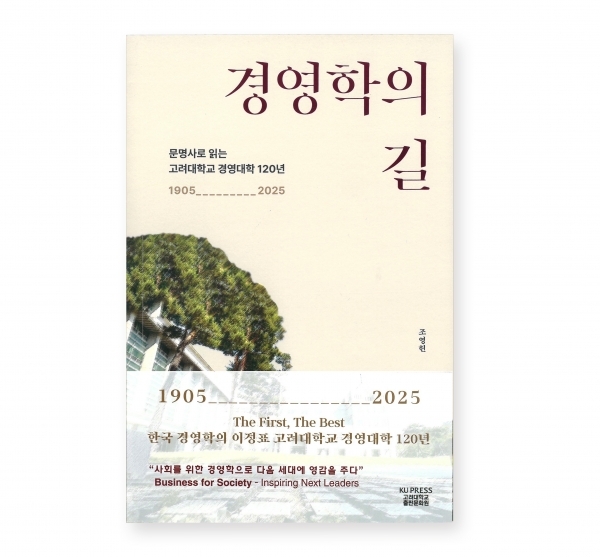
Management and the Question of Humanity's Path - A Civilizational Perspective on 120 Years of Business Administration Education    To commemorate its 120th anniversary, Korea University Business School has published The Path of Business Administration: A Civilization-Historical Reflection on 120 Years of Korea University Business School. The book presents a comprehensive history of business education in Korea, tracing its origins to the establishment of the Department of Commerce at Bosung College in 1905 and chronicling its growth into today’s world-class business school. It offers a new perspective that interprets the path of management as the path of civilization.    The author, Professor Cho Youngheon of Korea University’s Department of History Education, was inspired by the fact that two events coincided in 1905—the abolition of China’s imperial examination system and the establishment of the business school. He sought to explore the meaning of this historical turning point, showing that seemingly coincidental events can become catalysts for transformative change. The 120th Anniversary Project Committee of the Business School undertook the review process, ensuring the objectivity and factual accuracy of the narrative.    The book is structured around three themes: Civilization, Continuity, and Concept. From a civilizational perspective, it emphasizes that the period when the business school was founded 120 years ago was also a time of profound civilizational transformation. The abolition of China’s imperial examination system, Japan’s victory in the Russo-Japanese War, and the signing of the Eulsa Treaty by the Korean Empire are cited as examples. From the perspective of continuity, it highlights how management became a driving force in Korea’s economic development—producing educated talent, spreading entrepreneurship, fostering industrial growth, and even contributing to the advancement of Korean sports. From a conceptual perspective, it explores the evolution and usage of management-related terminology through classical texts and modern interpretations, reflecting on the essence and significance of the discipline.    This book goes beyond a mere chronological record to trace the path that Korea University Business School has taken within the civilizational context of Korea’s social, industrial, and economic transformation throughout its modern history. It follows major turning points—including the colonial era and subsequent wars, industrialization and democratization, globalization, and digital transformation—illustrating how the Business School responded to the demands of each era, generated new knowledge, and cultivated talent. Each period integrates discussions of academic progress and educational reform, thereby clarifying the School’s role in Korea’s modernization and industrialization.    A vast array of historical materials and archives were utilized in the making of the book. The materials include early school magazines and lecture notes, records of professors and students, graduation albums from the 1930s, and donated items from industry figures, as well as detailed timelines that trace the evolution of Korea University Business School.    However, the book does not stop at chronicling past achievements. In its final section, it presents KUBS’s vision for the next 60—and ultimately 120—years. Centered on future key agendas such as ESG, digital transformation, and startups, it offers a blueprint for how the school seeks to advance into the future.    The Path of Business Administration: A Civilization-Historical Reflection on 120 Years of Korea University Business School is both an academic record and a shared memory for alumni and current students. Standing at the juncture between reflection on the past and preparation for the next 120 years, the publication reaffirms the identity of Korea University Business School as a pioneer in Korean business education. At the same time, it underscores that management is an essential endeavor dedicated to preserving and enhancing human life. 

2025.10.14 Views 2202

KUBS Startup Research Institute joins Seoul RISE Campus Town Project

Korea University Business School’s Startup Research Institute joins Seoul RISE Campus Town Project— Launching a Program to Foster AI and Deep Tech Startup Talent    Korea University has been selected as a participant in the Seoul Metropolitan Government’s “Campus Town Project,” under the RISE (Regionally Innovative & Specialized Education) initiative. With this selection, the university has been recognized for its capacity as a regional innovation hub focused on youth entrepreneurship. The Business School’s Startup Research Institute will take a leading role by launching specialized programs in AI and deep tech.    Based on a startup-oriented campus town model, the Seoul Campus Town Project aims to promote youth entrepreneurship, create jobs, and support the commercialization of university-owned technologies. Selected universities will receive funding for an initial two-year period (January 2026 – February 2028), with a possible extension of up to four years depending on a midterm evaluation.    In this project, the Business School’s Startup Research Institute has identified AI-based talent development and technology startup support as key focus areas, and has submitted a proposal outlining three core programs. Among them, the AI Deep Tech Startup Practical Training Program is designed to provide a structured learning experience for early-stage entrepreneurs and students, covering everything from the fundamentals of AI to practical applications. It is expected to make a meaningful contribution to fostering a vibrant youth entrepreneurship ecosystem.    Joon Ho Hwang, Director of the Startup Research Institute, stated, “Our participation in the Campus Town Project demonstrates the university’s startup capabilities and innovation potential in AI,” adding, “We will continue to nurture deep tech-driven entrepreneurial talent and position ourselves as a startup hub that grows hand in hand with the local community.” 

2025.10.14 Views 3419

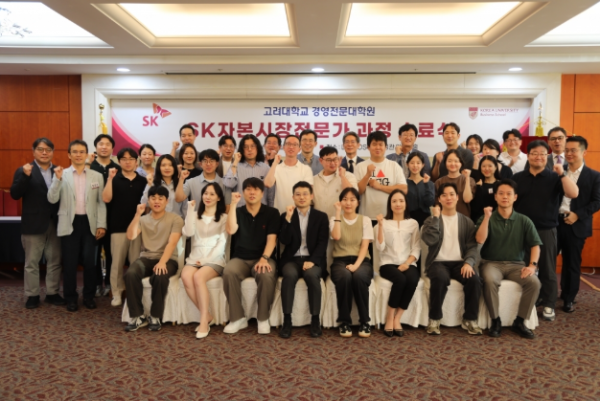
SK Capital Market Expert Program Completion Ceremony Successfully Held 

The rewards of learning Lead to Confidence in the Field of Corporate Finance – SK Capital Market Expert Program Completion Ceremony Successfully Held  On September 11, the completion ceremony for the “SK Capital Market Expert Program,” a corporate-commissioned course hosted by the Executive Education Center (EEC) of Korea University Business School, was successfully held at Ahn Young-Il Hall in the LG-POSCO Hall at Korea University. The event was organized to celebrate the successful completion of the five-month training program by 24 participants, and was graced by 29 distinguished guests, including Kim Wan-Young, Head of Financial Operations at SK Inc., and Kim Jin-Taek, Head of Growth Support at SK mySUNI, along with key university personnel.  In his congratulatory speech, Professor Eonsoo Kim, Dean of Korea University Business School, said, “I believe that through this course, you have experienced the ability to solve real-world problems and the valuable essence of collaboration,” and added, “I hope you continue to grow while building a strong network.” Kim Wan-Young, Head of Financial Operations at SK Inc., followed by saying, “Congratulations to the graduates who have successfully completed this challenging new endeavor,” and expressed his hopes that “this period of balancing work and study contributes not only to personal career growth but also to the betterment of your respective companies.”  Next, the Capstone Project Awards Ceremony took place. The Capstone Project is a problem-solving-oriented learning method that goes beyond simple lecture-based learning, where all trainees form teams to carry out projects similar to actual business assignments. Dean Eon Soo Kim personally presented the awards and encouraged the participants. Participants shared their reflections, saying, “It felt like solving real work tasks,” and, “It was a valuable opportunity to gain new perspectives through the diverse professional experiences within the team.”  The SK Capital Market Expert Program was not limited to theoretical education but was conducted through a practical curriculum aimed at developing analytical skills and strategic thinking required in the finance and capital markets sector. Along with an intensive learning process, the close interactions among participants served as an opportunity to form new human networks, allowing the graduates to achieve both learning and networking outcomes.  The graduates, having completed this five-month journey, are now preparing to make a fresh start as pioneers in corporate finance, equipped with the capabilities to strengthen financial soundness and lead strategic business restructuring for sustainable growth in their respective fields. This completion ceremony was not simply a closing event, but a meaningful occasion that confirmed the potential of the next generation of leaders who will shape the future of Korea’s capital market.  Meanwhile, EEC provides customized education programs that meet the diverse training needs of companies. To develop the competencies and expertise of corporate employees, the curriculum is designed through close cooperation among dedicated faculty directors, program managers, and the corporations themselves, offering the highest-level curriculum in the country. In fact, companies across Korea seek out Korea University Business School’s EEC to experience the best-in-class business education, and it has established itself as a cradle for nurturing tailored corporate talent.  Programs are meticulously designed to reflect the strategic goals and educational needs of each company and cover essential topics in today’s business environment, including △Finance & Accounting △Capital Market Analysis △Digital Transformation △Sustainability Management △Leadership Development. Participants acquire practical skills applicable to their work through lectures, discussions, case studies, team projects, and expert seminars.  The EEC’s corporate-commissioned programs have demonstrated their professionalism and reliability through training partnerships with domestic companies, and will continue contributing to the cultivation of globally competitive talent through customized education tailored to each company.   

2025.10.14 Views 2099

  • 첫페이지로
  • 11
  • 12
  • 13
  • 14
  • 15
  • 마지막페이지로