TOP

KUBS News

Total 1415

‘KUBS 120 MARCH’ Campaign Nears 40% of Goal … Total Pledges Reach Approx. KRW 4.6 Billion

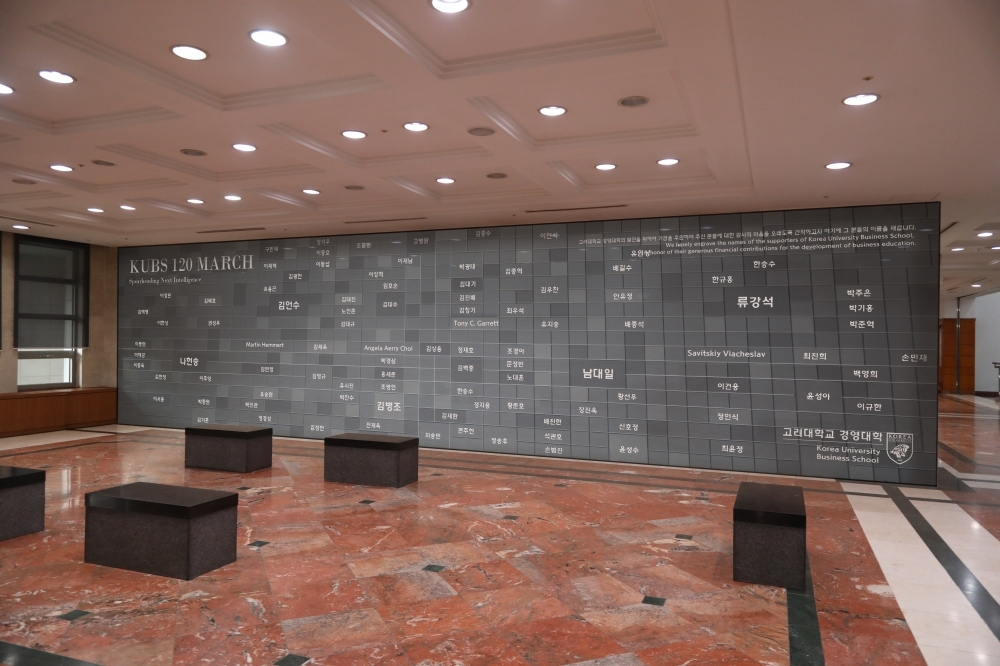
‘KUBS 120 MARCH’ Campaign Nears 40% of Goal … Total Pledges Reach Approx. KRW 4.6 Billion Three major large-scale pledges secured within four months of launch … Campaign continues through May 31     Korea University Business School’s KRW 12 billion fundraising campaign, “KUBS 120 MARCH,” has secured approximately KRW 4.6 billion in pledged donations within just four months of its launch, nearing 40% of its goal.   Since the campaign’s launch in January, when pledged donations stood at around KRW 2 billion, the total has more than doubled in just three months. From December 1, 2025, to March 29, 2026, total pledges reached KRW 4,652,317,231, with 324 participants, including corporations, alumni, faculty, staff, and students.       | Three major pledges secured … Alumni and corporations join forces    One of the most notable achievements is the securing of three major pledges. An anonymous donor pledged support for the research fund, Eugene Investment & Securities Co., Ltd. for the development fund, and Samyang Tongsang for scholarships. Alumni account for approximately 62% of total pledges, while corporations represent about 35%, jointly driving the campaign forward.   Group donations have also continued. Following the participation of the Class of ’81 alumni association, the Business School Class of ’79 Scholarship Committee (28 members), the KUBS Class of ’98 Alumni Night (126 participants), as well as faculty and staff, have also joined the campaign.     | Expanding participation across classes, generations, and professions    The donor base is highly diverse. Participation spans from alumni who entered in the 1970s to current students from the Class of ’26, as well as members of EMBA, DBA, and AMP programs, undergraduate alumni, and even alumni from the College of Medicine. From individual research labs and faculty bands to student councils, all corners of the Business School are actively engaging with the campaign, further broadening its base of participation.   This campaign is particularly meaningful in that it places value not only on the total amount raised but also on participation itself. From small contributions starting at KRW 10,000 to major gifts reaching KRW 1 billion, every act of giving becomes part of the shared legacy of KUBS’s 120-year history.    | Investing in the future campus… Advancing the 3C Trading Zone and 4Tech strategy    The funds raised are being used to realize the Business School’s future vision. Alongside the advancement of the “4Tech Strategy,” centered on AI, semiconductors, energy, and robotics, spatial innovation projects are also taking shape.   The Business School is already operating AI-focused tracks and 4Tech micro-degree programs, and continues to expand its educational and research capabilities with its largest-ever full-time faculty body of 95 members.   On the basement level of Hyundai Motor Hall, the “3C Trading Zone (tentative name)” is currently under development, with a trading demo day scheduled for early May. The space will also include an Art & Culture Room. Artist Uhm Jung-soon’s installation piece, K, the Noseless Elephant, has already been installed in the building.   Construction has also begun on an LED display in the lobby of LG-POSCO Hall, which will serve as a large-scale digital donor wall. An opening ceremony is scheduled following the conclusion of the campaign in May.   Dean Eonsoo Kim stated, “We have come this far thanks to the collective support of each and every member,” adding, “We hope more people will join us on this journey as we prepare for the next 120 years of the Business School.”   The “KUBS 120 MARCH” campaign will continue through May 31, 2026. Donations can be made via the official sponsorship page (box.donus.org/box/koreauniversity/KUBS120march).   As of December 1, 2025 – March 29, 2026 | Total pledged amount: KRW 4,652,317,231

2026.04.09 Views 335

Data Speaks the Language of Management… KUBS DT Day 

Data Speaks the Language of Management… KUBS DT Day      On Friday, November 7, the 6th KUBS DT Day, hosted by the Center for Digital Transformation & Business (CDTB), was held at the LG-POSCO Hall of Korea University Business School. KUBS DT Day is an event designed to identify and share new business models for the corporate and public sectors in the era of digital transformation. Through this event, KUBS aims to provide members of Korea University with business insights into digital transformation and to establish a virtuous cycle of academia–industry cooperation through mutually beneficial partnerships with corporations.      In the morning, the “DAB (Data Analytics for Business) Competition Finals” took place, followed in the afternoon by the “Capstone Project Midterm Presentations.” The DAB Competition is designed to address real-world social and industrial issues through data analysis. This year, three teams out of eight advanced to the finals and delivered their presentations. Professors Kyung Sam Park (Director) and Jeunghyun Kim served as judges.    The first presenting team, “Ttasum,” proposed an “Integrated Weather and Walking Environment Safety Map” for the elderly. By integrating environmental data such as heat waves, cold waves, and road slopes, the service guides safe walking routes for senior citizens. Simulation results showed that it could reduce accident risk by approximately 5.6%. It was an exemplary case of using data not merely for navigation but to realize the principle that “everyone has the right to move safely.”    The team “HippoKUrates” focused on the issue of re-transfer of emergency patients—commonly known as “emergency room bounce-backs.” By combining medical data with a RAG-LLM (retrieval-augmented large language model), the team implemented an emergency medical resource recommendation system that analyzes patient symptoms and hospital capacity in real time. Designed on the basis of interviews with active paramedics and medical professionals, the model received high praise from the judges for its technological approach to addressing the societal challenge of reducing the golden hour for critically ill patients.    Lastly, the team “TtareungPang” proposed a demand-based redistribution algorithm to address the imbalance in the rental and return of Seoul’s public bicycles, “Seoul Bike.” By incorporating rental failure data along with variables such as weather and time of day to design optimal truck relocation routes, the model enhanced not only operational efficiency but also citizen satisfaction. It served as a strong example of how data can be leveraged to improve the quality of public services.      The judges remarked, “All three teams remained committed to the essential question of not just how to use data, but for what purpose it should be used,” and added, “Their clear problem definition and incorporation of on-the-ground insights were particularly impressive.” The grand prize was awarded to “HippoKUrates,” while “Ttasum” and “TtareungPang” received excellence awards.    The “DAB Competition” is not merely an academic contest but serves as a testbed for addressing social issues through data analysis and as a microcosm of future-oriented business education. Participating students went beyond collecting and analyzing data, embodying the academic mindset of “understanding and transforming the world with data.” This year’s event stood as a vivid illustration of the Korea University Business School’s ideal of “Practical Wisdom.”      In the afternoon, under the theme of analytical thinking that drives digital transformation, the 6th cohort of MSBA students presented the interim results of their corporate collaboration projects.    In his opening remarks, Associate Dean for Planning Byung Cho Kim stated, “DT Day is a process of understanding the world through data and discovering new possibilities within complex challenges.” This year’s presentations featured 20 students working in collaboration with seven organizations: Hyundai Motor Securities, Hyundai Motor Company, LG CNS, Hyundai Home Shopping, Hyundai Department Store, PwC, and LG Household & Health Care Co., Ltd.    ▲ The Hyundai Motor Securities team analyzed the financial characteristics of the second generation of baby boomers and developed a retirement pension product recommendation algorithm.  ▲ The Hyundai Motor Company team designed a promotion-based customer segmentation model to strengthen retention among Blue Members customers.  ▲ The LG CNS team introduced a graph database–based AI modeling tool for consultants, while  ▲ the Hyundai Home Shopping team proposed a new content operation strategy that integrates broadcast identity preservation with data efficiency.  After the break,  ▲ the Hyundai Department Store team presented a store- and product-level demand forecasting model to improve inventory management efficiency,  ▲ the PwC team showcased a model that automatically generates consulting reports using a multi-agent system, and  ▲ the LG Household & Health Care Co., Ltd. team implemented an AI decision-making framework capable of developing brand strategies using consumer review data.      Following the presentations, Professor Jeunghyun Kim, Director of the BA program, remarked, “This year’s projects have clearly advanced in their ability to handle industry data,” adding, “What stood out was the effort to redefine problems through data and to translate insights into real business decision-making.”  Through this process, students experienced firsthand how data is transformed into insight and insight into strategy. Over approximately two and a half hours, each team’s analytical process and practical proposals were delivered in a dense and engaging manner. While students gained direct experience in how data evolves into strategy, partnering organizations and faculty explored the potential for applying these new ideas to real industry settings.  Even after the event concluded, the presenting students and representatives from partner organizations continued to exchange ideas freely and share feedback. On site, participants remarked that “data analysis is becoming the language through which industrial problems are rewritten.” True to its name, DT Day concluded as a day in which data expanded the boundaries of thinking. 

2025.11.26 Views 1312

“2025 Fall CHOO CHOO DAY” Held… A Stage of Innovation for Young Entrepreneurs’ Innovation

“2025 Fall CHOO CHOO DAY” Held… A Stage of Innovation for Young Entrepreneurs’ Innovation   On November 7, “2025 Fall CHOO CHOO DAY (Korea University Student Start-up Demo Day),” hosted by the Korea University Business School, was held at D.CAMP Mapo in Mapo-gu, Seoul. Under the theme “Open the Window of Innovation,” the event featured five start-up teams that had completed Korea University’s start-up incubation program, providing them with a platform to share their achievements and visions with current students and industry professionals.  In his opening remarks, Youngkyung Kim, Director of the Startup Station’s Iljin Center for Startup Incubation, stated, “Recently, SK Hynix and Samsung Electronics have been leading the global market by supplying HBM semiconductors, the core components of AI,” and emphasized, “Now that AI has become foundational infrastructure—as essential as water and air—this is the ideal moment for young entrepreneurs to develop innovative services.”      Welcoming the participants, Eonsoo Kim, Dean of the Korea University Business School, remarked, “Just like the name ‘CHOO CHOO,’ this event symbolizes a strong departure toward new paths,” expressing his hope that “today’s stage will become the starting point where founders’ ideas connect to investment and collaboration.”  Serving on the Q&A panel were Henry Chung, CEO of KAIST Venture Investment Holdings; Seunghyun Kim, Director at Shinhan Venture Investment; Ino Jung, Team Leader at POSTECH Holdings; Hagyeong Kim, CEO of ZD Ventures; and Na Yeon Kim, Associate at BonAngels Venture Partners. The panelists thoroughly assessed each team’s strategies and execution plans, offering practical and grounded advice.  During the open-mic session, Sangil Bae, CEO of SPACEJUMP, took the stage as a guest speaker and advised, “Even if you fail, take actions that allow you to measure outcomes,” adding, “You need the courage to identify your top priority and boldly let go of the rest.”      During the main startup presentation session, five teams presented their work: ▲HandyBus, a fandom mobility platform; ▲Samnyangeez, an AI pet simulation game; ▲Gaon, an AI audio correction solution; ▲StellUp (Hangleling), a business Korean conversation service for foreigners; and ▲PRAP (Tarte AI), an AI-based STO (fractional investment) platform.  During the Q&A session, Na-yeon Kim asked, “Samnyangeez’s monthly active users (MAU) are currently around 350, which is not very high. Is this because content expansion is still in progress?” In response, CEO Sojung Choi said, “Although the service is not yet fully complete, users continue to stay because they form emotional bonds with their characters. This gives us confidence in the platform’s future growth potential.”  Next, Director Seunghyun Kim asked whether creators or indie musicians have a need to invest in improving audio quality in the same way professional musicians do. Gaon’s CEO, Jae-eun Noh, explained, “Professional musicians invest significant time and money to achieve the best quality, but creators prioritize quick uploads for monetization, so they prefer solutions that are easy to use and applicable even in live settings.”        This “2025 Fall CHOO CHOO DAY” was more than just a presentation event—it demonstrated that universities are increasingly functioning as practical platforms within the youth start-up ecosystem. The event provided student start-up teams with a valuable on-site opportunity to meet directly with investors and industry professionals, engage in networking, and explore ways to translate their ideas into real business opportunities.  For the students, the greatest takeaway was experiencing a full learning cycle of “idea → presentation → feedback → execution.” Refining their service models while preparing for the presentation, strengthening their strategies through direct feedback from the panel, and building connections with industry professionals during post-event networking constituted a form of hands-on learning that went beyond traditional education. In addition, the booth exhibitions and networking sessions held before and after the presentations enabled meaningful interactions with fellow founders, investors, and industry leaders, significantly expanding the students’ presence and roles within the start-up ecosystem.  Korea University plans to continue strengthening industry–academia cooperation and to further its efforts in fostering entrepreneurial talent so that innovative start-ups can continue to grow. 

2025.11.26 Views 1424

A Closer Look at the 2025 SK Research Award-Winning Papers

A Closer Look at the 2025 SK Research Award-Winning Papers The 2025 SK Research Award Recipients.  From left: Professors Minjae Koo, Baek Jung Kim, Jeunghyun Kim, In Joon Noh, Kwangtae Park, Gunwoong Lee, Kyuhan Lee and Ju Hyun Pyun.      Riding Attention Spikes: How Analysts Respond to Advertising  Authors: Professor Minjae KOO et al. (co-authors: Annika Wang, Yin Wang, Liandong Zhang)  Journal: Contemporary Accounting Research  This study empirically examines how security analysts strategically respond when product advertising increases investor attention. By combining weekly advertising data with analyst report data, the analysis reveals that analysts tend to issue more optimistic earnings forecasts following periods of intensive advertising. This tendency is particularly pronounced among analysts at brokerage firms whose revenue structures rely on commissions, suggesting that such behavior reflects the strategic use of investor attention rather than mere cognitive bias.  The study also finds that optimistic forecasts increase trading activity among retail investors, thereby amplifying market reactions. These findings demonstrate that analysts are not passive recipients of information distortion but active participants in shaping market sentiment, offering new insights into the interactions among advertising, information flows, and financial decision-making. As an integrative study bridging accounting and finance, it provides important implications for market transparency and regulatory policy.        The Closing-the-Gap Effect: Joint Evaluation Leads Donors to Help Charities Farther from Their Goal  Authors: Professor Baek Jung KIM et al. (co-authors: Rishad Habib, David J. Hardisty, Katherine White)  Journal: Journal of Marketing Research  This study identifies the “Closing-the-Gap Effect,” a phenomenon in which donors contribute more to charities that are farther from meeting their fundraising goals when these organizations are evaluated jointly. Drawing on six preregistered experiments, seven follow-up experiments, and more than 10,000 real crowdfunding observations, the researchers empirically validate this effect. The findings show that when donors assess charities side by side, they perceive greater need salience and therefore tend to allocate more donations to organizations with lower goal-achievement rates. However, this effect disappears when charities are evaluated individually.  The effect also weakens when differences between organizations are small or when for-profit entities are included in the choice set. By illuminating the psychological mechanisms linking social comparison to donation behavior, this study advances theoretical understanding in nonprofit marketing and social psychology. It further offers practical implications for designing platform-based fundraising campaigns and strategies that effectively encourage charitable giving.        Service Operations for Justice-on-Time: A Data-Driven Queueing Approach  Authors: Professor Jeunghyun Kim et al. (co-authors: Nitin Bakshi, Ramandeep Randhawa)  Journal: Manufacturing & Service Operations Management (Vol. 27, Issue 1)  This study offers an innovative attempt to analyze structural delays in judicial systems from an Operations Management perspective. Focusing on the Supreme Court of India, the authors conduct simulations based on real court data and model the judicial process, in which cases are routed through pre-admission and post-admission stages. The analysis identifies judges’ limited processing capacity and rigid scheduling practices as key drivers of delays. The results further show that implementing greater work-hour flexibility and schedule-adjustment policies can reduce average delays by up to 65%.  As the first empirical study to reframe the social value of “Justice-on-Time” as a data-driven operations efficiency problem, this research is recognized as an exemplary convergence study that bridges public service and operations management.        Evaluating Quality Reward and Other Interventions to Mitigate US Drug Shortages  Authors: Professor In Joon Noh et al. (co-authors: Sergey Naumov, Hui Zhao)  Journal: Journal of Operations Management (Vol. 71, Issue 3)  This study quantitatively evaluates policy interventions aimed at addressing drug shortages in the U.S. generic pharmaceutical market. The researchers develop a system dynamics model to compare the long-term effects of traditional policies—such as shortening approval processes and expanding production—with those of the recently highlighted “Quality Reward” incentive system. The simulation results indicate that while traditional policies offer only short-term relief, quality-based incentives provide a sustainable solution that structurally mitigates drug shortages. However, the study also finds that such incentives may induce market monopolization by certain firms, underscoring the need for complementary quality information disclosure mechanisms.  By empirically demonstrating that quality-focused supply chain management can maintain a balance between public health stability and industrial competitiveness, this study offers robust scientific evidence for pharmaceutical policy design and is highly regarded for its contribution.        Are All Generic Drugs Created Equal? An Empirical Analysis of Generic Drug Manufacturing Location and Serious Drug Adverse Events  Authors: Professor In Joon Noh et al. (Gray John, Ball George, Wright Zachary, Hyunwoo Park)  Journal: Production & Operations Management  This study quantitatively evaluates policy interventions aimed at addressing drug shortages in the U.S. generic pharmaceutical market. The researchers develop a system dynamics model to compare the long-term effects of traditional policies—such as shortening approval processes and expanding production—with those of the recently highlighted “Quality Reward” incentive system. The simulation results indicate that while traditional policies offer only short-term relief, quality-based incentives provide a sustainable solution that structurally mitigates drug shortages. However, the study also finds that such incentives may induce market monopolization by certain firms, underscoring the need for complementary quality information disclosure mechanisms.  By empirically demonstrating that quality-focused supply chain management can maintain a balance between public health stability and industrial competitiveness, this study offers robust scientific evidence for pharmaceutical policy design and is highly regarded for its contribution.        Protecting Workers from Rude Customers to Enhance Organizational Identification in Emotional Labor Environments  Authors: Professor Kwangtae Park (co-authors: Hyojeong Kim, Nagesh N Murthy, Anurag Agarwal)  Journal: Production and Operations Management  This study empirically examines how Emotional Dissonance—experienced by workers in call center environments where emotional labor is routine—affects their Organizational Identification (OID). Emotional dissonance arises when employees’ actual feelings do not align with the emotional expressions required by the organization, and over time, it weakens organizational commitment and job satisfaction. Using data from a large sample of call center employees, the study elucidates the mechanism through which emotional dissonance diminishes organizational identification and tests moderating factors that may alleviate this effect.  The analysis shows that, first, the more employees perceive customer-interaction protection policies as genuine and effective, the more the negative impact is reduced; and second, strong supervisor Servant Leadership helps sustain OID levels. Notably, although long-tenured employees experience greater cumulative emotional labor, their sense of organizational attachment can be restored when institutional protection and leadership support are provided together. By demonstrating that psychological protection for emotional laborers and organizational policy design operate complementarily, this study expands scholarly understanding of human-centered leadership in the field of service management.        Consumer Evaluation of Digital Product Innovations: Disentangling Effects of Novelty, Familiarity, and Complementarity  Authors: Professor Gunwoong Lee et al. (co-authors: Nilla Zhang, Wai Fong Boh) Journal: MIS Quarterly  This study empirically examines how consumers’ familiarity and novelty perceptions influence their evaluations when digital product manufacturers pursue innovation. Using data on hardware feature innovations in complex digital devices such as smartphones and laptops, the researchers test the interaction effects of innovation timing and software support on consumer satisfaction. The results indicate that familiar functions receive more favorable evaluations when introduced early in the product cycle, whereas novel functions gain greater acceptance when introduced with some delay. In contrast, simultaneously releasing new features alongside complex software leads to consumer confusion and negative evaluations.  By clarifying the complementarities and timing strategies between hardware and software innovation, the study offers meaningful practical implications for technology marketing and innovation management. It is also academically recognized for explaining the market acceptance of technological innovation through the lens of the consumer learning curve.        Leveraging Large Language Models for Hate Speech Detection: Multi-Agent, Information-Theoretic Prompt Learning for Enhancing Contextual Understanding  Authors: Professor Kyuhan Lee et al. (co-author: Sudha Ram)  Journal: Journal of Management Information Systems  This study proposes a novel approach to enhancing the accuracy and contextual understanding of hate speech detection by designing Large Language Models (LLMs) within a Multi-Agent framework. Whereas single-model detection methods struggle to capture complex linguistic elements such as context, satire, and metaphor, this study develops a system in which multiple AI agents cross-verify and collaborate on their judgments. The authors also introduce an information-theoretic entropy criterion to quantify the efficiency of prompt selection, resulting in significant improvements in detection accuracy compared with existing models.  This approach improves the feasibility of real-time content monitoring on large-scale online platforms and demonstrates that technological interventions can help curb the spread of hate speech, a major source of social conflict. The study is recognized for advancing ethical and public values in the information systems field by illustrating how AI technologies can support societal responsibility. In doing so, it contributes to reducing social tensions and fostering healthier communication environments.        Fear of Appreciation and Current Account Adjustment  Authors: Professor Ju Hyun Pyun et al. (co-corresponding authors: Paul R. Bergin a, Kyunghun Kim b)  Journal: Journal of International Economics  This paper finds that one-sided nominal exchange-rate interventions—specifically, a “fear of appreciation”—delay the adjustment of current account surpluses, offering new evidence for Friedman’s claim that current account adjustment proceeds more rapidly under flexible exchange rates. The study shows that countries with more flexible exchange-rate regimes adjust current account deficits more quickly than those with fixed regimes, but this pattern does not hold in the case of surpluses.  This asymmetry is associated with policies aimed at resisting currency appreciation in some countries. To account for this, the authors develop a multi-country monetary model that incorporates a policy rule representing a “fear of appreciation,” modeled as an occasionally binding constraint. The model illustrates how government capital controls that sustain an exchange-rate regime influence international financial adjustment mechanisms and explains the substantial asymmetries in adjustment speeds depending on the exchange-rate regime and whether a country is in surplus or deficit.  The study empirically extends Friedman’s argument and presents a new theoretical framework that accounts for asymmetries in modern capital control and reserve accumulation policies. 

2025.11.24 Views 1576

Korea Zinc Leadership Academy Holds Completion Ceremony for Its 1st Cohort…Marks the First Milestone

Korea Zinc Leadership Academy Holds Completion Ceremony for Its First Cohort… Marks the First Milestone in Fostering Future Leaders     The completion ceremony for the first cohort of the Korea Zinc Leadership Academy, including participants from Korea Zinc and its affiliates, was held on Thursday, October 30, at Cuckoo Hall on the 6th floor of the LG-POSCO Building. The academy is a leadership development program jointly designed by Korea University Business School and Korea Zinc to nurture future leaders, and a total of 29 participants successfully completed the six-month course.  Attending the ceremony were Eonsoo Kim, Dean of the Business School; Associate Dean Gangseog Ryu; Professors Seokkyun Kim, Ji-Woong Chung, Gunwoong Lee, and Young-Kyu Kim; as well as In-Dae Kwon, Head of the HR Management Division at Korea Zinc, along with other officials and participants who gathered to celebrate the completion.  The first cohort of Leadership Academy graduates opened the ceremony by presenting a report on the four training modules they completed over the past six months, followed by a video summarizing their activities. Through the program, participants deepened their understanding of Korea Zinc’s future vision and business structure, while strengthening their managerial insight and leadership competencies. In particular, they acquired practical management skills that can be applied immediately in the workplace through courses such as Korea Zinc’s mission, core values and business model analysis, leadership simulations and action learning, as well as organizational decision-making and change management.     Dean Eonsoo Kim was the first to congratulate the graduates for their dedication and accomplishments despite their busy schedules. He stated, “This academy is a development program designed to realize Korea Zinc’s people-centered management philosophy. I hope that completing all components of the program, including the action learning module, will be of great help to your future work. I also encourage you to continue to Keep Reading and Keep Learning.”  Next, Myung-Seon Kim, Manager of the Convergence Innovation Team at Korea Zinc, delivered a representative address on behalf of the 29 graduates. Manager Kim said, “I would like to express my gratitude to the esteemed professors, university staff, and Korea Zinc’s HR Management Division for providing us with this valuable learning opportunity.” She continued, “By gaining an understanding of fundamental management principles and studying ESG and leadership, I now feel a stronger sense of responsibility to reflect on the company’s future.”  The ceremony continued with the presentation of completion certificates and commemorative gifts, followed by an awards segment recognizing outstanding participants. Ji-Min Bang, Senior Manager, received the Encouragement Award; Ji-Ho Kim, Senior Manager, received the Excellence Award; and Chang-Hyun Lee, Manager, received the Top Award, with each honoree presented with a small prize.  In his congratulatory remarks, Head In-Dae Kwon noted, “It is not easy to develop your own leadership style and deliver results within such a short period,” adding, “I hope you will become the seeds of positive change within our company.”  After the ceremony, a farewell dinner was held. During the dinner, professors, graduates, and guests enjoyed a networking opportunity, sharing the relationships and experiences they had built throughout the program. The event concluded in a warm and collegial atmosphere as participants exchanged advice and words of encouragement.  This Leadership Academy carries significant meaning in that it presents a model of industry–academia partnership for nurturing future leaders through the collaboration between Korea University Business School and Korea Zinc. Through a curriculum that bridges theory and practice, participants strengthened the insight, sense of responsibility, and foundation for innovative leadership required in a rapidly changing era. This completion is expected to lay the groundwork for continued leadership development and talent cultivation in the years ahead. 

2025.11.20 Views 1370

Warm Exchange Between Professors and Students — KUBS Successfully Concludes Mentoring Day

Warm Exchange Between Professors and Students — Korea University Business School Successfully Concludes ‘Mentoring Day’  Korea University Business School (KUBS) held the 2025 Fall Semester Faculty Mentoring Day from Monday, October 27 to Wednesday, October 29, spanning three days. Mentoring Day is an annual event designed to provide KUBS students with the opportunity to meet their academic advisors for guidance on academic and career development, as well as to promote open communication between professors and students. This year’s program focused on helping students share the challenges they encounter in university life and refine their career directions through one-on-one consultations with professors. The event, held at Young-Il Ahn Hall and Cuckoo Seminar Room in the LG-POSCO Building, was open to students enrolled in Freshman Seminar II, who registered in advance based on their availability.      On the first day, professors and students gathered around ten pre-assigned tables to share lunch and snacks while discussing various aspects of campus life. The atmosphere was lively as participants exchanged experiences and stories. Professor Young Kyu Kim brought several books he thought would be useful to students and distributed them, fostering a warm and friendly mood. He also led discussions on artificial intelligence and offered personalized advice regarding students’ double majors and career paths. International students actively participated in the mentoring sessions in English. Professors and students listened attentively to one another, occasionally sharing laughter in a relaxed and pleasant setting. Professor Weon Sang Yoo remarked, “Since many students had questions about their future paths, I shared how I discovered my own career direction in the past. We also discussed things I recommend doing during university, as well as exchange programs.” Student Seo Jin Kim (Business Administration, Class of 2025) reflected, “I had many questions about my career, but through my conversation with the professor, I was able to gain a clearer sense of direction.” Professors and students spent about an hour engaging in genuine, meaningful conversation, strengthening their bond in the process.      On the second day, nine tables were arranged in Cuckoo Hall and twelve in Young-Il Ahn Hall, where students sat with their respective academic advisors to share meals and discuss campus life and career development. Professor Jong-Ho Lee recommended Capitalism as a must read for business students and presented personally prepared copies to participants. Sharing stories from his own college days, he encouraged students to “take on diverse challenges during university life,” fostering a friendly and open atmosphere. Although the conversations began a bit formally, they soon became natural and engaging as laughter and empathy filled the room. Lighthearted jokes were exchanged, and the session ended in a warm and cheerful mood. Professor Sunwoo Hwang, who also participated that day, remarked, “I listened to students share their interests and career concerns and tried to offer advice that could be of help. Rather than leading a one-way conversation, I enjoyed hearing about their daily lives, campus experiences, and even their favorite sports.” Student Ji-An Ryu (Business Administration, Class of 2025), who spoke with Professor Hwang, shared, “I was initially worried that the atmosphere might feel too formal, but our conversation turned out to be very natural and personal. It helped me feel closer to my professor, which was truly meaningful.”      On the final day, students once again gathered around round tables with their academic advisors, greeting one another with a mix of warmth and slight awkwardness before beginning lighthearted conversations over a simple meal. Professor Thummim Cho eased the atmosphere by asking students how they had been since the recent exams, fostering a friendly environment filled with smiles and laughter. They shared stories about clubs, grades, and various aspects of campus life, deepening the sense of connection between professors and students. At Professor Min Jung Kim’s table, participants switched to English to include an international student in the conversation. When the student responded with a few words in Korean, the others applauded and laughed in encouragement, further enhancing the cheerful and inclusive mood.    As the event was designed primarily for first-year students — many of whom are beginning to explore their career paths — most of the discussions centered on individual interests and future goals. Professors asked students about their plans and aspirations, offering advice and exchanging insights tailored to each student’s area of interest. They also drew on their own experiences to recommend meaningful activities such as enhancing English communication skills, participating in exchange programs, and developing a reading habit.     The 2025 Fall Semester Faculty Mentoring Day, held over three days, concluded as a meaningful occasion that encouraged open and genuine conversations between professors and students about career goals and everyday life. Through the program, the connection between faculty and students grew stronger, helping students gain confidence in their campus life and build closer, more personal relationships with their mentors.    A Korea University Business School representative remarked, “Mentoring Day is more than just an academic advising session — it is a time for professors and students to build mutual understanding and trust. We will continue to enhance this program so that students can maintain ongoing dialogue with their advisors and explore their paths of growth together.” 

2025.11.13 Views 1440

AI Is Redefining Marketing—Kong Ventures CEO Juhyung Lee Says GEO Will Be the Next Standard

AI Is Redefining Marketing — KONG Ventures CEO Juhyung Lee says GEO Will Be the Next Standard   On Tuesday, October 28, Juhyung Lee, CEO of Kong Ventures, delivered a lecture titled “The Paradigm Shift in Marketing in the Age of AI” as part of the Entrepreneurship Academy Lecture on Demand, hosted by the Startup Research Institute at Korea University Business School. The session, introduced by Professor JinKyu Park, Director of the Startup Research Institute, focused on practical insights drawn from Lee’s hands-on experience in startup founding and global market expansion, receiving an enthusiastic response from attending students.    Lee shared that he began his entrepreneurial journey with the mission of “delivering the full value of compelling brands to customers.” Recognizing that limited development skills often pose a major barrier for entrepreneurs, he launched Hatchhiker, a no-code, AI-powered platform that enables users to create websites and mobile apps with ease. However, he soon realized a hard truth: “Even with a website, a brand cannot survive without marketing capabilities.” To tackle this challenge, he developed an SEO (Search Engine Optimization) writing solution, expanding into the marketing field. Throughout this process, Lee identified a broader shift—one in which advanced AI delivers brand value by offering users the most optimized answers. While exploring the U.S. market, he came across the concept of GEO (Generative Engine Optimization) and became convinced that the future of brand experience would be shaped by AI. This conviction ultimately evolved into his company’s current business model.    At present, Kong Ventures operates Scope, a GEO diagnostic platform, and NAR Enterprise, a GEO consulting service. The company has also signed an MOU with Innocean to strengthen AI-based search capabilities and has secured major domestic clients—including a leading global cosmetics manufacturer and a global electronics company—as it continues to build practical GEO project cases.      Lee defined GEO as “the process of optimizing AI to serve as a brand’s faithful representative, enabling it to deliver the brand’s intended message to customers accurately and effectively.” He explained, “While traditional SEO focused on improving website rankings for human searchers, GEO represents a fundamental shift—its optimization is directed not primarily at people, but at AI systems themselves.” He continued, “When people stop typing queries into Google and start asking ChatGPT directly, that will mark the beginning of a new era in marketing. In a world where consumers can discover and purchase products entirely through conversations with AI—or engage in real-time interactions with AI through smart glasses as they walk down the street—GEO will demonstrate its true power.” As an example, Lee highlighted Walmart’s collaboration with OpenAI to develop agentic commerce capabilities that allow users to plan meals, discover products, and make purchases seamlessly through natural conversations with AI.    Lee characterized the advancement of AI not as a “problem of replacement,” but as a “problem of design,” emphasizing the importance of individuals who can decide what tasks to assign to AI and how to apply its results effectively. He added, “We are now entering the era of one-person development teams,” noting that Kong Ventures has also achieved rapid growth through an efficient organizational structure.      During the Q&A session, an attendee asked whether GEO would lose its relevance as AI continues to advance. Lee replied, “The importance of GEO has already been demonstrated in a market where AI is evolving at an unprecedented pace,” emphasizing that “the core of AI advancement ultimately lies in data.” He explained, “AI learns from and cites web content to improve its performance. For companies, this means that information intended for customers must be structured into data that AI can recognize and use effectively. As AI continues to evolve, the role of GEO will only become more essential.”    He added, “Conversion rates driven by AI recommendation platforms are steadily rising, and competition in this area will only intensify. Technical and conceptual competence, along with continuous improvement, will become key differentiators.” When asked about how the company attracted its initial clients, Lee said, “At a time when the term GEO wasn’t even defined, our goal was to optimize our clients’ content so that it would be recommended by multiple AIs.” He added, “Rather than relying on aggressive sales, we focused on forming and testing hypotheses about GEO. As we proved the effectiveness of our solutions and strategies, clients began approaching us first.”    Responding to a question about the reliability of AI recommendations, Lee remarked, “Google didn’t become the world’s leading search engine because it delivered 100% factual results.” He continued, “AI recommendation features will also evolve to provide greater value and refinement—and GEO will be part of that process.” He concluded, “Instead of philosophical debates, what truly matters is how well a brand is positioned within AI’s recommendation structures. Companies are already recognizing this value and investing in GEO solutions.”    This lecture provided students interested in marketing, entrepreneurship, content creation, and AI with a structured understanding of how marketing is transforming in the AI era and how to respond strategically. Lee’s insights into structural approaches centered on GEO, learning through failure, and pivoting experiences offered students valuable, practical lessons. He closed by saying, “AI, content, and marketing are not independent domains; they demonstrate true power only when tightly interconnected,” presenting a new direction for marketing in the age of AI.      Meanwhile, the Entrepreneurship Academy Lecture on Demand, hosted by the Startup Research Institute, had previously held successful sessions in September on topics such as “Prompt Design Methods for AI in the World of Design” and “Building a Web App with AI in One Hour.” Those lectures drew high attendance and active participation, reflecting students’ strong enthusiasm to develop skills essential for the AI era. This latest lecture also concluded successfully, and upcoming sessions will feature Art Director Minjung Seo and Wisely CEO Dong-wook Kim. The Startup Research Institute plans to continue hosting high-impact lectures that provide practical knowledge and insights necessary for entrepreneurship, reflecting the needs of both resident startups and students.   

2025.11.13 Views 1613

  • 첫페이지로
  • 11
  • 12
  • 13
  • 14
  • 15
  • 마지막페이지로