TOP

KUBS News

Total 1417

[Entrepreneurship Academy Lecture On-Demand] “Coding Now Done by ‘Vibe’”

“Coding Now Done by ‘Vibe’”... Special Lecture on AX-Based Startup Insights   On March 17, the Entrepreneurship Academy Lecture On-Demand was held, hosted by Korea University Startup Institute. The session featured Malacca, an AX strategist and AX builder, who delivered a hands-on lecture titled “Vibe Coding Practice: From Planning to MVP Deployment (Gemini & Firebase),” combining AI-based development methods with real-world startup experience.    The lecture drew strong interest from students and was held across two classrooms in the Hyundai Motor Hall. Approximately 170 participants attended, reaching maximum capacity. Although each classroom accommodates around 100 people, attendance exceeded seating capacity, with even stair areas being utilized. To accommodate all participants, a live Zoom broadcast was conducted simultaneously, allowing students to join from both classrooms.      Participants were highly engaged in the hands-on session, following along with coding exercises during the lecture. Students had the opportunity to build simple programs in real time, gaining practical experience with AI-based development processes.    During the lecture, AI-based processes were introduced, emphasizing that AI is not merely a tool but a key driver of AX (AI Transformation), transforming corporate workflows and organizational culture. While highlighting the high productivity of AI “vibe coding,” Malacca also noted the need for safeguards such as “context engineering” and “harness” to address the challenges of maintaining complex systems. He further emphasized that the essence of entrepreneurship lies not in technology-driven thinking, but in validating hypotheses through customer interviews. He advised that “starting quickly, failing, and learning fosters a virtuous cycle of growth driven by execution.”      During the session, Malacca utilized “Jjap Slack,” a tool he personally developed using vibe coding, to facilitate real-time interaction through live comments, enabling participants to ask questions and receive feedback instantly. The session was particularly meaningful in that it was conducted using the same harness template provided to students, allowing them to work with programs at a level applicable to real-world practice.    This “Entrepreneurship Academy Lecture On-Demand 1” highlighted both the evolving role of developers in the AX era and the practical capabilities required for entrepreneurship, offering students integrated insights that bridge technology and business perspectives. The Korea University Startup Institute plans to continue expanding hands-on, practice-oriented startup education programs. 

2026.04.14 Views 59

KUBE’s Completion and Commencement Ceremony for 2020 Spring semester

KUBE’s Completion and Commencement Ceremony for 2020 Spring semester     The completion and commencement ceremony for Korea University Business School (Dean=Jaewook Kim) student ambassador group KUBE was held on May 25th(Mon), at LG-POSCO building 301. A total of 21 people attended the ceremony, including KUBS Associate Dean, Joonghyuk Kim, and 18 KUBE members.      The ceremony was hosted by KUBE’s 11th president Eunsu Kim (Business ‘19) and vice president Seonghyun Baek (Business ‘19). The event commenced with a brief overview of past activities and future plans. As KUBS student ambassadors, KUBE aims to enhance the external and internal status of KUBS by organizing events for teenagers and supporting protocol events. KUBE reported their main activities for 2019 fall semester such as SNS promotions, scholarship ceremonies and protocol events, 2019 fall KUBS Campus Visit and Teen Gathering Day. Due to difficulties in face-to-face interaction amid COVID-19 situation, KUBE announced that it will actively organize promotion events online for 2020 Spring semester.     In his congratulatory message, Associate Dean Joonghyuk Kim said “we appreciate 10th KUBE members’ service during this past year; We hope KUBE will continue to do its best in promoting KUBS.” “Let us all contemplate on ideas for active promotion online, in the face of COVID-19,” he emphasized. Lastly, “instead of the Dean Jaewook Kim who could not attend because of other schedules, I want to thank KUBE 10th members for their hard work and encourage 11th and 12th KUBE members in advance,” he said.     The completion ceremony for KUBE 10th members was held after the congratulatory message.  Minsung Kim (Business ’18), Seoeun Moon (Business ’19), Yongchan Park (Business ’19), Yeon chan Jung (Business ’19), Hwibin Cho (Business ’19) and Seokjun Hong (Business ’18) received certificate of completion and additional prizes for the year of their services.      Lastly, the appointment and scholarship ceremony were held for newly selected as KUBE 12th members, and scholarship ceremony was held for KUBE 11th members who will continue their services. KUBS highly appreciates KUBE’s efforts and have been providing “KUBS student ambassador scholarship” to KUBE members since 2019 Spring semester.     Meanwhile, KUBE first started in 2013 and was officially established in June 2015. KUBE’s main activities are △KUBS Campus Visit and Teen Gathering Day △Teen Mentoring day △protocol service for KUBS ceremonies.

2020.06.03 Views 3314

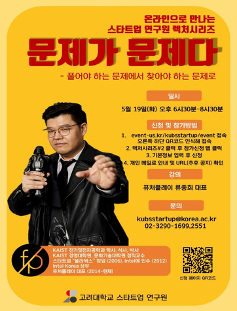
[Startup Institute Lecture Series #2] “A problem is the problem” – Futureplay CEO Joonghee Ryu 

[Startup Institute Lecture Series #2] “A problem is the problem” – Futureplay CEO Joonghee Ryu    “A problem is the problem” From the problem to solve to the problem to find. The second lecture of 2020 Lecture Series hosted by Korea University Business School (Dean = Jaewook Kim) Startup Institute (Director = Hicheon Kim) was held on May 19th(Tuesday). The Lecture Series is a lecture given by start-up mentors currently active in the field as a part of the Entrepreneurship Academy hosted by Seung Myung-Ho Center for Entrepreneurship Education - the education institution in the Startup Institution. The second Lecture Series was given by a technology startup specialized investment company - ‘Futureplay’ CEO Joonghee Ryu, and was held in the online format due to the current situation of COVID-19.   CEO Joonghee Ryu said “Although the phrase ‘A problem is the problem’ may sound like a play on word, it is a very important topic. There are a lot of people who can solve problems well in Korea, but there aren’t many who can make or find problems. The core of startups is defining the problem, but there aren’t many people good at it”.   #A technical startup starts with technology Technology startups start with technology, but technology itself is not money. Making technology into products and making products into businesses makes money. If you are a prospective entrepreneur who majored in management, you should have a defined product for your business, even if you don't have the technology. There is something that student start-ups misunderstand – they think that business is creating added value and receiving money for that. The product is the reason why the customer has to pay for the business, so a definition of the product is needed. Being a medium to commercialize technology is a 'problem' that exists in the market.   #A problem is the problem Defining a problem is identifying the pain of a potential customer that exists. Customers pay to solve the pain. It is important to understand what people are talking about these days and what are the disadvantages of solutions on the market. For a good start-up, the essence must be well defined.   #What a good problem is It should be at the intersection of what people want, what I like, and what I'm good at. If I do something that I'm not good at to fit people only, there will be someone who does it better than me. But if you only consider what the market wants and what I'm good at, you would have to even like it eventually because you're tired and can't do business for a long time. Businessman is a person who makes money by understanding what the market wants, and an artist who does what he or she likes, and an expert who makes money by using what he or she is good at. The CEO must have all three aspects.   #How to start finding a problem You must first define your customers and approach their pain. Using the "T-shirt method," you can start with a problem that has received the highest score by evaluating it as s, m, l, xl according to the level of what the market wants, what I am good at and what I like. Nothing is more important than finding good problems in the early days of business. It is a matter of putting the greatest resources into it. After all, the "problem" that technology start-ups need to focus on is to search diligently while thinking about "products" and "market" together.    

2020.06.03 Views 2885

Program Meeting Held for ‘Department of Business Analytics’ of Graduate School MS program

Program Meeting Held for ‘Department of Business Analytics’ of Graduate School MS program Program meeting for ‘Business Analytics (hereinbelow BA)’, which is a one-year Master's degree program in Korea University Business School (hereinbelow KUBS), was held at 2 p.m. on May 15 (Friday) at B201 of Hyundai Motor Building. The event, which was attended by students majoring in BA, was held by wearing masks and following appropriate regulations for the prevention of COVID-19.   The event began with the hosting of Baeho Kim, Associate Dean for Research of KUBS. "It was a program that KUBS prepared with great plans, but we were sorry that the COVID-19 hindered us from carrying out effective classes early in the semester. However, we are grateful for doing your best in difficult situations, he said. He went on to explain the purpose of the meeting by saying, "As this is the first semester of BA major, if you have any questions or suggestions, please feel free to tell us.”   Jaewook Kim, Dean of KUBS, said, "BA major has newly established to reflect the trend of knowledge in the current era, so called ‘Fourth Industrial Revolution’. I hope all of you study hard and contribute to society as a proud member of KUBS after graduation.”   Next, Byungcho Kim, who has been appointed as Academic Director for BA since March, delivered his first greeting to the students, saying, "I feel quite burdened to take the heavy responsibility in such a meaningful program. But I will do my best to help you achieve your dreams as much as all of you are working hard. Professor Byungcho Kim also introduced the Center for Digital Transformation & Business (hereinbelow CDTB). "CDTB aims to serve as a platform to link Industry, University, and Institute based on academic excellence, excellence in education, and networks with companies," he said. "In case of the BA program, it is very important that each student establishes and implements short-term, medium-term, and long-term goals. We will provide wholehearted support at the center level to help students achieve their goals," he said.   After that Q&A Session was followed. One student who attended the meeting asked, "I wonder what strengths you think a BA major graduate has in the real job market." Professor Byungcho Kim replied, "Even though there is little profit that companies can gain from sharing data, I think the reason why they provide data to the BA program is because they are interested in identifying students' capabilities and recruiting talent that can be used in the future." Professor Baeho Kim then added, "The main purpose of creating the BA program lies in the need for a communicator with business capabilities. The company needs experts who can respond to the rapidly changing market, and I think it will be an important issue to find talented people who can act as a bridge between machines and people, and people and people like those with ‘data literacy’.”   Meanwhile, the BA program is a newly established master's course in 2020, with a total of 32 credits, including 15 credits of major required, 9 credits of major selection, and 8 credits of project, for one year. It operates in a two-month six-module system, including summer and winter semesters, and is designed to carry out field-close capstone projects instead of degree papers. The admission schedule for 2021 can be found on the KUBS website on September.

2020.06.03 Views 3985

2020 Spring Online CHOO CHOO Day Successfully Held

2020 Spring Online CHOO CHOO Day Successfully Held   The ‘2020 Spring CHOO CHOO Day(hereinbelow CHOO CHOO DAY)’, which was hosted by Korea University Business School (Dean = Jaewook Kim) and organized by Startup Institute (Director = Hicheon Kim) as well as the Crimson Startup Support Center, was held at KUBS Startup Station ‘The Stage’ of KUBS Main Building on May 15th (Friday). CHOO CHOO Day is an event where young entrepreneurs who moved into Startup Incubation Platform of KUBS present their products and services after the incubation program which lasts from 6 months to 1 year. Due to the current situation of COVID-19, the event was provided as live online streaming with about 100 investors, industry insiders and prospective entrepreneurs who showed their keen interest. “Since this is a very important event where 6 teams can deliver their outcome of hard work, I hope they can achieve good results,” said Jaewook Kim, Dean of KUBS, and gave words of congratulation by saying “We ask for your generous attention and support to expand and operate the system for students' start-ups”. A welcome speech by Jungbin Moon, Director of Iljin Center for Startup Incubation followed by asking for continuous attention, “I would like to kindly ask for warm encouragement and advice to all teams for their tireless passion that helped holing this event even with many difficulties caused by COVID-19”.   Following 6 teams out of 12 teams in the Startup Station have participated in the event: △ ‘AMP’ – a brokerage platform of Idol goods for overseas K-POP fans △ ‘The Seasonal’ that develops simple food using seasonal marine products in each region △ ‘POPLE’ – a free mask vending machine that allows free supply of masks △ ‘Dalgona’ - a platform which allows Celebrities to film cookies themselves and to make marketing possible △ ‘Morit’ – a customized nutrition counseling food curator for seniors △ ‘Petpeotalk’ – a chatting service with pets. Each team was provided 5 minutes of presentation time and 7 minutes of Q&A time. Startup Institute Director Hicheon Kim gave a closing speech by encouraging students, “Enterprises in the KUBS Startup Station will motivate other students and revitalize the university ecosystem, ultimately making a major contribution to the society”.   Gain Shin and Gunwoo Park, representative of ‘POPLE’ gave their thoughts of participating in this CHOO CHOO day, “We were able to gain a lot of support from the constructive feedback and a message of support through the event”. Kihyun Joo and Eunji Kim, representative of ‘Morit’ said “It was a meaningful experience which allowed us to take a step forward”.   Meanwhile, KUBS Startup Institute provides a lot of support to future entrepreneurs by allowing them to realize innovation through sharing and cooperation. There are about 63 startups which graduated from KUBS Startup Station as of May, and the next future entrepreneurs of the Startup Institute will be selected from the upcoming startup contest ‘2020 Startup Express Summer Season’ in June 19th.

2020.06.03 Views 4260

Retirement Ceremony Held for Professor Emeritus Manwoo Lee

Retirement Ceremony Held for Professor Emeritus Manwoo Lee Retirement Ceremony Held for Professor Emeritus Manwoo Lee An event to commemorate the retirement of Professor Manwoo Lee, who has worked hard for 32 years at the Korea University Business School (Dean=Jae Wook Kim), was held at 7 p.m. on May 15 (Fri) at the Jupiter Hall on the 30th floor of COEX, InterContinental Seoul. The retirement ceremony of Professor Manwoo Lee, who retired in February 2020, was scheduled to be held at Korea University Business School (hereinbelow=KUBS) on February 27 (Thu), but was postponed due to COVID-19. Thus, Manwoo Lee’s students prepared the ceremony to commemorate his retirement and Teacher's Day.   More than 50 guests attended the event, including professor Manwoo Lee and his students, former KU president Phil Sang Lee, Shinhan Financial Group Chairman Yong-byung Cho, Tax Tribunal President Taek-soon Ahn, Korea Economic Daily's standing editorial advisor Hak-young Lee, and KUBS Associate Dean Joonghyuk Kim.   The celebration began with the introduction of guests and students, followed by introduction of Professor Manwoo Lee’s resume. Manwoo Lee majored in business administration at KU, earned a master's degree in accounting from Syracuse University in the U.S., and a doctorate in business administration from Georgia University. He was appointed to KUBS in 1988 and served as Chairman of the sports committee and Director of IBRE, and contributed greatly to the development of the school as a member of various committees. Furthermore, he wrote and published 91 papers, served as Chairman of the Korea Tax Society and Chairman of the Korea Accounting Association, contributing to the development of tax and accounting studies in Korea. In addition, he was appointed as a commissioner for certified tax accountant and certified public accountant exam for many years, and served as a member of the National Tax Service's National Tax Review Committee and the Ministry of Planning and Budget's steering committee of government-invested institutions, and has continued various social activities as a member of the Tax Development Review Committee of the Ministry of Strategy and Finance and a non-executive tax judge of tax judges.   After then, Joonghyuk Kim, Associate Dean of KUBS who attended the event on behalf of the business school, delivered a plaque of appreciation and a bouquet of flowers, expressing his deep respect and gratitude for the professor's dedication as a scholar and teacher.   Next, a video clip of congratulating the Teacher's Day and retirement was shown, followed by Professor Manwoo Lee’s resignation speech, which showed his affection for his students. "It was such a pleasure to meet students while I was in office," he said. "I will live with the memories I have made at school for the rest of my life." Finally, a group photo session was held, and the ceremony was wrapped up with both students and guests shouting "I love you, professor."   Meanwhile, Professor Manwoo Lee has been appointed as a professor emeritus of KUBS since March 2020, continuing his active social activities and contributing to the development of Korea University.  

2020.05.27 Views 3330

[Startup Lecture Series #1] ‘Doing big things with a small team’ – Interview with Dreamary

[Startup Lecture Series #1] ‘Doing big things with a small team’ – Interview with Dreamary  The first KUBS Startup Lecture Series of 2020 was held on April 28th (Tue). Startup Lecture Series is run and supported by Seungmyungho Center for Entrepreneurship Education, which opens various kinds of lectures with CEO mentors from KUBS. For April’s lecture, Dreamary (Gunwoo Shim and Taehoon Lee, two co-founders), a platform that connects hair designers and customers made a lecture through online, due to the concerns of ongoing COVID-19.     (From the left) Gunwoo Shim, Taehoon Lee, Co-founder of Dreamary   [Part I. Q: Gunwoo Shim A: Taehoon Lee]   Q. Please describe the overall service of Dreamary. A: Dreamary is a platform between the hair designers who need practice opportunities and the customers who want reasonable prices for hair services. We initiated our beta service at the end of 2018, and has launched version 1.0 since the mid of 2019. Currently, more than 60,000 users are enjoying our platform, and our monthly sales has reached around 100 million won recently.    Q. What was your main motivation to start up a business? A: The first incentive that made me dream of starting a business was a “Demo Day” video clip produced by the Start-up CEOs in Netherlands. After watching this video, I sent an email to the CEOs that came out at the video with a request of meetings. Apparently, one of them accepted my request and that made me fly to Netherland right away. I asked him how to begin a startup and what to do, but the first question he asked me was “Do you have a family to serve?”. “No”, I replied, but then he asked me again why don’t you start business right now. The point was that after having family members to support, it becomes much harder to make an adventure of doing business. After that conversation, I just decided to start my own business.    Q. Could you introduce your decision-making criteria? Before, I believed that there would be an absolute criterion for every decision. That made me attach on the problem, and made the problems difficult to solve. However, what I realized while growing up with Dreamary is that there’s no single answer to solve every issue. For example, I remember one marketing team member arguing an idea that seem unfeasible according to the past experience and criteria. But our team made a bold decision to proceed it and that became a game changing moment in our service. I believe that the core beauty of startup is making experiments. There would be no progress in venture firms without repeated experiments.     Q. What was the most memorable experience while operating a business? The best memory was the time when we got the first investment from the markets. At the beginning, we made various efforts to receive support from the government and the campus society, but the best result was the financial valuation given from market side: company value 1billion won (April 2019).      Q. What’s your perspective in undergraduates doing start-ups? I support people doing business in their earliest career. It’s really good to make success but even if the result turns out bad, the experience of adventures will become a huge asset for the future. Furthermore, KUBS students have extra advantages in start-up fields, thanks to the support from KUBS Start-up stations and Crimson Start-up center. There’s no reason for KU student dreaming start up business to hesitate a challenge.   [Part II. Q: Taehoon Lee A: Gunwoo Shim]   Q. What’s your primary principle when it comes to running a business? The shape of company always varies, and the culture changes all the time. Therefore, I always strive to come up with the most efficient way to prepare for the changes. In case of Dreamary, we have our own decision-making process which is separated by 4 steps of ‘Execution level’ (E1 to E4). Projects classified as E1 are signed by CEO, and E4 by each department head; CEO only takes role of an advisor for them. It makes the team work much efficient, and also puts autonomy into each team member.   Q. Could you share some interesting memory while developing the company? For a while since the team establishment, we failed most of the startup competitions that we applied. 8 months later, we found that we were nominated as a social venture candidate supported by LH. Accidently, after checking that news in the elevator at KUBS main building, we cried out loud, throwing ourselves into the professor who was standing in front of us. The aid was about 10million won, and it was very important amount of support for us at that time because we could sustain our business without paying monthly wages to the staff.    And another memorable story is that in November 2018, right after we launched our platform, we were wondering how many customers will book our service at the opening day. Expecting a huge number of orders, our team made a bet for the number of customers, but the result was shocking. I had placed my bet for a lowest number for a joke; but I won the bet at last. We realized the importance of communication with the customers and keep developing based on the feedbacks, rather than making high expectation on the service opening.   Q. Please advise to the students who are to start up a business. A: (Gunwoo Shim, CEO) Reading books helps a lot for the start-ups. Basically, I’m not used to reading books, but now I love reading and even books like principles of marketing became one of my favorites. Start a new habit of reading!  (Taehoon Lee, CEO) I know it’s a stereotyped argument, but “Do not make what you want, make what your customers want” is a most important key in business. You have to listen carefully to what customers are saying. I think the most significant component that made Dreamary grow is the habit of listening to the demands of hair designers and customers. 

2020.05.27 Views 3489

  • 첫페이지로
  • 101
  • 102
  • 103
  • 104
  • 105
  • 마지막페이지로