TOP

KUBS News

Total 1417

‘KUBS 120 MARCH’ Campaign Nears 40% of Goal … Total Pledges Reach Approx. KRW 4.6 Billion

‘KUBS 120 MARCH’ Campaign Nears 40% of Goal … Total Pledges Reach Approx. KRW 4.6 Billion Three major large-scale pledges secured within four months of launch … Campaign continues through May 31     Korea University Business School’s KRW 12 billion fundraising campaign, “KUBS 120 MARCH,” has secured approximately KRW 4.6 billion in pledged donations within just four months of its launch, nearing 40% of its goal.   Since the campaign’s launch in January, when pledged donations stood at around KRW 2 billion, the total has more than doubled in just three months. From December 1, 2025, to March 29, 2026, total pledges reached KRW 4,652,317,231, with 324 participants, including corporations, alumni, faculty, staff, and students.       | Three major pledges secured … Alumni and corporations join forces    One of the most notable achievements is the securing of three major pledges. An anonymous donor pledged support for the research fund, Eugene Investment & Securities Co., Ltd. for the development fund, and Samyang Tongsang for scholarships. Alumni account for approximately 62% of total pledges, while corporations represent about 35%, jointly driving the campaign forward.   Group donations have also continued. Following the participation of the Class of ’81 alumni association, the Business School Class of ’79 Scholarship Committee (28 members), the KUBS Class of ’98 Alumni Night (126 participants), as well as faculty and staff, have also joined the campaign.      | Expanding participation across classes, generations, and professions    The donor base is highly diverse. Participation spans from alumni who entered in the 1970s to current students from the Class of ’26, as well as members of EMBA, DBA, and AMP programs, undergraduate alumni, and even alumni from the College of Medicine. From individual research labs and faculty bands to student councils, all corners of the Business School are actively engaging with the campaign, further broadening its base of participation.   This campaign is particularly meaningful in that it places value not only on the total amount raised but also on participation itself. From small contributions starting at KRW 10,000 to major gifts reaching KRW 1 billion, every act of giving becomes part of the shared legacy of KUBS’s 120-year history.    | Investing in the future campus… Advancing the 3C Trading Zone and 4Tech strategy    The funds raised are being used to realize the Business School’s future vision. Alongside the advancement of the “4Tech Strategy,” centered on AI, semiconductors, energy, and robotics, spatial innovation projects are also taking shape.   The Business School is already operating AI-focused tracks and 4Tech micro-degree programs, and continues to expand its educational and research capabilities with its largest-ever full-time faculty body of 95 members.   On the basement level of Hyundai Motor Hall, the “3C Trading Zone (tentative name)” is currently under development, with a trading demo day scheduled for early May. The space will also include an Art & Culture Room. Artist Uhm Jung-soon’s installation piece, K, the Noseless Elephant, has already been installed in the building.   Construction has also begun on an LED display in the lobby of LG-POSCO Hall, which will serve as a large-scale digital donor wall. An opening ceremony is scheduled following the conclusion of the campaign in May.   Dean Eonsoo Kim stated, “We have come this far thanks to the collective support of each and every member,” adding, “We hope more people will join us on this journey as we prepare for the next 120 years of the Business School.”   The “KUBS 120 MARCH” campaign will continue through May 31, 2026. Donations can be made via the official sponsorship page (box.donus.org/box/koreauniversity/KUBS120march).   As of December 1, 2025 – March 29, 2026 | Total pledged amount: KRW 4,652,317,231

2026.04.17 Views 455

2024 Fall Management Studies Program (MSP) 105th Completion Ceremony Held… `Wishing You All the Best

2024 Fall Management Studies Program (MSP) 105th Completion Ceremony Held… 'Wishing You All the Best for the Future.'    The 105th class completion ceremony of the Management Research Program (MSP) at Korea University Graduate School of Business (Dean: Eonsoo Kim) was held on February 7 at Young-Il Ahn Hall on the 6th floor of the LG POSCO Building. The event was attended by MBA Associate Dean Gangseog Ryu, Academic Director Seokkyun Kim, Alumni Association President Hwan Ki Son, as well as honorary advisors of the MSP Alumni Association and the graduating students.      The ceremony began with a video summarizing the activities of the past four months. The MSP program is a mini MBA program aimed at cultivating innovative business leaders equipped with specialized knowledge and leadership skills.      Associate Dean Gangseog Ryu stated, "Korea University's MSP was the first of its kind in Korea, launched in 1963, and has produced over 10,000 alumni." He further explained that the program helps develop rational and strategic thinking in various fields such as finance, marketing, and big data. He added, "This program must have provided you with an opportunity to experience and prepare for an MBA course in advance. I hope that what you have learned will serve as a foundation not only for your personal growth but also for the growth of your organizations."      Speaking on behalf of the 10 graduating students, MSP 105th student Semi Yoo expressed her gratitude, saying, “I was able to apply the knowledge and theories I learned here to real-world situations, and I am also grateful to have met fellow students from diverse backgrounds.”      Following this, the ceremony proceeded with the awarding of completion certificates and honors. The graduates then stood to sing the school anthem and concluded the ceremony with a group photo session.

2025.02.24 Views 2175

Orientation for New Students in the Master of Science in Business Analytics(MSBA) Program for the 20

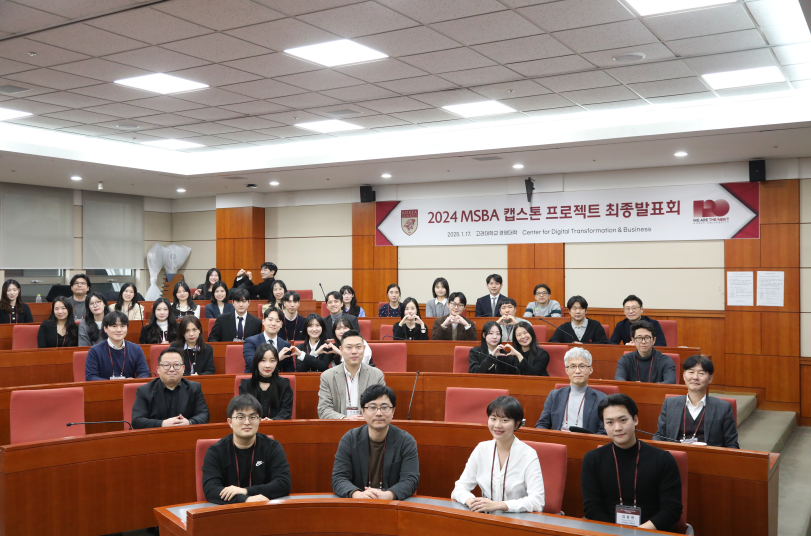
Orientation for New Students in the Master of Science in Business Analytics (MSBA) Program for the 2025 Spring Semester    The orientation for new students in the MSBA program for the 2025 academic year was held on Wednesday, February 5th, at 3:00 PM in Room 433 of the LG-POSCO Hall at Korea University. During the orientation, the new students were briefed on various aspects of graduate school life, including the curriculum, academic schedule, and academic records.      The first part of the orientation began with area chair Jeunghyun Kim, who briefly presented the organizational structure of the Graduate School of Business Administration and introduced the staff responsible for various tasks. This was followed by an introduction to the curriculum. The curriculum overview included an explanation of the semester schedule for the current term, which is organized in two-month modules. New students were then guided through topics such as the designation of academic advisors, credit recognition, and the Capstone project.      Meanwhile, the Master of Science in Business Analytics (MSBA) program at Korea University Business School was established in the spring semester of 2020 to provide customized educational services centered around digital transformation, which is required in today’s AI era. The one-year program, consisting of six modules, offers knowledge in areas such as mathematical statistics and information computing, along with skills for designing and applying data analysis techniques, and fostering awareness of information ethics. Students are trained to become interdisciplinary management professionals equipped to work in various application areas requiring advanced technologies in the digital and mobile fields.   

2025.02.24 Views 3695

Young Scholars’ Conference: A Hub for Academic Exchange and Growth Successfully Held 

Young Scholars’ Conference: A Hub for Academic Exchange and Growth Successfully Held      On January 10th, the Young Scholars’ Conference, held for the first time this year, was hosted by the BK21 Business Education Research Group, led by Professor Woochan Kim, of Korea University Business School (Dean: Eonsoo Kim) at the LG-POSCO Hall. This event aimed to provide graduate students with opportunities for academic exchange and professional development. Professor Woochan Kim emphasized the theme of "sharing and succeeding," highlighting that collaboration through the exchange of ideas, experiences, and insights is pivotal for success in academia. He expressed his hope that the conference would foster such meaningful interactions, underscoring its purpose and essence.      The conference was organized into two main sessions. The first, an academic session titled the Mini Conference Session, focused on three core areas: Management, Marketing, and Information Systems; Finance; and Global Business. These sessions were held across the Cuckoo Seminar Room and Rooms 530 and 531 of LG-POSCO Business Hall. A total of 19 graduate students, many of whom had presented their research at prestigious international conferences like the Academy of International Business (AIB) Conference and the Pacific Asia Conference on Information Systems (PACIS), showcased their work. These students shared their research findings and personal experiences from participating in global academic forums, engaging with juniors, peers, and faculty members.      The second session, a Round Table Session held in the Cuckoo Seminar Room, adopted a more informal and interactive format. Participants enjoyed refreshments while engaging in small-group discussions tailored to their academic fields. These discussions delved deeper into topics that could not be fully explored during the academic sessions, such as the preparation process for international conferences and practical advice on navigating the academic journey. A notable feature of this session was the ‘Job Market’ table, where recent graduates shared invaluable insights and guidance on the faculty recruitment process, benefiting those preparing to enter the academic job market.  This successful first edition of the Young Scholars’ Conference not only fostered intellectual exchange but also strengthened the academic community within Korea University Business School. It set a promising precedent for future events, aiming to inspire and support budding scholars on their academic journeys.   

2025.01.22 Views 2744

Celebrating Tradition and Unity: The 42nd KUBS Alumni Night

Celebrating Tradition and Unity: The 42nd KUBS Alumni Night   On December 6, 2024, the 42nd KUBS Alumni Night was held at the InterContinental Seoul Parnas Hotel. Hosted by the Korea University Business School (KUBS) Alumni Association and supported by KUBS, this annual year-end event has become the association’s most celebrated festival, serving as a meaningful way to conclude the year.  This year's Alumni Night featured a variety of programs, including the entrance of the KUBS flag and the alumni association banner, opening remarks and greetings by the Dean and the Alumni Association President, introductions of undergraduate representatives, presentations of appreciation plaques and scholarships, the Alumni of the Year Awards, celebratory performances, and a cheerleading show.      The event commenced with the entrance of the representatives of the Class of '97, who organized this year’s event, accompanied by KUBS student ambassadors, KUBE, carrying the KUBS flag and the alumni association banner. Dean Eonsoo Kim and Alumni Association President Dong-seop Lee then waved the flags together, marking the grand opening of the 42nd KUBS Alumni Night.  Following the introduction of distinguished guests, Dong-seop Lee President of the KUBS Alumni Association, delivered his welcoming remarks. Expressing gratitude to the esteemed attendees for joining the meaningful occasion, President Lee stated, “This year marks the 42nd KUBS Alumni Night, an event dedicated to celebrating the unity of KUBS alumni and wishing for the continued growth of our alma mater.” He also highlighted the global presence of KUBS alumni, noting, “KUBS graduates are making remarkable contributions not only in Korea but also across the world.”  Myung-ho Seung, President of the Korea University Alumni Association, followed with remarks, noting, “I am also a proud alumnus of the Business School. Since its inception in 1982, the KUBS Alumni Night has become a cherished tradition, fostering beautiful harmony and camaraderie among alumni across generations.” President Seung also highlighted the longstanding tradition of awarding scholarships during the event, expressing his hope that this practice would continue to contribute to the development of KUBS and support for future students.      President Dong-One Kim remarked, “The year 2025 is a momentous milestone, as it marks the 120th anniversary of both Korea University and the Business School.” He emphasized the deep historical connection between the two, stating, “The Business School has been an integral part of Korea University since its foundation.” He concluded by expressing confidence that, “With the 120th anniversary as a turning point, Korea University and KUBS will advance to become leading global institutions.”  Next, Dean Eonsoo Kim delivered an introduction to the academic programs. As a proud alumnus of the Business School and a valedictorian graduate, Dean Kim brought a unique perspective to the presentation. Departing from the traditional format, he introduced an innovative style commonly seen in startup IR pitches, focusing on the concepts of "3C and 4Tech."      The 3Cs and 4Tech, representing Dean Eonsoo Kim's vision and philosophy, are Curiosity, Collaboration, and Contribution, as well as AI, AI-oriented Semiconductor, AI-embedded Robotics, and Energy. Additionally, Dong-seop Lee, President of the KUBS Alumni Association, presented a plaque of appreciation to the president of the Class of 1996, and the Class of 1997 donated 40 million KRW in scholarships, demonstrating the strong alumni network where both senior and junior alumni come together, following the tradition of the Alumni Night.     The Alumni of the Year Awards followed. This prestigious honor is presented annually to KUBS alumni who have brought distinction to the Business School through their outstanding achievements. For 2024, the Alumni of the Year Award was presented to Chun Hyuk Jun (Class of ’88, Business), Chairman of CESCO Co., Ltd., and Joon Young Choi (Class of ’82, Business), CEO of Kia Corporation. Special Awards were also given to Jin Woo Lee (Class of ’89, Business), Editorial Director at Maeil Business Newspaper, and  Chang Kyu Choi (Class of ’90, Business), Director of Namu Business Academy.    This year’s Alumni Night concluded with celebratory performances, a cheerleading show, and a prize draw, leaving all KUBS alumni in attendance with lasting memories of the event.

2025.01.21 Views 2514

The Story Behind the Birth of the Choo Choo Entrepreneur Award

The Story Behind the Birth of the Choo Choo Entrepreneur Award    The Startup Institute at Korea University Business School (KUBS) selects innovative and marketable business models through its biannual Startup Express Summer and Winter Seasons, organized by the Myung Ho Seung Entrepreneurship Education Center. Winners gain access to workspace, operational funding, and educational support. In 2024, the Choo Choo Entrepreneur Award was introduced during the Startup Competition, branded as Choo Choo Day.    The award was established by the first cohort of the Startup Institute, including Ik Jung Kim, co-founder of Taling, and Young Kyung Kim, head of the Iljin Center for Startup Incubation. It reflects their dedication to nurturing the next generation of entrepreneurs. To learn more, we spoke with Young Kyung Kim, one of the founding members of the cohort and an integral part of the award’s creation.      Q: We heard you graduated from Korea University Business School. What kind of student were you during your undergraduate years?  A: I didn’t start in the Department of Business Administration. Initially, I studied History but transferred to KUBS as a junior. Before transferring, I had a vague dream of starting a business. This was back in 2007, when the mobile market was still in its early stages. Seeing the growth of the web market, I thought about bringing offline fashion businesses online to create value.  However, after transferring to KUBS, I set aside my entrepreneurial dreams and focused on developing logical thinking through my involvement in a strategy society. After graduation, I joined a large corporation.    Q: What was life like working in a large corporation?  A: As a business school graduate, I thought I’d be able to apply the knowledge I’d learned. But in reality, my tasks mostly involved preparing documents and writing emails. While these tasks had significance within the corporate ecosystem, I questioned their broader relevance. Over time, I grew bored and decided to quit.  I didn’t plan to start a business right away; leaving was more of a leap of faith. During this time, I searched for inspiration through success stories. I vividly remember a lecture by Professor Ick-Soo Kim, who mentioned reverse-engineering the paths of successful people to uncover patterns. One example that stood out was Steve Jobs learning calligraphy in college, which influenced me to audit Professor Dae Il Nam’s course, New Venture Creation and Management.    Q: That must have marked the start of your connection with Professor Dae Il Nam.  A: Exactly. I emailed him, asking for permission to audit his class. He responded and invited me to his office. I nervously showed up, and his words still resonate: “If you’re going to be late even once, don’t bother attending. I’ll treat you as an equal student, not as an alumnus.” That class was transformative. For the midterm, we created and presented a business model, which reignited my entrepreneurial aspirations.    Q: You later joined the first cohort of the Startup Institute.  A: The program provided invaluable support. At the time, Facebook was the dominant social media platform. We created a debate series called Stocks Talk, featuring stock market enthusiasts from Korea University and Yonsei University. The content went viral and even secured Series B funding.  The Startup Institute offered resources that were crucial for this success. We filmed the content at their facilities and received legal guidance from Kim & Chang on partnership agreements. It was the perfect environment to develop and refine our MVP (Minimum Viable Product), leveraging school resources to launch projects smoothly.    Q: You later returned to school and established the Choo Choo Entrepreneur Award.  A: The Choo Choo Entrepreneur Award isn’t just a donation; it’s an investment in future entrepreneurs. For the Startup Institute to grow into a premier incubator, it needs to attract and support strong teams with high potential. Competitions like Startup Express play a pivotal role in this process. The award aims to inspire these teams to surpass us and reinvest in the ecosystem.  We’re confident that the teams supported by this award will one day return to invest in the program, creating a virtuous cycle of growth.    Q: That’s a profound vision.  A: Education, mentoring, and funding are the keys to entrepreneurial success. Besides providing initial funding, building meaningful relationships with founders is crucial for creating a sustainable startup ecosystem. “We must support startups through investment, not charity, so both the teams and the program can thrive.”    Q: What does the Choo Choo Entrepreneur Award represent?  A: It’s a spark of entrepreneurial energy. I hope it inspires many students to take on the challenge of starting their own ventures. Think of it as a “positive virus”—just as we talk about a “laughter virus,” I want this award to spread the entrepreneurial spirit. With the abundance of government support available today, I believe it’s an excellent time for students to start their entrepreneurial journey.    Q: Do you have any advice for current or future cohorts?  A: Korea University Business School students are among the top 1%, and with that comes a responsibility to innovate and embrace entrepreneurship. Don’t fear failure—while statistics like a 99.7% failure rate might seem daunting, the infrastructure and support available make entrepreneurship less intimidating. I urge students to take on the challenge with confidence and a sense of purpose. 

2024.12.03 Views 3585

  • 첫페이지로
  • 36
  • 37
  • 38
  • 39
  • 40
  • 마지막페이지로