TOP

KUBS News

Total 1417

‘KUBS 120 MARCH’ Campaign Nears 40% of Goal … Total Pledges Reach Approx. KRW 4.6 Billion

‘KUBS 120 MARCH’ Campaign Nears 40% of Goal … Total Pledges Reach Approx. KRW 4.6 Billion Three major large-scale pledges secured within four months of launch … Campaign continues through May 31     Korea University Business School’s KRW 12 billion fundraising campaign, “KUBS 120 MARCH,” has secured approximately KRW 4.6 billion in pledged donations within just four months of its launch, nearing 40% of its goal.   Since the campaign’s launch in January, when pledged donations stood at around KRW 2 billion, the total has more than doubled in just three months. From December 1, 2025, to March 29, 2026, total pledges reached KRW 4,652,317,231, with 324 participants, including corporations, alumni, faculty, staff, and students.       | Three major pledges secured … Alumni and corporations join forces    One of the most notable achievements is the securing of three major pledges. An anonymous donor pledged support for the research fund, Eugene Investment & Securities Co., Ltd. for the development fund, and Samyang Tongsang for scholarships. Alumni account for approximately 62% of total pledges, while corporations represent about 35%, jointly driving the campaign forward.   Group donations have also continued. Following the participation of the Class of ’81 alumni association, the Business School Class of ’79 Scholarship Committee (28 members), the KUBS Class of ’98 Alumni Night (126 participants), as well as faculty and staff, have also joined the campaign.      | Expanding participation across classes, generations, and professions    The donor base is highly diverse. Participation spans from alumni who entered in the 1970s to current students from the Class of ’26, as well as members of EMBA, DBA, and AMP programs, undergraduate alumni, and even alumni from the College of Medicine. From individual research labs and faculty bands to student councils, all corners of the Business School are actively engaging with the campaign, further broadening its base of participation.   This campaign is particularly meaningful in that it places value not only on the total amount raised but also on participation itself. From small contributions starting at KRW 10,000 to major gifts reaching KRW 1 billion, every act of giving becomes part of the shared legacy of KUBS’s 120-year history.    | Investing in the future campus… Advancing the 3C Trading Zone and 4Tech strategy    The funds raised are being used to realize the Business School’s future vision. Alongside the advancement of the “4Tech Strategy,” centered on AI, semiconductors, energy, and robotics, spatial innovation projects are also taking shape.   The Business School is already operating AI-focused tracks and 4Tech micro-degree programs, and continues to expand its educational and research capabilities with its largest-ever full-time faculty body of 95 members.   On the basement level of Hyundai Motor Hall, the “3C Trading Zone (tentative name)” is currently under development, with a trading demo day scheduled for early May. The space will also include an Art & Culture Room. Artist Uhm Jung-soon’s installation piece, K, the Noseless Elephant, has already been installed in the building.   Construction has also begun on an LED display in the lobby of LG-POSCO Hall, which will serve as a large-scale digital donor wall. An opening ceremony is scheduled following the conclusion of the campaign in May.   Dean Eonsoo Kim stated, “We have come this far thanks to the collective support of each and every member,” adding, “We hope more people will join us on this journey as we prepare for the next 120 years of the Business School.”   The “KUBS 120 MARCH” campaign will continue through May 31, 2026. Donations can be made via the official sponsorship page (box.donus.org/box/koreauniversity/KUBS120march).   As of December 1, 2025 – March 29, 2026 | Total pledged amount: KRW 4,652,317,231

2026.04.17 Views 424

The Power Behind 1.2 Million Subscribers: Geekble CEO Chanhoo Park`s Content Strategy 

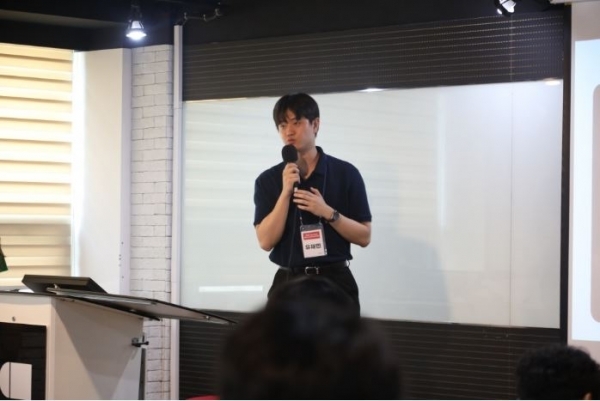
The Power Behind 1.2 Million Subscribers: Geekble CEO Chanhoo Park's Content Strategy      The “2025 Spring Semester Entrepreneurship Academy: Lecture Series 5,” hosted by the Startup Research Institute at Korea University Business School, was held on Tuesday, June 10 in Room B307 (Kolon Lecture Hall), Hyundai Motor Hall. The special lecture featured Chanhoo Park, co-founder and CEO of the maker-based content startup Geekble, who delivered a talk titled “The Hidden Secrets of the Media Content Industry.”  Park began by sharing his personal journey—graduating from a science high school and studying computer engineering in college—along with the career-related uncertainties he faced. He recounted how his accidental participation in the Google News Lab during his undergraduate years sparked a deep interest in the content industry and new media.  Highlighting a graph that showed smartphone screen time surpassing TV viewing time—despite the latter remaining steady—he explained that this shift helped him realize that the total volume of content consumption was increasing, which ultimately inspired him to pursue entrepreneurship.      Founded in 2016, Geekble has become a leading media content company with over 1.2 million subscribers on YouTube. The company has expanded its business into a variety of fields, including engineering, education, and branded content.  Park shared, “We wanted to take on the role that traditional media outlets like National Geographic or BBC Science play—only on new media platforms.” He went on to explain that the name ‘Geekble’ reflects the philosophy that ‘Geeks are able’ (Geek + Able).  The lecture also highlighted several of Geekble’s bold and innovative content projects. These ranged from experimental videos that focus on the creative process—such as the “Failed Fish-Shaped Bread Automation Machine”—to more advanced creations like an AI-powered scent-mixing device developed in collaboration with Google.  This machine, which can blend up to eight out of 45 fragrance components to produce personalized scents, was even exhibited in Japan.      Beyond producing content, Geekble also serves as a media platform that shines a spotlight on engineers. “Just as artists and athletes receive attention and support, we want to create a stage where scientists and engineers can be recognized and celebrated,” said Park. He added that Geekble works in collaboration with schools and educational institutions to help nurture the next generation of engineers.  In the latter part of the lecture, a participatory session was held in which students analyzed and presented industry data. One student from the Department of Statistics presented a graph illustrating the growth of the web novel market alongside the steady state of the print book market. Park remarked that the trend was similar to the relationship between TV and smartphone usage, describing it as a noteworthy case.  To conclude, Park introduced Warren Buffett’s concept of a business “moat,” outlining its five key elements: network effects, cost structure, intangible assets, switching costs, and efficient scale. He emphasized that aspiring entrepreneurs should develop long-term vision and build structural competitiveness from the outset.      During the Q&A session that followed the lecture, Park revealed one of the “hidden secrets” of the media content industry. “Platforms design their algorithms based on viewer retention time,” he explained. “It’s not just about producing one good video—it’s about designing an experience that aligns with the user’s overall content consumption journey.” For instance, Geekble uses tagging strategies to increase the likelihood of algorithmic recommendations on YouTube—such as guiding viewers from a science documentary to a related movie review.  Through this special lecture, attendees gained valuable insights into the content industry and the startup ecosystem, and had a meaningful opportunity to experience firsthand the entrepreneurial spirit that embraces challenges and failures.      Meanwhile, the “Entrepreneurship Academy” is a startup education program organized by Korea University’s Startup Research Institute. It aims to provide aspiring entrepreneurs with practical insights through special lectures delivered by startup experts. 

2025.06.19 Views 2652

2025 International Symposium of Marketing Successfully Concludes 

"Exploring the Future of AI and Consumer Behavior Analysis" — 2025 International Symposium of Marketing Successfully Concludes      On Friday, May 23, the Institute for Business Research and Education (IBRE) at Korea University Business School hosted the 2025 International Symposium of Marketing in Room 432 of the LG-POSCO Hall. Held in celebration of the university’s 120th anniversary, the symposium convened leading scholars from around the world to explore the convergence of artificial intelligence (AI) technologies and consumer behavior analysis.  Held under the theme “The Intersection of AI and Consumer Behavior Analysis,” the symposium moved beyond the mere adoption of technology to explore the multifaceted impacts of AI on human emotions, well-being, and market behavior. The event attracted significant interest from both academia and industry, underscoring AI’s potential to redefine the paradigms of marketing.      The first session featured Professor Stefano Puntoni of the Wharton School at the University of Pennsylvania, who presented on the topic “AI Companions Reduce Loneliness.” Professor Puntoni offered an in-depth analysis of how AI-based chatbots and virtual companions affect the emotional connection of modern consumers. His findings revealed that AI interactions can alleviate loneliness to a degree comparable to human interaction and yield greater emotional benefits than activities such as watching YouTube. Notably, the sense of “being listened to” significantly enhanced the AI’s effectiveness in reducing loneliness, underscoring the emerging potential of emotional bonding between consumers and AI as a new frontier in technology.      In the afternoon session, Professor Xin (Shane) Wang of the Pamplin College of Business at Virginia Tech delivered a presentation titled “Predicting Consumer Behaviors with Large Language Model (LLM)-Powered Digital Twins of Customers.” Professor Wang introduced a framework that leverages LLM-based digital twins of customers (DToC) to accurately predict consumer behavior. These digital twins are connected to real-time data and simulate consumers’ thought processes, emotions, and purchasing decisions—allowing marketers to forecast and optimize outcomes without direct consumer engagement. Unlike conventional prompt engineering approaches, this framework incorporates fine-tuning to improve contextual understanding and real-time responsiveness. As a result, it is gaining attention as a next-generation marketing tool that offers both high predictive accuracy and practical applicability.      The final session was led by Professor Masakazu Ishihara of New York University’s Stern School of Business, who presented on “Welfare Implications of Egg Price Regulation and Bird Flu: Evidence from the Japanese Market.” Professor Ishihara conducted a quantitative analysis of the relationship between market regulation and welfare outcomes, focusing on the bird flu outbreak and the Japanese government's egg price subsidy policy. His findings indicated that while the subsidy helped artificially stabilize prices, it also increased the financial burden on consumers. The study further suggested that alternative regulatory approaches without tax burdens could potentially lead to greater welfare gains.      The event concluded with closing remarks from Dean Eonsoo Kim of Korea University Business School. Dean Kim remarked, “This symposium provided a valuable opportunity for in-depth discussion on the future direction of marketing in the age of artificial intelligence. In celebration of our 120th anniversary, it was all the more meaningful as it allowed us to reaffirm the Business School’s vision for future-oriented research and education.” He presented commemorative gifts to the speakers in appreciation of their contributions, and the symposium came to a successful close with a group photo.      The symposium concluded successfully, presenting new directions for understanding consumer behavior while fostering in-depth discussions on how AI technologies can advance human-centric marketing. A representative from the Institute for Business Research and Education (IBRE) remarked, “Interdisciplinary dialogue that re-examines the core of marketing-in the age of AI will remain a key focus. We will continue to create platforms that connect academia and industry.”  Meanwhile, Korea University Business School has actively fostered academic engagement across a range of disciplines. In 2005, to commemorate its centennial, the school hosted a series of international symposiums organized by academic fields. Among them, the marketing discipline has continued to hold annual international symposiums, consistently sharing cutting-edge research and strengthening ties with industry through global academic exchange. This long-standing tradition has served as a key foundation for KUBS’s emergence as a research-driven institution. As a result, in the recently released 2025 QS World University Rankings by Subject, Korea University Business School ranked 28th globally and 1st in Korea in the field of marketing. This year’s symposium continues that legacy—providing a forward-looking platform to explore the future of marketing in the AI era, while meaningfully bridging academia and industry. 

2025.06.16 Views 3332

UEH Chooses to Learn from 50 Years of AMP Expertise at KUBS

University of Economics Ho Chi Minh City (UEH) Chooses to Learn from 50 Years of AMP Expertise at Korea University Business School      On Tuesday, June 10, representatives from the University of Economics Ho Chi Minh City (UEH) visited Korea University Business School (KUBS) for an in-depth benchmarking meeting focused on KUBS’s overall operations and its flagship Advanced Management Program (AMP). The UEH delegation included President Nguyen Hoang Le; Le Quoc Thai, Head of Training Strategy; Duoong Minh Hai, Chief Accountant; and Christopher Han, Director of Innovation Strategy. Their visit aimed to deepen their understanding of the AMP offered by the KUBS Executive Education Center (EEC) and to exchange insights on program management and operational practices.    From KUBS, the delegation was welcomed by Associate Dean of the MBA Program Gangseog Ryu, Professor Kihoon Kim, Program Manager Sunyoung Park, and staff members Soyeon Eom and Suyeon Kang. The KUBS team provided an overview of the school’s educational philosophy and history, presented the structure and operational strategies of the Advanced Management Program (AMP), and engaged in a Q&A session with the visitors.  Founded in 1976, the University of Economics Ho Chi Minh City (UEH) is one of Vietnam’s premier universities. Designated as a National Key University by the Vietnamese Ministry of Education, UEH is also ranked among the world’s top 1,000 business schools. This visit formed part of UEH’s strategic efforts to develop high-level executive education programs aimed at supporting Vietnam’s continued growth and socio-economic development.  During the meeting, KUBS highlighted the strengths of its Advanced Management Program (AMP), including over 50 years of accumulated operational expertise, a systematic and practice-oriented curriculum, and one of the largest alumni networks in Korea. The two institutions engaged in a positive discussion on potential collaboration in the development and operation of future educational programs and reaffirmed their mutual commitment to ongoing exchange and cooperation. 

2025.06.16 Views 2589

“120 Years of Legacy, Connecting to the Future” – KUBS Celebrates Its 120th Anniversary

“120 Years of Legacy, Connecting to the Future” – Korea University Business School Celebrates Its 120th Anniversary      On Friday, May 23, Korea University Business School (KUBS) held a commemorative ceremony at SUPEX Hall in the LG-POSCO Hall to celebrate the 120th anniversary of its founding. This meaningful occasion marked both the 120th anniversary of Korea University and the establishment of the Department of Commerce at Bosung College—the predecessor of KUBS—offering an opportunity to reaffirm the school’s pioneering role as the cradle of business education in Korea.      The ceremony began with student ambassadors Shin Woo-jin (President of KUBE) and Kang Min-ji (Vice President of KUBE) serving as hosts. Following the national anthem and official proceedings, a series of congratulatory remarks were delivered. KU President Dong-One Kim stated, “The 120-year journey of KUBS is not only the history of the growth of business education in Korea, but also a story of challenge and innovation that has contributed to the development of the nation’s economy and society. In this era of great transformation symbolized by AI, I hope KUBS will continue to lead as a hub of future intellect and innovation.”  Alumni Association President Myung Ho Seung encouraged the students, saying, “KUBS has preserved its traditions while keeping pace with the changing times. I hope every student will rise to the global stage with fiery ambition and unwavering conviction.” Dongseop Lee, President of the KUBS Alumni Association, reflected on the school’s legacy, stating, “The 120-year history of business education has been built on the passion of our professors, the efforts of our students, and the dedication of our alumni.” He went on to highlight the late Sang-il Lee (Class of ’57) as a devoted benefactor, noting his consistent donations and support. “I am deeply grateful to KUBS for laying the foundation that enabled me to grow as an entrepreneur,” he said. He concluded by emphasizing, “Even in a globalized world, KUBS will continue to cultivate outstanding talent and contribute to the advancement of our alma mater, grounded in its traditions and strong alumni bonds.”  Alumnus Haksoo Lee (Class of ’65) delivered a congratulatory address, offering warm encouragement to the students: “I hope the four years you spend at Korea University Business School will be a great fortune and blessing for the Class of 2025.” He continued, “Today, I was once again reminded of how truly fortunate I was to have entered Korea University 60 years ago.” He went on to say, “When the university celebrates its 180th anniversary in 2085, I hope today’s freshmen will have become distinguished alumni who proudly pass down the traditions of Korea University and its Business School to future generations.”He also expressed his deep affection and gratitude for his alma mater, stating, “Korea University has always been my greatest source of strength and support.” “In return for the many blessings I have received, I have continuously sought to contribute to the university’s growth and development,” he added.      The event continued with a presentation reflecting on the 120-year legacy of KUBS. Professor Hojung Shin, Chair of the 120th Anniversary Commemorative Committee, gave a briefing on key milestones that have shaped Korea University Business School as a pioneer of business education in Korea, including: △the founding of Bosung College, △the establishment of the Department of Business Administration, △its elevation to an independent college, and △its transformation into a global business school.  Dean Eonsoo Kim presented an academic and strategic development report, expressing his appreciation by saying, “What began as the humble Department of Plutology has grown into Korea’s leading business school, thanks to the passion and dedication of so many.” He then introduced the school’s forward-looking vision of Next Intelligence, which aims to integrate Human Intelligence and Artificial Intelligence, and announced plans to establish the “3C 4Tech Trading Zone” within the school as a central space to bring this vision to life.      He emphasized, “A creative convergence space that breaks down the boundaries between technology, business, and art is a vital environment for nurturing the talent of the future,” and added, “This Trading Zone will serve as an open platform where students, companies, startups, and artists can freely interact, experiment, and grow together.”  The 3C 4Tech Trading Zone will feature the following:  △ 3C Café, offering refreshments and beverages; △ Transparent Whiteboards that encourage the free flow of ideas; △ Open Theater, presenting cultural content on Friday afternoons; △ Art Sculpture, a fusion of sculptural art and technology; and △ Art-Multimedia Practice Rooms.  Students from the Business School, College of Engineering, and School of Art and Design will form interdisciplinary teams to identify and carry out projects. These teams will collaborate with startups and companies, ultimately leading to the production of real-world products. The space will be operated as an Experiential Learning Place, where learning is driven by hands-on engagement. Dean Kim declared that through this initiative, Korea University Business School aims to become a central hub for cultivating creative talent grounded in 4Tech, reaffirming his strong commitment to leading innovation in future-oriented education.      The highlight of the ceremony was the Intergenerational Message Exchange. Alumnus Jaebong Suh (Class of ’65) delivered a heartfelt message to the freshmen of the Class of 2025, which was followed by a hopeful response from Hyunho Lee (Class of ’25), addressed to the incoming students of 2085. This symbolic moment of connection across generations left a lasting impression.  In his message, Alumnus Suh shared his life journey, including his experience of studying abroad in the United States with his family after graduation and the many challenges he overcame along the way. “I proudly say that I have lived a happy life thanks to the support of many people,” he said, encouraging the younger generation to embrace a spirit of challenge. He continued, “Although today’s youth face a difficult reality, you are students of Korea University Business School—carry the pride and responsibility that come with that name. When opportunities come your way, I hope you won’t hesitate, but step forward with courage.”    In his message to the Class of 2085, student Hyunho Lee began by saying,  “I feel truly grateful to be here, taking part in the 120th anniversary celebration of Korea University Business School.” He continued, “As I go through my student life, I often realize how fortunate I am to be studying in such an exceptional environment. The thoughtful care and warm atmosphere of the Business School support our growth,” and expressed his hope that this sense of gratitude will carry on into 2085 and beyond. His message to future generations has been sealed in a time capsule—along with a special edition of the Korea University newspaper from 1965 and articles featuring students from the Class of ’65—and is now on display at the KUBS Story exhibition in Hyundai Motor Hall, scheduled to be opened in 2085.      After the official ceremony concluded, all attendees stood together to sing the school anthem, sharing the emotion of the 120th anniversary. A group photo was then taken in front of SUPEX Hall, followed by a celebratory luncheon. The second part of the event began with a toast from alumnus Kwang Na (Class of ’65), who lifted the mood by proclaiming,  “Let us raise our glasses and shout: ‘Korea University Business School, shine forever, and ever, and ever!’”      For the past 120 years, Korea University Business School has laid the foundation for business education in Korea. For the next 120 years, it will continue its bold journey of innovation and global leadership. 

2025.06.16 Views 2926

KU Bayes Colloquium 2025: Bridging Theory and Practice in an Academic Exchange Forum 

KU Bayes Colloquium 2025: Bridging Theory and Practice in an Academic Exchange Forum      Korea University Business School (KUBS) will host the KU Bayes Colloquium: Bayesian Inference for Econometrics and Marketing on Saturday, May 31, in Room 217 of the LG-POSCO Hall.  This colloquium provides a forum for sharing the latest research on Bayesian inference in the fields of econometrics and marketing, fostering academic exchange that bridges theory and practice. Since the spring semester of 2017, the KU Bayesian Econometrics Research Group—led by Professor Kyu Ho Kang of the Department of Economics and Professor Jae Hwan Kim of KUBS—has organized this event annually in collaboration with interested researchers at Korea University.  This year’s colloquium will feature a total of five research presentations.  The first presentation, titled “Market-Oriented Consumer Research,” will be delivered by Professor Greg Allenby of Ohio State University as part of an international collaborative project. This study explores consumer-centric quantitative modeling in the field of marketing.  The second session, titled “Linking Product Experience to Preference via Lexical Priors,” will be jointly presented by Professor Hyowon Kim (Sungkyunkwan University) and Professor YiChun Miriam Liu (Iowa State University). This study employs Bayesian methods to examine the relationship between product experience and consumer preference through the lens of lexical priors.  The third presentation, titled “Finding Inflation Uncertainty Factors: A Sparse Stochastic Volatility Approach,” will be delivered by Professor Kyu Ho Kang (Korea University) and Professor Hui-Jhong Choi (University of Rochester). This study investigates a quantitative method for estimating macroeconomic uncertainty through a sparse stochastic volatility framework.  The fourth presentation, titled “Modeling Disjunctive Topic Associations with Metadata,” will be delivered by Professor Dongsoo Kim (Chung-Ang University) and Professor Dongyub Kim (Gachon University). This study presents a novel approach to modeling topic associations based on metadata.  The final presentation, titled “Music Royalty Trading: Investment or Fandom,” will be jointly delivered by Professors Byungwan Ko, James L. Park, and Jaehwan Kim (all from Korea University Business School). This study analyzes transaction data to investigate the nature of music royalty trading platforms, exploring whether they primarily function as vehicles for financial investment or as fandom-driven marketplaces.  Following the colloquium, an open discussion session will be held under the theme “Bayesian Inference for Contemporary Research.”  This event is expected to serve as a meaningful platform for exploring interdisciplinary collaboration centered on Bayesian analytical methods, while also promoting active academic exchange among researchers from Korea and abroad. 

2025.06.16 Views 2437

  • 첫페이지로
  • 26
  • 27
  • 28
  • 29
  • 30
  • 마지막페이지로