


News
KUBS News
Transforming Educational Environments, Innovating Systems — 2026 KUBS Startup Station New Resident S
2026.01.14 Views 3001 국제실
Transforming Educational Environments, Innovating Systems
— 2026 KUBS Startup Station New Resident Startup Interviews

On Friday, December 5, in Room 432 at Korea University’s LG-POSCO Hall, presentations by startup teams participating in the 2025 Startup Express Winter Season, hosted by the KUBS Startup Station, provided a broad overview of their ideas and strategies. However, these presentations left little room to fully capture the processes behind their projects or the challenges they confronted along the way. In response, this publication met with two teams with different approaches following the competitive PT session to hear their stories in greater depth. One team seeks to change the “environment” of education by reducing repetitive administrative burdens in special education settings, while the other takes an engineering-driven approach to problem-solving through technology. Although their fields differ, both teams share a common starting point—“inconvenience in the field”—and a commitment to developing practical, executable solutions. Below is a Q&A with the representatives of the two teams.
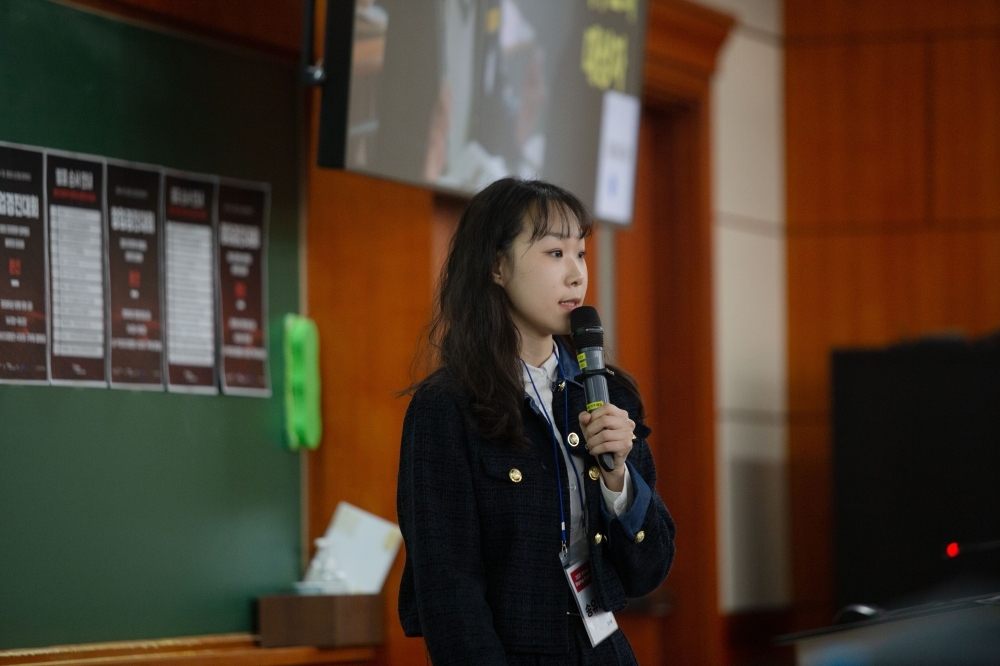
Reducing Administrative Burdens for Special Education Teachers
Interview with ‘Peering,’ a New Resident Startup at the KUBS Startup Station
Q1. What kind of service is ‘Peering’?
A1. Peering is an administrative support platform designed for special education teachers. It was launched to ease the heavy administrative burden faced by teachers, who process more than 200 documents each year and often have to manage paperwork even during class. The platform aims to create an environment in which teachers can focus on education rather than administration by offering standardized forms for special education, digitizing handwritten tasks, and providing AI-based sentence recommendations and analysis.
Q2. What led you to start this idea?
A2. I was first introduced to special education settings while participating in a project that supported the school lives of children with hearing impairments. As I learned about concepts such as inclusive education and Individualized Education Plans (IEPs), I came to realize how critical the “environment” is for children with disabilities to settle into educational settings, and how essential teachers are in shaping that environment. However, the reality faced by special education teachers was far from easy. As these concerns grew, the Incheon special education teacher death incident became a catalyst that prompted us to seriously explore solutions to reduce teachers’ workloads.
Q3. If you had to choose one sentence that best represents Peering, what would it be?
A3. “Lighten the desks of special education teachers, deepen the lives of children with disabilities.” Special education still relies heavily on individual capability and dedication rather than on systems, but we believe that quality education cannot be sustained if it depends on one person alone. Our role is to cut down on unnecessary administrative time so that teachers’ attention and effort—where they truly want to invest them—are not drained by paperwork, but can return to the classroom.
Q4. What features are you currently developing?
A4. The core features fall into three areas. First, we provide supplementary document templates that are frequently used in the field but poorly organized, and use AI to suggest phrasing tailored to each document’s purpose. Second is an automatic timetable generation function. Because special education teachers often cannot directly input schedules into NEIS, they typically collect individual timetables from general education teachers and manually compile them. Peering allows users to upload students’ schedules and automatically generate a complete timetable by simply selecting subject filters. Third, we help teachers easily create observation logs—often abandoned when handwritten—through keyword-based input, and offer a dashboard that analyzes behavioral patterns based on accumulated records.
Q5. As a new resident startup at the KUBS Startup Station, what kind of support do you expect?
A5. Above all, we are most excited about having a proper office space. Until now, we have worked while moving between cafés, so having a space of our own will be a major source of motivation. We also expect meaningful support through the incubation program, particularly advisory services in legal, tax, and financial areas, which are major concerns at the early stages of a startup. Throughout the startup process, we have faced challenges in preparing and implementing complex issues such as intellectual property rights, privacy policies, and MOUs. With the support of the Station’s faculty members and expert network, we hope to grow Peering to the next level.
Q6. What are your goals for the next year, and what kind of change does Peering hope to create?
A6. Over the next year, we plan to focus on securing paid users and expanding partnerships with institutions such as schools and local governments as we move toward full-scale commercialization. While teachers are our primary users, connections with institutions are essential for adoption and broader implementation. In the long term, we hope that Peering will complement existing systems in the field, create tangible changes in the work of special education teachers, and demonstrate that the special education sector can also be a viable and sustainable startup field.
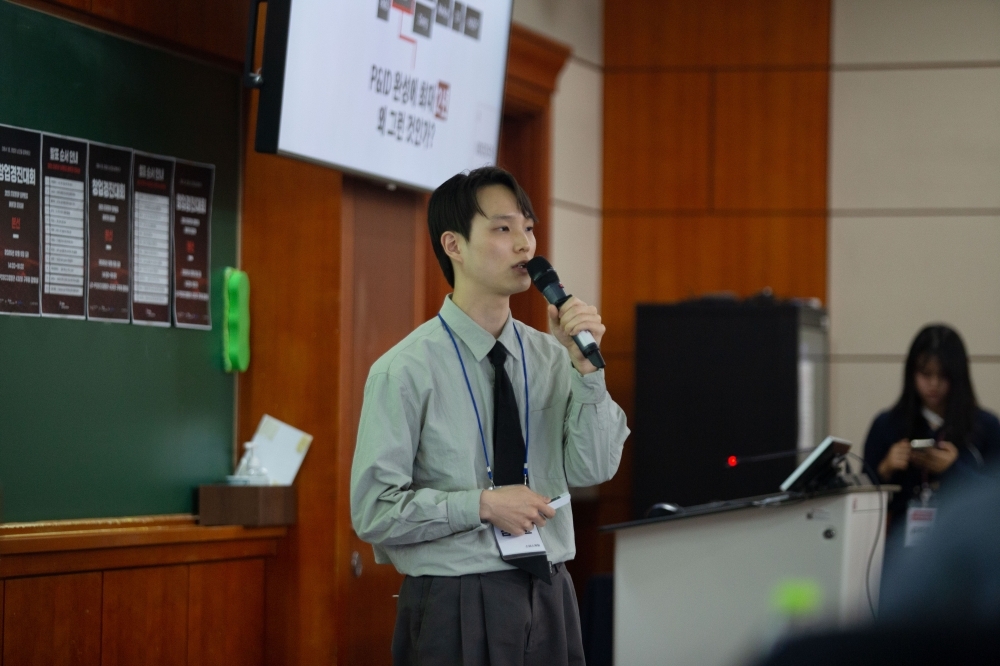
Automating Process Design
Interview with ‘SnapScale,’ a New Resident Startup at the KUBS Startup Station
Q1. Thank you for agreeing to this interview. Could you briefly introduce yourself and SnapScale’s business as a new resident startup at the KUBS Startup Station?
A1. Hello, I am Sangyun Kim, CEO of SnapScale. I am currently a student in the Department of Computer Science at POSTECH, and I am developing an AI-based plant design automation solution that covers the entire design lifecycle, driven by a strong sense of urgency about addressing the climate crisis. SnapScale’s AutoFlow uses AI to automate the design processes of complex systems such as oil refineries and gas plants. Because plant design allows no room for error, it requires a high level of precision and extensive repetition. Our goal is to replace time-consuming yet repetitive tasks with AI, thereby improving efficiency across the industry. In the long term, we aim to reduce unnecessary costs and inefficiencies in large-scale projects.
Q2. What problem does the SnapScale team see as the core issue?
A2. We believe that inefficiencies in plant design do not simply stem from a lack of manpower, but from the accumulation of repetitive tasks and knowledge that are not properly structured within the design process. While the field requires highly specialized judgment, it also involves many repetitive tasks governed by clear rules and patterns. By automating these repetitive parts, we aim to help engineers focus on more critical decision-making and verification.
Q3. We hear that ‘Vertical LLM’ is SnapScale’s core technology. What is the key point of differentiation compared to general-purpose LLMs?
A3. In domain-specific AI, we believe that deeply understanding the context of the field is more important than the technology alone. To achieve this, we conducted in-depth interviews with 75 engineers both in Korea and internationally, identifying patterns embedded in the relationships between inputs, outputs, and processes in design work. While general-purpose LLMs are trained on broad language patterns, SnapScale’s Vertical LLM operates on the structure, context, and specialized knowledge of the plant design domain. This domain-level understanding is our most significant differentiator.
Q4. SnapScale emphasizes that ‘structuring data is more important than collecting it.’ How is this perspective reflected in your product development?
A4. There is a common perception that plant companies use entirely different design methods, but through repeated interviews we found that, in practice, many standardized elements and shared stages exist. Rather than simply collecting large volumes of data, we focused on understanding the dozens of steps involved in design and structuring the relationships and context between them. As a result, we were able to build an integrated knowledge database encompassing design inputs, outputs, and intermediate processes, and to map various AI-driven automation functions onto design tasks based on this foundation. In other words, our belief that structure and context matter more than the sheer volume of data has become a core principle guiding the overall product design.
Q5. Why did you choose the Korea University Business School KUBS Startup Station, and what kind of support do you expect after moving in?
A5. After winning the grand prize in the preliminary startup track of the Chung Ju-yung Startup Competition, where our technology and market potential were recognized, we considered several incubators. Through that process, we concluded that the business expertise and networking opportunities offered by the KUBS Startup Station were essential for a technology-driven team like ours. While we are strong in technical development, we see room to strengthen our capabilities in enterprise B2B sales and business strategy. As a resident startup, we hope to receive practical mentoring in areas such as building a B2B sales pipeline, negotiating with large corporate clients, and developing IR capabilities for fundraising. Above all, as an organization under a business school, the Station offers access to a close-knit network of senior founders, experts, and fellow resident startups who share similar challenges. We expect to quickly gain feedback from industry and market perspectives through networking, and to reflect that feedback directly in our product and business strategies. We also look forward to broadening our perspective through exchanges with startups from diverse fields, and exploring collaboration opportunities, including joint projects with teams interested in the manufacturing and energy sectors.
Q6. Could you briefly describe your current stage and future goals?
A6. Within one year of preparing for our startup, we have grown to the point of conducting a proof of concept (PoC) with a construction company of approximately 300 employees, and we have since established a corporation to pursue full-scale business operations. In the short term, we are focusing on building an integrated knowledge database that enables AI to understand and utilize Korea’s highly sophisticated chemical plant domain knowledge. In the long term, our goal is to lead standardization in the field of process engineering and plant design, and to grow into a globally competitive technology company.
The two teams share a common goal: reducing “repetition in the field.” Peering aims to return teachers’ time from administrative work to the classroom, while SnapScale introduces automation that allows engineers to focus on verification and decision-making rather than repetitive tasks. While their approaches differ, both ultimately seek to enable people to concentrate on work that truly requires human judgment.
As Peering and SnapScale begin their residency in January, the Korea University Business School Startup Station plans to support the advancement of their businesses through the office space support and entrepreneurship education and mentoring systems it has long provided to resident companies. This includes office space support, such as co-working spaces and dedicated resident offices, as well as one-on-one expert mentoring and external advisory and network connections in practical areas where early-stage teams face the greatest challenges—such as legal affairs, tax and accounting, labor, intellectual property (IP), investment, and marketing. In addition, regular seminars and networking events will expand opportunities for engagement with fellow resident startups and stakeholders across the startup ecosystem. Furthermore, as the Station has continued to create opportunities for interaction with investors through events such as its demo day, CHOO CHOO DAY, the two teams are expected to receive ongoing, practical support tailored to their stages of product and service validation and growth, including strengthening IR capabilities and facilitating follow-up partnerships. Ultimately, attention will be drawn not only to how quickly these two teams validate their hypotheses and move on to the next stage, but also to the broader trajectories of the newly joined resident startups that have come together through this Winter Season.